
Introduction
The growing electric vehicle industry is creating new business opportunities across India. Alongside the expansion of electric mobility, investors are exploring different ways to participate in this developing sector.
Investment plans with monthly payouts are one area attracting attention, particularly among individuals interested in understanding how EV-related businesses generate revenue and distribute income.
Electric vehicle fleets, rentals, commercial transportation, and charging infrastructure are among the business models contributing to this evolving landscape.
Let’s understand how these investment models work and what individuals should consider before exploring them.
Background: India’s Electric Mobility Opportunity
The electric vehicle sector in the country is expanding quickly, providing ways for people to earn money as entrepreneurs, investors, or by discovering new sources of income. These changes are happening due to growing awareness about sustainable mobility, high fuel prices, and increasing demand for electric transport.
The electric vehicle sector promises not only ecological benefits but also exciting business opportunities. The booming EV ecosystem introduces different business models, including electric two-wheelers, EV fleets, charging infrastructure, and battery technologies.
One area gaining attention is investment plans with monthly payouts through EV-related investment models. These models aim to connect investment participation with income-generating electric mobility businesses. For individuals interested in exploring alternative income opportunities, EV investments may offer an interesting way to participate in the future of transportation.
Individuals exploring monthly income investment options in India are increasingly considering asset-based business models, including professionally managed electric vehicle fleets.
Let’s understand how EV-related investment models work, what opportunities they offer, and why investment plans with monthly payouts are attracting attention in India.
Key Takeaways
- EV-related investment models connect investment participation with the growing electric mobility industry.
- Electric vehicle fleets, rentals, leasing, and charging infrastructure are emerging business segments.
- Monthly payouts may depend on the revenue and financial performance of the underlying business.
- Vehicle maintenance, operational efficiency, and customer demand can influence business performance.
- Understanding investment agreements and associated risks is important before making an investment decision.
Understanding EV-Related Investment Models
To understand how electric vehicles can function as commercially productive assets, explore our detailed guide on EV fleet investment.
Investment models related to electric vehicles involve investing money in companies, assets, and activities connected with the EV ecosystem. Unlike conventional vehicles, these investment models can provide opportunities to participate in the growing electric mobility industry.
Depending on the business structure, investment opportunities might cover:
- Electric vehicle fleet operations.
- Rental businesses based on electric scooters and electric bicycles.
- Delivery and logistics services using electric vehicles.
- EV charging stations.
- Battery-swapping technologies.
- Electric mobility commercial solutions.
- Leasing and managing electric vehicle fleets.
Certain electric vehicle businesses generate revenue through rentals, transportation services, charging fees, and commercial partnerships. Depending on the agreement, a portion of the revenue may be distributed among participating investors.
This is where investment plans with monthly payouts become relevant. Such models aim to connect the revenue generated by EV businesses with periodic investor payments. However, payout frequency, amounts, and guarantees depend on the specific business agreement and its financial performance.
Quick Revision: Understanding EV Investment Models
EV-related investment models can involve different commercial activities, including vehicle rentals, fleet management, charging infrastructure, and electric mobility services. The revenue generated through these activities may form the basis of investment distributions, depending on the agreement.
Why Is the EV Industry Becoming an Attractive Investment with Monthly Payouts in India?
India’s electric vehicle market is transforming the transportation sector. Consumers, companies, and logistics businesses are increasingly looking at electric mobility as an alternative to traditional fuel-based vehicles.
The growth of the market can be attributed to several factors.
1. Rising Popularity of Electric Vehicles
Electric two-wheelers, electric three-wheelers, electric cars, and commercial EVs are becoming increasingly visible in Indian cities. Their potential to reduce operating costs and dependence on traditional fuels is encouraging more customers and businesses to consider EV adoption.
The rising trend of EV usage will drive demand for supporting services and infrastructure, potentially creating new business prospects.
For investors exploring investment plans with monthly payouts, the growing adoption of electric vehicles presents an opportunity to understand emerging business models within the mobility sector.
According to the India Brand Equity Foundation (IBEF), India’s electric vehicle industry is experiencing significant growth, supported by increasing EV adoption, government initiatives, and expanding charging infrastructure.
2. Growth of Electric Delivery Fleets
The boom in e-commerce, food delivery, and quick-commerce businesses has increased the need for efficient last-mile transportation.
Electric two-wheelers and three-wheelers can be used for commercial deliveries, creating opportunities for owners and operators of EV fleets.
Investors looking at EV-related business models may find commercial electric vehicle operations particularly interesting. These businesses can also form the foundation of investment plans with monthly payouts, depending on their revenue-sharing arrangements.
3. Growth of EV Charging Infrastructure
Charging infrastructure is crucial for the successful adoption of electric vehicles. As more EVs enter the market, the demand for accessible charging facilities also increases.
EV charging points, charging networks, and battery-swapping stations offer business potential within electric mobility.
These infrastructure businesses may also be explored through investment plans with monthly payouts, where investor distributions depend on business revenues and contractual terms.
The Government of India is supporting electric mobility through initiatives such as the PM E-DRIVE scheme, which includes measures to encourage EV adoption and develop charging infrastructure across the country.
4. Increased Interest in Sustainable Transportation
People and businesses are becoming increasingly environmentally conscious. Electric vehicles can help reduce transportation-related emissions compared with conventional fuel-powered vehicles.
The increasing focus on sustainable mobility is encouraging innovation and investment in the EV sector, creating opportunities for individuals exploring investment plans with monthly payouts in emerging industries.
Quick Revision: Factors Driving EV Investment Interest
| Growth Factor | Investment Relevance |
| Rising EV adoption | Growing electric mobility ecosystem |
| Electric delivery fleets | Commercial vehicle requirements |
| Charging infrastructure | Supporting EV business opportunities |
| Sustainable transportation | Increasing interest in electric mobility |
How Do Investment Plans With Monthly Payouts Work In The EV Ecosystem?
Opportunities for monthly payments through electric vehicle-related investments generally depend on the revenue or profits generated by the underlying business.
For example, consider a fleet of electric vehicles operating in a particular city. These vehicles may provide passenger transportation, commercial deliveries, or rental services.
The business may generate revenue through:
- Renting vehicles on a daily or monthly basis.
- Entering into commercial delivery contracts.
- Providing passenger transportation services.
- Partnering with corporate fleets.
- Leasing vehicles to other companies.
After accounting for operating expenses, maintenance, insurance, charging costs, and other expenses, the business may distribute an agreed portion of eligible revenue or profits to investors.
Depending on the business structure, investment plans with monthly payouts may provide periodic distributions to participating investors.
It is essential to remember that EV business income is not automatically fixed or guaranteed. Vehicle usage, customer demand, maintenance expenses, operational efficiency, and market conditions can affect business performance and investor payouts.
Before choosing investment plans with monthly payouts, investors should carefully examine the agreement, revenue-sharing structure, and associated risks.
Understanding the Monthly Payout Mechanism
| Business Activity | Potential Revenue Source |
| Vehicle Rentals | Daily or monthly rental charges |
| Delivery Services | Commercial delivery contracts |
| Passenger Transportation | Transportation service fees |
| Corporate Partnerships | Agreed commercial arrangements |
| Vehicle Leasing | Leasing payments |
The actual distribution of income depends on the business model, operating expenses, and investment agreement.
Learn more about EV fleet investment returns in India and how fleet deployment, operating expenses, and asset utilisation can influence financial performance.
Compare the Three Main Payout Structures
The payment schedule and calculation method are separate questions. A monthly schedule does not, by itself, tell you whether the amount is fixed, linked to revenue, or dependent on profit.
| Structure | How the amount is calculated | What to establish in writing |
|---|---|---|
| Contractual fixed payment | An amount specified in the agreement, subject to its conditions. | Payment start date, due date, conditions, deductions, default remedies and responsibility during downtime. A contractual obligation still carries counterparty risk. |
| Revenue sharing | An agreed percentage of defined eligible revenue. | Whether revenue means invoiced or collected amounts; treatment of taxes, refunds, non-payment and expenses; access to statements. |
| Profit sharing | An agreed percentage of profit after the costs defined in the agreement. | Permitted costs, battery reserves, depreciation, management charges, losses and verification rights. |
Illustrative Monthly Fleet Calculation
This hypothetical example explains the arithmetic only. It is not a Ridoji quote, payout commitment or forecast. All figures relate to one hypothetical fleet for one month.
| Rental collections actually received | ₹50,000 |
|---|---|
| Maintenance | ₹5,000 |
| Insurance allocation | ₹2,000 |
| Charging | ₹6,000 |
| Operations and administration | ₹7,000 |
| Battery replacement reserve | ₹5,000 |
| Balance before other applicable costs and taxes | ₹25,000 |
Under a hypothetical 40% share of that defined balance, the calculated payment would be ₹10,000. The actual distributable amount could be lower after additional applicable costs and taxes. An agreement for a fixed payment uses its contractual formula instead. Gross rental collections are not the same as investor profit, and a payout is not necessarily net profit or a return of capital.
Ownership, Downtime and Exit Checklist
- Identify the vehicle purchaser and legal owner, and obtain the applicable invoice, registration records, and asset identification.
- Confirm insurance coverage, policyholder, claim beneficiary, exclusions, and responsibility for uninsured loss or theft.
- Record who pays for servicing, charging, accidents, insurance, battery replacement, and management charges.
- State what happens to payments during repairs, delayed deployment, low utilisation, or rider non-payment.
- Confirm the first payment date, payment schedule, reporting process and remedies for delay or default.
- Document early exit, transfer, termination, settlement timing and any fees.
- Specify whether the vehicle is returned, sold, transferred, or retained at the end of the term; distinguish residual asset value from repayment of the original contribution.
Popular EV Business Models That Can Create Investment Plans With Monthly Payouts
Before participating in an EV-based business arrangement, read our guide on how to choose an EV rental business to invest in.
Various business models form part of the electric mobility ecosystem and may offer recurring revenue potential.
1. EV Fleet Investment
EV fleet investment involves financing or participating in a fleet of electric vehicles used commercially. These vehicles may support transportation, logistics, and last-mile delivery operations.
A properly managed EV fleet can generate recurring revenue through commercial usage. Depending on the investment structure, these earnings may create the foundation for investment plans with monthly payouts.
2. Electric Vehicle Leasing
Leasing and renting EVs have become relevant for individuals and companies that want to use electric vehicles without purchasing them outright.
Businesses can generate revenue by leasing EVs to delivery companies, corporates, and individuals, creating opportunities for EV leasing and rental investments.
This model can be explored by individuals interested in investment plans with monthly payouts, subject to the leasing business’s financial performance and agreed payment structure.
Entrepreneurs interested in independent operations can explore our complete guide to starting an EV rental business in India.
3. Charging Station Business
Charging infrastructure is one of the key elements of India’s EV ecosystem.
Businesses operating charging stations can generate revenue by providing charging services to EV users. Potential revenue depends on several factors, including:
- Charging station location.
- Traffic volume.
- Electricity expenses.
- Infrastructure investment.
- Customer demand.
These factors are important when evaluating investment plans with monthly payouts connected with EV charging businesses.
4. Electric Two-Wheeler Commercial Services
Electric two-wheelers are useful for urban transportation and last-mile logistics. Businesses can utilise electric scooters in delivery, rental, and mobility services, opening new investment opportunities.
As demand for commercial electric two-wheelers grows, investors may explore investment plans with monthly payouts linked to suitable rental and fleet-based business arrangements.
5. Battery Swapping and EV Support Services
Battery-swapping systems allow compatible electric vehicles to exchange depleted batteries for charged ones, reducing downtime in certain commercial applications.
Battery-swapping infrastructure, battery management, and electric vehicle maintenance services are additional business opportunities within the electric mobility ecosystem.
These services represent another area to evaluate when exploring investment plans with monthly payouts in India’s growing EV industry.
Quick Revision: Popular EV Business Models
The EV ecosystem includes several commercial segments:
- EV fleet investment.
- Electric vehicle leasing.
- Charging station businesses.
- Electric two-wheeler commercial services.
- Battery-swapping and support services.
Each business model has its own revenue-generation mechanism and operational requirements.
Benefits of Exploring EV Investment Plans with Monthly Payouts
For individuals interested in emerging industries, EV investments may offer several potential benefits.
Investing in a Growing Industry: EV investments can help individuals participate in India’s developing electric mobility sector.
Recurring Revenue Potential: Certain EV business models can generate income through rentals, fleet operations, leasing, and charging services. These revenues may support Investment plans with monthly payouts if the investment agreement provides for periodic distributions.
Business Diversification: EV opportunities allow individuals to explore an industry beyond traditional investments and conventional businesses.
Rising Commercial Applications: There is increasing interest in electric vehicles for logistics, delivery services, passenger transportation, and corporate mobility.
Supporting Sustainable Mobility: Participating in the EV ecosystem can contribute to the transition towards cleaner transportation.
Investors comparing traditional options can also explore how EV fleet investment differs from FD and SIP.
However, these potential benefits should always be evaluated alongside operational, financial, regulatory, and market risks.
Important Factors to Consider Before Choosing Investment Plans with Monthly Payouts
It is necessary to analyse a business model before choosing investment plans with monthly payouts.
The following considerations should be taken into account:
1. Business Transparency
Understand where your funds are invested and how the EV business operates.
2. Revenue Generation
Establish how a company generates revenue, whether through vehicle rentals, fleet management, charging services, or commercial agreements.
3. Monthly Payout Structure
Check whether payments are fixed or variable and whether they depend on revenue or profits. Understand the conditions attached to investment plans with monthly payouts.
4. Vehicle Maintenance
Understand the procedures for maintaining and servicing vehicles, replacing batteries, and managing operational expenses.
5. Investment Agreement
Review the investment tenure, withdrawal conditions, payment terms, and obligations of all parties involved.
6. Risk Assessment
Evaluate the possibility of low vehicle utilisation, changing customer demand, operational losses, and other business challenges.
7. Regulatory Compliance
Ensure that the business has the necessary permissions and complies with applicable regulations.
These steps help investors form realistic expectations when evaluating investment plans with monthly payouts in the electric vehicle industry.
Quick Revision: What Should Investors Check?
| Important Factor | What to Evaluate |
| Business Transparency | Fund allocation and business operations |
| Revenue Generation | Sources of business income |
| Monthly Payout Structure | Fixed or variable payment terms |
| Vehicle Maintenance | Servicing and battery expenses |
| Investment Agreement | Tenure and withdrawal conditions |
| Risk Assessment | Operational and financial risks |
| Regulatory Compliance | Applicable permissions and regulations |
Why Are EV Investment Plans with Monthly Payouts Attracting Modern Investors?
Today’s investors are increasingly exploring opportunities connected with emerging industries and businesses.
The electric vehicle sector brings together transportation, technology, infrastructure, and commercial services. As a result, it creates different ways to participate in the growing EV ecosystem.
For individuals seeking regular income opportunities, EV-related businesses are worth understanding, particularly commercial vehicle operations and fleet-based services.
Investment plans with monthly payouts may appeal to individuals who prefer a structured payment schedule. However, investors must understand how the underlying business generates income and whether the payout structure is financially sustainable.
Transparency, operational efficiency, proper management, and realistic financial expectations are essential considerations when evaluating EV investments.
Recent EV market trends in India highlight the growing commercial adoption of electric vehicles, creating opportunities for businesses involved in EV fleet management, vehicle rentals, and electric mobility services.
How Ridoji Fits into India’s Growing EV Investment Plans with Monthly Payouts Landscape
The electric mobility industry is rapidly evolving, creating opportunities for companies and individuals to explore innovative income-generating business models.
Ridoji aims to be part of the conversation around emerging EV investment opportunities and the potential of new business models connected with electric mobility.
Before considering investment plans with monthly payouts, individuals should develop a clear understanding of the business model and its revenue-generation process.
Investors should be familiar with:
- The actual source of business revenue.
- The operational arrangement.
- The terms and conditions of the investment.
- The monthly payout mechanism.
- The risks and responsibilities involved.
The world of mobility goes beyond simply owning an electric vehicle. Commercial EV operations, fleet management, vehicle rentals, and supporting infrastructure are creating new business opportunities.
Ridoji encourages individuals to understand these evolving opportunities and make informed decisions when exploring EV-related investments.
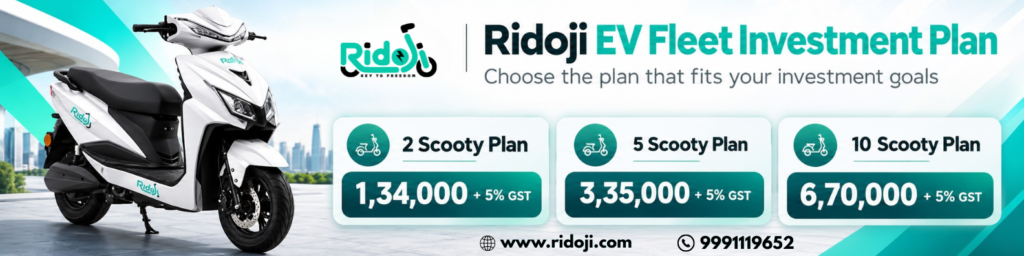
Explore Ridoji’s EV Investment Plans to understand the company’s managed electric scooter fleet program, available plans, and monthly payout structure.
What Does Ridoji Actually Do?
Ridoji operates in the electric mobility space, with a focus on electric vehicles and fleet management. Its approach involves exploring how electric vehicles can be utilised for commercial transportation, rental operations, and other mobility-related requirements.
By focusing on electric mobility and commercial EV operations, Ridoji is relevant to individuals interested in understanding the business models emerging within India’s EV ecosystem.
Ridoji’s Managed Electric Scooter Fleet Programme
Ridoji operates a managed EV fleet programme: participants fund electric scooters, while Ridoji manages deployment, rider operations, maintenance, tracking and rental-payment administration. Its programme is described as having a four-year term with fixed monthly payouts under the applicable agreement. Ridoji is a fleet management provider, rather than a vehicle manufacturer or delivery company.
For programme-specific terms, review the current Ridoji fleet programme details together with the agreement. Confirm ownership documentation, the payment commencement date, applicable taxes and deductions, expense allocation, battery replacement, downtime treatment, early exit and end-of-term asset treatment before proceeding. A fixed contractual amount does not eliminate business or counterparty risk.
The wider business models described in this article explain the EV ecosystem. They should not be read as a statement that Ridoji offers every model, or that its payments follow a generic revenue-sharing or profit-sharing formula.
Conclusion: Exploring Investment Plans with Monthly Payouts in India’s EV Market
Investment plans with monthly payouts through electric vehicle-related business models represent an emerging area of interest for individuals looking to participate in India’s electric mobility transformation.
Electric vehicle fleets, EV rentals, charging stations, and electric two-wheeler businesses are some of the opportunities worth exploring.
However, every EV investment opportunity involves financial and operational risks. Monthly payouts depend on the underlying business model, its performance, and the terms of the investment agreement, not simply on the growth of the EV industry.
Investors should conduct proper research, understand the investment structure, and maintain realistic expectations before making a decision.
Explore emerging electric mobility opportunities with Ridoji and learn more about investment plans with monthly payouts in India’s growing EV ecosystem.
Frequently Asked Questions (FAQs)
1. What are investment plans with monthly payouts in the EV sector?
Investment plans with monthly payouts in the EV sector are investment arrangements connected with electric mobility businesses that may provide periodic payments to investors. These can involve EV fleets, rentals, leasing, and charging infrastructure, depending on the business model.
2. How do EV investment plans with monthly payouts work?
These investment models generally connect investor participation with revenue-generating EV businesses. Revenue may come from vehicle rentals, delivery operations, transportation services, or leasing arrangements. Payouts depend on the agreement and business performance.
3. Which EV business models can generate recurring revenue?
EV fleet operations, electric vehicle rentals, vehicle leasing, charging stations, and battery-swapping services are some business models that may generate recurring revenue.
4. Are investment plans with monthly payouts guaranteed?
No. Monthly payouts are not automatically guaranteed. They depend on the contractual arrangement, business performance, revenue generation, and associated risks. Investors should carefully review the terms before participating.
5. What factors should investors consider before choosing an EV investment plan?
Investors should evaluate business transparency, revenue sources, asset ownership, vehicle maintenance, investment tenure, payout terms, withdrawal conditions, and regulatory compliance.
6. Why are electric vehicle fleets attracting investment interest in India?
Electric vehicle fleets support commercial transportation, last-mile delivery, and rental services. Growing interest in electric mobility is creating opportunities for businesses involved in fleet operations.
7. How does Ridoji relate to EV investment opportunities?
Ridoji is associated with electric mobility, particularly electric vehicles and fleet management. Individuals can explore its business model to understand the commercial applications of electric vehicles and emerging opportunities within the EV ecosystem