

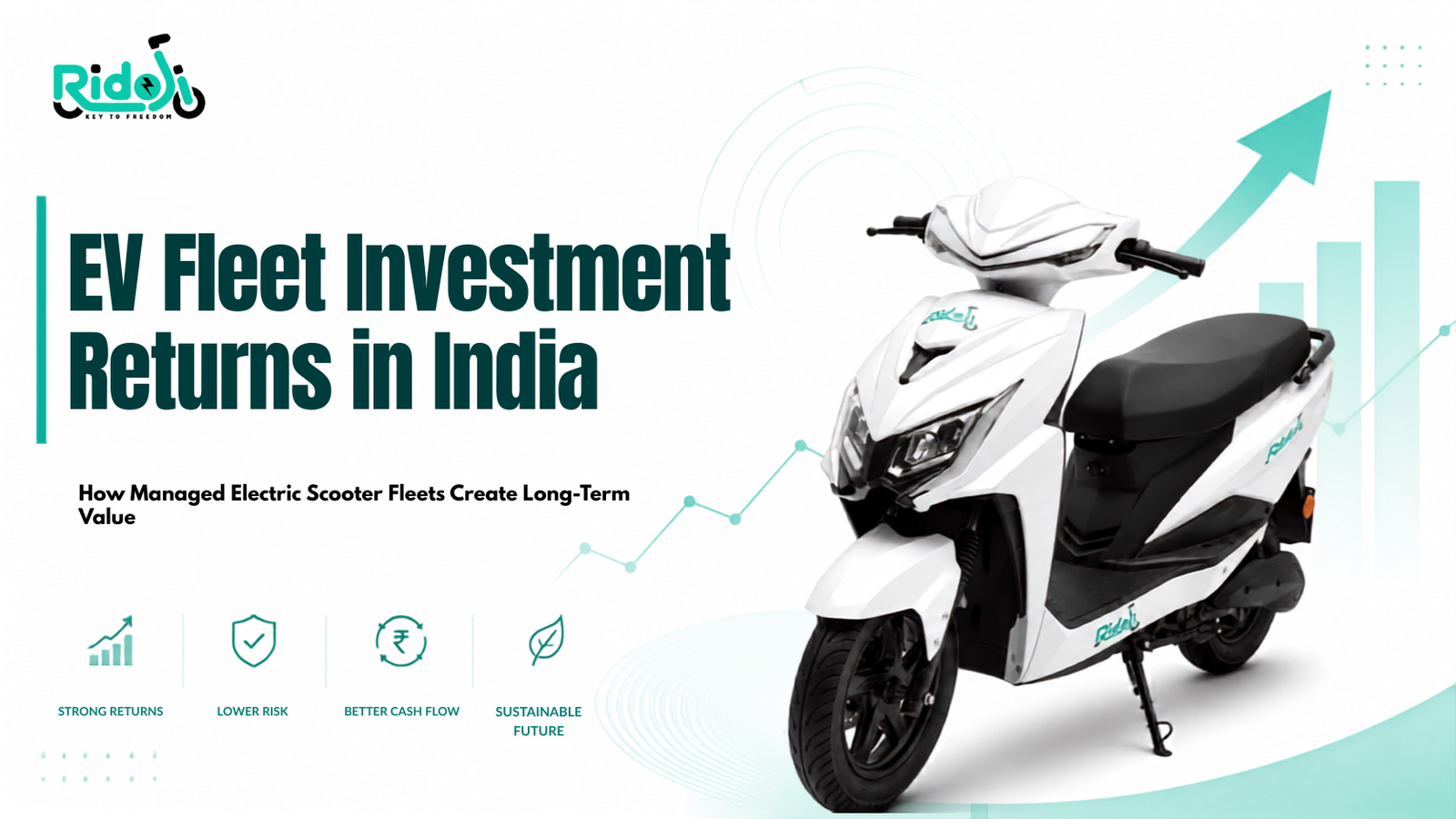
Introduction: Why Investors Are Exploring EV Fleet Returns
India’s investment landscape is changing.
For years, most investors looked at familiar options such as fixed deposits, mutual funds, gold, real estate, insurance products, or small businesses. These options are still important, but a new category is now gaining attention: EV fleet investment.
As electric vehicles become more common in India’s cities, electric scooters are no longer seen only as personal mobility products. They are increasingly being used in food delivery, grocery delivery, logistics, rider rentals, last-mile movement, and commercial fleet operations.
This shift is creating a new question for investors:
Can electric scooters become productive mobility assets that create long-term value?
The answer depends on one important factor: management.
An electric scooter by itself is only a vehicle. But when that scooter is deployed into a commercial fleet, used regularly, maintained properly, tracked consistently, and managed professionally, it can become part of a structured mobility asset model.
That is the foundation of EV Fleet Investment Returns in India.
The return potential does not come only from owning the scooter. It comes from the complete system around the scooter:
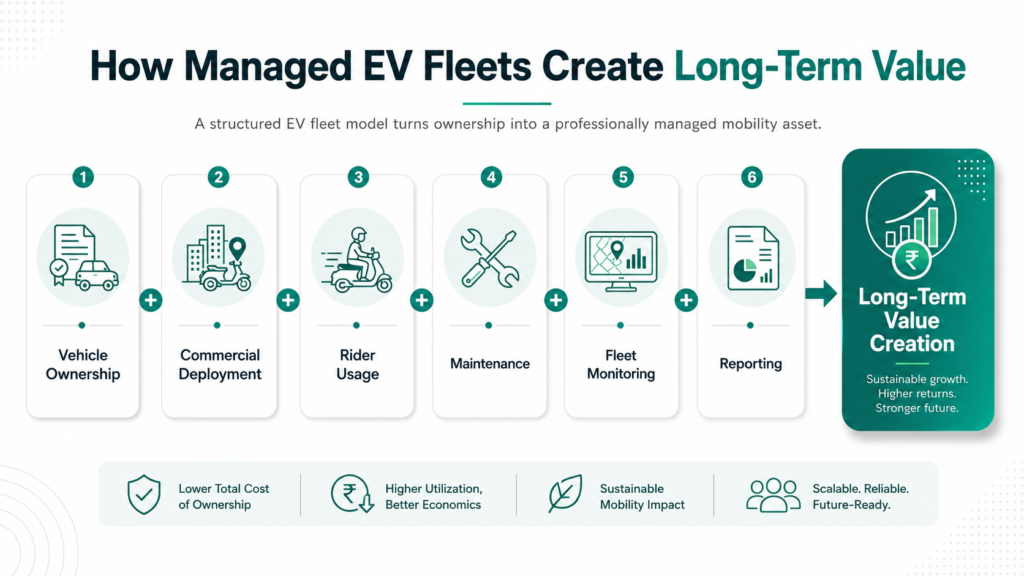
Vehicle ownership + commercial deployment + rider usage + maintenance + fleet monitoring + reporting = long-term value creation
This is why managed electric scooter fleets are becoming important. They allow investors to participate in India’s growing EV mobility sector without personally handling daily operations such as rider coordination, vehicle service, fleet deployment, usage tracking, or reporting.
For investors, this creates an asset-backed opportunity.
For businesses, it supports cleaner and more efficient mobility.
For India, it accelerates the shift toward electric transportation.
India’s EV Market Growth and Why It Matters for Investors
EV investment becomes more meaningful when the underlying market is growing. In India, the electric mobility market is showing clear signs of expansion, especially in the two-wheeler segment.
Another Autocar India report said electric scooter, motorcycle, and moped sales crossed 1 million units in 2026 by July 6, showing strong momentum in the category.
Electric two-wheelers have become one of the largest drivers of India’s EV transition. Autocar India reported that electric two-wheelers recorded 8,01,277 retail sales in the first five months of 2026, up 49% year-on-year, and already equal to around 60% of the full-year 2025 record of 13.4 lakh units. The report also noted that electric two-wheelers accounted for 56% of all EVs sold in India over the past decade, making them the biggest contributor to the country’s EV transition.
This matters for investors because electric two-wheelers are not just growing as consumer products. They are also becoming commercial tools for India’s urban economy.
They are used by:
- Delivery riders
- Logistics companies
- Rental platforms
- Fleet operators
- Field service teams
- Hyperlocal businesses
- E-commerce partners
- Food and grocery delivery networks
When a vehicle category has both consumer demand and commercial use, it becomes more interesting as an asset.
Government support is also strengthening the ecosystem. The official PM E-DRIVE portal states that the scheme aims to incentivize approximately 24.79 lakh electric two-wheelers, with benefits extended to eligible EVs fitted with advanced battery technology.
This combination of market demand, policy support, and commercial use makes electric two-wheelers an important category for investors to watch.
What Are EV Fleet Investment Returns?
EV fleet investment returns refer to the potential earnings or value generated when electric vehicles are deployed as part of a managed commercial fleet.
In simple terms, an investor participates in an EV asset, and that asset is used in real mobility operations. The vehicle may be deployed for rider rentals, deliveries, logistics, business mobility, or other commercial use cases.
However, returns do not happen automatically.
They depend on how well the vehicle is managed.
Key return drivers include:
- Vehicle deployment
- Rider availability
- Daily usage
- Maintenance quality
- Downtime control
- Charging support
- Battery health
- Demand in the operating area
- Agreement structure
- Fleet management efficiency
- Operational reporting
This is why EV fleet investment is different from simply buying a scooter.
If an electric scooter is purchased but not deployed properly, its value remains limited. If it is deployed in a managed commercial system, its productivity can improve.
The vehicle is the asset.
The fleet system creates utilization.
Utilization creates value.
Why Electric Scooters Are Becoming Mobility Assets
Electric scooters fit India’s mobility needs very naturally.
Indian cities are dense, fast-moving, and heavily dependent on two-wheelers. For short-distance and medium-distance travel, two-wheelers remain one of the most practical formats.
Electric scooters add more advantages to this format:
- Lower running cost compared to petrol scooters
- Fewer moving parts
- Lower maintenance requirements
- Easier use in city traffic
- Suitable for delivery and rental operations
- Reduced tailpipe emissions
- Better fit for short urban routes
For personal users, this means convenience and lower daily running cost.
For businesses, it means operational efficiency.
For investors, it means the scooter can potentially become a productive commercial asset when placed inside a managed fleet model.
This is the reason electric scooter investment is attracting attention. It is not because the scooter is new. It is because the scooter can be used repeatedly in business operations.
A personal scooter may remain parked for most of the day.
A commercial scooter can be used actively for deliveries, rentals, and urban mobility.
A professionally managed fleet scooter can be monitored, maintained, and deployed with greater discipline.
That difference is what creates long-term value.
How Managed Electric Scooter Fleets Create Long-Term Value
A managed electric scooter fleet creates value by solving the biggest challenge in vehicle-based investment: operations.
Many investors may be willing to buy an EV asset, but very few want to manage riders, track daily movement, handle maintenance, coordinate service, solve breakdown issues, or manage fleet reporting.
A managed EV fleet company handles these responsibilities through a structured process.
A strong managed fleet system usually includes:
- Vehicle onboarding
- Rider coordination
- Deployment planning
- Daily usage monitoring
- Maintenance support
- Breakdown handling
- Battery and charging support
- Fleet reporting
- Documentation support
- Operational supervision
This is important because returns are connected to uptime.
If the vehicle is running, it has the potential to generate value.
If the vehicle is idle, poorly maintained, or not deployed, value reduces.
Fleet management helps reduce this gap.
In other words, managed EV fleets create long-term value through:
1. Better Deployment
The vehicle is placed into commercial use instead of sitting idle.
2. Better Utilization
Fleet managers track how often and how effectively the vehicle is used.
3. Better Maintenance
Regular maintenance helps protect the asset and reduce breakdown risk.
4. Better Rider Coordination
A managed system handles rider onboarding, coordination, and operational support.
5. Better Reporting
Investors receive structured updates instead of depending on guesswork.
This is why the managed model is important. It converts a simple EV purchase into an organized fleet opportunity.
Vehicle Ownership vs Fleet Deployment
Many investors confuse vehicle ownership with fleet investment. They are not the same.
Buying an electric scooter means you own a vehicle.
Deploying that scooter into a managed fleet means the vehicle becomes part of a commercial mobility system.
The difference is important.
| Factor | Simple Vehicle Ownership | Managed EV Fleet Deployment |
| Asset | Electric scooter | Electric scooter used in commercial fleet |
| Usage | Personal or limited | Commercial deployment |
| Management | Owner manages everything | Fleet company manages operations |
| Maintenance | Owner responsibility | Supported through managed process |
| Reporting | Limited | Structured reporting |
| Value Creation | Depends on personal use/resale | Depends on utilization and fleet operations |
| Investor Effort | High if rented independently | Lower due to professional management |
This is why EV fleet investment returns should be understood through an operational lens.
The return is not just about what the scooter costs.
It is about how the scooter is used.
What Factors Influence EV Fleet Investment Returns?
EV fleet investment returns depend on multiple practical factors.
1. Vehicle Utilization
A vehicle must be used regularly to create value. Higher utilization generally improves the asset’s productivity.
2. Deployment Location
Some cities, business zones, and delivery hubs have stronger demand than others. Location affects rider availability and commercial usage.
3. Maintenance Quality
Poor maintenance can increase downtime and reduce long-term asset performance.
4. Rider Management
Rider behavior affects vehicle condition, safety, and operational consistency.
5. Charging Access
Without reliable charging or battery support, a vehicle cannot operate efficiently.
6. Downtime Control
Downtime directly affects productivity. A strong fleet system focuses on reducing idle time.
7. Agreement Terms
Investors must review payout structure, lock-in period, maintenance terms, responsibilities, and exit clauses.
8. Market Demand
Commercial EV demand is growing, but it can vary by city, season, partner network, and rider availability.
9. Reporting Transparency
Regular reports help investors understand asset performance and program execution.
10. Fleet Management Quality
This is the most important factor. A well-managed vehicle can perform better than an unmanaged one, even if both vehicles are the same model.
Why Ridoji’s Managed EV Fleet Model Becomes Relevant
At this point, the key lesson is clear:
EV fleet investment returns depend heavily on operations.
This is where Ridoji’s EV Fleet Management Program becomes relevant.
Ridoji’s model is designed for investors who want to participate in India’s EV mobility sector without managing the daily work themselves.
Through the program, Ridoji handles key operational responsibilities such as:
- Vehicle deployment
- Rider coordination
- Maintenance support
- Fleet monitoring
- Reporting
- Operational management
This makes the model suitable for investors who want an asset-backed EV opportunity but do not want to personally run a fleet business.
The investor participates in the EV asset.
Ridoji manages the fleet ecosystem.
That is the real value of a managed electric scooter fleet.
EV Fleet Investment Returns vs Traditional Investment Options
Before investing in any new opportunity, investors usually compare it with familiar options such as fixed deposits, SIPs, mutual funds, real estate, gold, or small businesses.
EV fleet investment is different from all of them because it is connected to a physical vehicle asset that is deployed for commercial mobility.
It is not purely financial like a fixed deposit.
It is not market-linked like a mutual fund.
It is not as capital-heavy as real estate.
It is not as passive as gold.
It is also not as demanding as running a full transport business yourself.
A managed EV fleet model sits between asset ownership and business participation.
| Investment Option | Type | Return Nature | Main Advantage | Key Risk |
| Fixed Deposit | Financial product | Interest-based | Stability | Lower return potential |
| SIP / Mutual Fund | Market-linked | Growth-based | Long-term wealth creation | Market volatility |
| Real Estate | Physical asset | Rent + appreciation | Tangible asset | High capital required |
| Gold | Commodity | Price appreciation | Hedge against uncertainty | No regular cash flow |
| Small Business | Active business | Profit-based | Control and scale | Requires daily involvement |
| EV Fleet Investment | Mobility asset | Operationally linked returns | Asset-backed commercial deployment | Management and utilization risk |
This comparison shows why EV fleet investment should be understood carefully. It is not a replacement for every traditional investment option. It is a different category.
The main strength of EV fleet investment is that it connects a physical asset with a growing commercial mobility demand.
The main challenge is that returns depend on execution.
That means the quality of the fleet management company matters as much as the asset itself.
Why Fleet Management Matters More Than the Vehicle Itself
Many people assume that the scooter is the main investment.
In reality, the scooter is only the starting point.
The real performance of the investment depends on how the scooter is used after purchase.
Two investors can buy the same electric scooter, but their outcomes may be completely different depending on how the vehicle is deployed, maintained, tracked, and managed.
A scooter that remains idle creates limited value.
A scooter that is poorly maintained loses efficiency.
A scooter used by unreliable riders may face damage or downtime.
A scooter without proper tracking can become difficult to manage.
A scooter inside a structured fleet system has better operational discipline.
This is why fleet management is the heart of EV fleet investment.
A professional fleet management system helps with:
- Vehicle deployment
- Rider onboarding
- Daily tracking
- Maintenance planning
- Downtime reduction
- Charging coordination
- Performance reporting
- Documentation support
- Operational supervision
The vehicle creates the asset base.
Fleet management creates the operating structure.
The operating structure creates long-term value.
Understanding Potential Returns in EV Fleet Investment
When investors search for “EV fleet investment returns in India,” they usually want a direct answer:
How much can I earn?
But a responsible answer should not be based on unrealistic promises.
EV fleet returns depend on several moving parts. These include vehicle cost, deployment model, rental structure, rider demand, city-level operations, maintenance cost, downtime, agreement terms, and management quality.
That is why investors should not only ask:
What is the return?
They should also ask:
How is the return generated?
A better way to understand EV fleet returns is through the value chain:
- The investor participates in the EV asset.
- The vehicle is deployed into a commercial mobility use case.
- Riders or business partners use the vehicle.
- The fleet management company monitors operations.
- Maintenance and downtime are managed.
- The investor receives payout as per the agreed structure.
This makes the return operationally linked.
It is not magic.
It is not automatic.
It depends on managed utilization.
What Makes Returns Better in a Managed EV Fleet Model?
A managed EV fleet model can improve the investment experience because it reduces the operational burden on the investor.
Instead of personally finding riders, collecting payments, checking the vehicle, managing service, handling breakdowns, and tracking usage, the investor works with a company that manages these responsibilities.
The following factors can help improve the quality of returns.
1. Strong Vehicle Utilization
The more consistently the vehicle is deployed, the stronger its productivity potential. Good fleet operators focus on keeping vehicles active and reducing idle time.
2. Reliable Rider Network
Rider availability is important. A strong fleet program needs trained, verified, and coordinated riders who can use the vehicle responsibly.
3. Preventive Maintenance
Regular maintenance helps protect the scooter’s life and reduces sudden breakdowns. This is important because downtime can affect performance.
4. Charging Planning
Electric scooters need reliable charging support. Fleet managers must plan charging cycles so that vehicles remain available for operations.
5. Transparent Reporting
Investors need clarity. Reports help them understand how the fleet is performing, how the vehicle is being managed, and what operational updates matter.
6. Commercial Demand
Returns are stronger when vehicles are deployed in areas where rider demand, delivery demand, or fleet demand is active.
7. Operational Discipline
A well-managed fleet follows processes. It does not depend on guesswork. This includes documentation, service schedules, rider coordination, and issue resolution.
Risks Investors Should Understand Before Investing
EV fleet investment has potential, but it also carries risks. A professional blog should always explain these clearly.
1. Deployment Risk
If the vehicle is not deployed quickly or consistently, returns may be affected. Deployment depends on rider demand, business partnerships, and location-level operations.
2. Downtime Risk
A vehicle may be unavailable due to maintenance, repair, accidents, battery issues, or documentation delays. Downtime can reduce productivity.
3. Rider Misuse Risk
Commercial vehicles are used more frequently than personal vehicles. Poor rider behavior can affect vehicle condition and maintenance cost.
4. Maintenance Risk
Even though EVs generally have fewer moving parts than petrol vehicles, they still require servicing, tyre checks, brake maintenance, battery monitoring, and periodic inspection.
5. Policy Risk
EV policies, subsidies, and regulations may change over time. Investors should not base their entire decision only on current government incentives.
6. Market Demand Risk
Commercial EV demand is growing, but it can vary by city, season, rider availability, and business partnerships.
7. Agreement Risk
Every investor must carefully review the agreement. Important areas include payout structure, lock-in period, exit terms, maintenance responsibility, damage policy, insurance coverage, and reporting process.
Understanding these risks does not make EV fleet investment unattractive. It makes the decision more mature.
Serious investors do not invest only because a market is growing. They invest after understanding the model, risks, responsibilities, and long-term potential.
Who Should Consider EV Fleet Investment?
EV fleet investment may be suitable for people who want exposure to India’s electric mobility growth but do not want to operate a fleet business personally.
It may be suitable for:
- Salaried professionals looking for asset-backed opportunities
- Business owners who want to diversify
- Investors interested in electric mobility
- NRIs exploring managed opportunities in India
- People who prefer physical assets over purely financial products
- Individuals who want structured participation in commercial EV growth
However, it may not be suitable for everyone.
It may not be right for people who:
- Want a completely risk-free investment
- Need instant liquidity
- Do not want any lock-in period
- Expect guaranteed returns
- Do not want to read agreements
- Are uncomfortable with operational risk
This distinction is important because EV fleet investment is not a bank deposit. It is a managed business-linked asset model.
How Ridoji’s EV Fleet Management Program Supports Investors
Ridoji’s EV Fleet Management Program is designed around one core idea:
Investors should be able to participate in the EV fleet ecosystem without managing daily operations themselves.
Ridoji supports investors by handling important fleet responsibilities such as:
- Electric scooter deployment
- Rider coordination
- Maintenance support
- Fleet monitoring
- Operational reporting
- Documentation coordination
- Day-to-day fleet management
This allows investors to enter the EV mobility space through a structured model instead of trying to operate vehicles independently.
The benefit is not only ownership of an EV asset.
The benefit is having that asset managed inside a professional fleet ecosystem.
That is what creates long-term value.
Why Long-Term Thinking Matters
EV fleet investment should not be approached with a short-term mindset.
The value of this model comes from consistent deployment, disciplined fleet management, and long-term commercial mobility demand.
Electric scooters are becoming more important in India’s urban economy, especially for delivery, rental, logistics, and rider-based businesses. As this demand grows, professionally managed EV fleets can play a bigger role.
But investors should look for structure, not hype.
They should ask:
- How does the program work?
- What is the payout structure?
- What are the risks?
- Who manages maintenance?
- How is the vehicle deployed?
- What reports are shared?
- What happens during downtime?
- What are the exit terms?
A good investment decision is built on clarity.
Final Thoughts: EV Fleet Returns Come from Managed Utilization
EV fleet investment returns in India should not be understood as a simple “buy and earn” model.
The real value comes from managed utilization.
An electric scooter becomes valuable when it is used consistently in a commercial environment, maintained properly, monitored regularly, and deployed through an organized fleet system. Without proper management, even a good vehicle can remain underused. With professional fleet management, the same asset can become part of a structured mobility ecosystem.
This is why managed electric scooter fleets are becoming important for investors.
They combine three powerful elements:
- A physical EV asset
- Growing commercial mobility demand
- Professional fleet operations
As India’s EV market grows, electric two-wheelers are expected to play a major role in last-mile delivery, rider mobility, local logistics, and urban business operations. For investors, this creates a new-age opportunity to participate in electric mobility through an asset-backed model.
However, it is important to approach this opportunity with the right mindset.
EV fleet investment is not a risk-free financial product. It is a business-linked asset model where returns depend on deployment, utilization, rider management, maintenance, downtime control, and agreement terms.
The investors who understand this clearly will be better prepared to evaluate the opportunity.
Why Ridoji Is Relevant in This Space
Ridoji’s EV Fleet Management Program is designed for people who want to participate in India’s growing electric mobility sector without managing daily fleet operations themselves.
Instead of asking investors to handle vehicle deployment, riders, maintenance, reporting, and operational issues independently, Ridoji manages the fleet ecosystem through a structured process.
Ridoji supports investors with:
- Electric scooter deployment
- Rider coordination
- Maintenance support
- Fleet monitoring
- Operational reporting
- Documentation coordination
- Day-to-day fleet management
This makes the model more practical for investors who want exposure to EV mobility but do not want to personally run a fleet business.
The idea is simple:
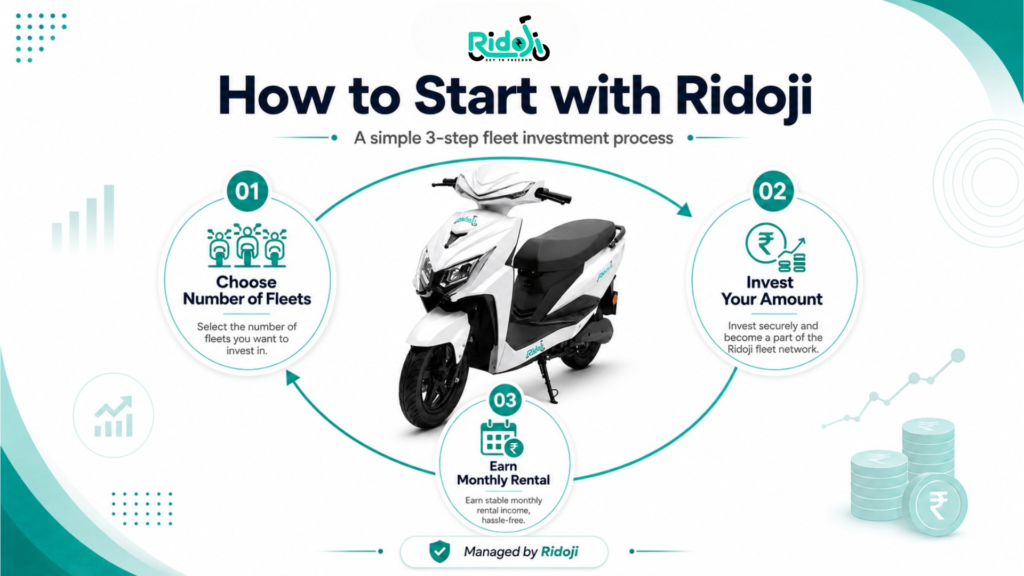
You participate in the EV asset. Ridoji manages the fleet operations.
That is where long-term value can be created.
CTA: Explore Ridoji’s EV Fleet Management Program
Looking for an asset-backed way to participate in India’s growing EV mobility sector?
Explore Ridoji’s EV Fleet Management Program, where Ridoji manages vehicle deployment, rider coordination, maintenance support, reporting, and fleet operations.
To understand the program structure, payout model, agreement terms, responsibilities, and risks, connect with Ridoji today.
Call: 9991119652
Website: www.ridoji.com
Disclaimer: EV fleet investment involves operational and business risks. Investors should carefully review all terms, conditions, payout structures, lock-in period, responsibilities, risks, and agreements before making any investment decision.
FAQs
1. What are EV fleet investment returns in India?
EV fleet investment returns refer to the potential earnings or value generated when electric vehicles are deployed in a managed commercial fleet. These returns depend on factors such as vehicle utilization, rider availability, maintenance quality, downtime control, deployment location, and agreement terms.
2. How do managed electric scooter fleets create long-term value?
Managed electric scooter fleets create long-term value by keeping vehicles deployed, maintained, monitored, and used in commercial mobility operations. The value comes from professional fleet management, not just vehicle ownership.
3. Is EV fleet investment a guaranteed return model?
No. EV fleet investment should not be treated as a guaranteed return or risk-free model. It is an operationally linked asset opportunity where returns depend on fleet performance, management quality, market demand, rider usage, and agreement terms.
4. Why are electric scooters suitable for fleet investment?
Electric scooters are suitable for fleet investment because they are practical for city movement, last-mile delivery, rider rentals, logistics, and daily commercial mobility. Their lower running cost and suitability for short urban routes make them useful fleet assets.
5. How is EV fleet investment different from buying a scooter?
Buying a scooter means owning a vehicle. EV fleet investment means placing that vehicle into a managed commercial mobility system where it is deployed, tracked, maintained, and operated professionally.
6. What factors affect EV fleet investment returns?
Important factors include vehicle deployment, daily usage, rider coordination, maintenance, downtime, battery performance, charging access, demand in the operating area, fleet management quality, and agreement structure.
7. Is EV fleet investment better than FD or SIP?
EV fleet investment is different from FD or SIP. A fixed deposit is interest-based, SIPs are market-linked, and EV fleet investment is an asset-backed operational model. Each option has different risks, liquidity, and return potential.
8. Who should consider EV fleet investment?
EV fleet investment may suit investors who want exposure to India’s electric mobility sector, prefer physical asset-backed opportunities, and do not want to manage daily fleet operations themselves. It is better suited for investors who understand operational risks.
9. What risks should investors understand before investing?
Investors should understand deployment risk, downtime risk, maintenance risk, rider misuse risk, policy risk, market demand risk, agreement risk, and liquidity limitations before entering any EV fleet investment program.
10. How does Ridoji’s EV Fleet Management Program work?
Ridoji’s EV Fleet Management Program allows investors to participate in EV assets while Ridoji manages fleet operations such as deployment, rider coordination, maintenance support, monitoring, reporting, and day-to-day fleet management.
11. Can EV fleet investment provide monthly payouts?
Some managed EV fleet programs may follow a monthly payout structure, depending on the agreement. Investors should review the exact payout model, conditions, deductions, risks, and lock-in period before investing.
12. How can I invest in Ridoji’s EV Fleet Management Program?
You can contact Ridoji directly to understand the program structure, vehicle model, agreement terms, payout structure, risks, maintenance process, and operational responsibilities.