What Is EV Fleet Management?
EV Fleet Management is becoming important for Indian businesses that want to reduce delivery costs, manage electric scooters, improve rider productivity, and build cleaner last-mile delivery operations.
For general EV awareness, users can refer to the e-AMRIT EV awareness portal, developed by NITI Aayog as an information resource for electric vehicle adoption in India.
EV Fleet Management is the process of managing electric vehicles used for business operations. For Indian businesses, this usually includes electric scooters, electric bikes, electric three-wheelers, or other EVs used for last-mile delivery, rider movement, logistics, courier services, grocery delivery, food delivery, pharmacy delivery, and quick commerce.
In simple words, EV fleet management means making sure every electric vehicle in a business fleet is properly deployed, charged, maintained, tracked, monitored, and used efficiently.
Many businesses think that switching to EVs only means buying electric scooters. But in reality, vehicle purchase is only the first step.
The real challenge begins after the vehicle comes on the road.
A business has to manage rider allocation, vehicle availability, charging schedules, service issues, breakdowns, documentation, route planning, fleet monitoring, daily reporting, and cost control. Without a proper system, even a good electric scooter fleet can become difficult to manage.
That is why EV Fleet Management is becoming important for Indian businesses.
India’s electric mobility ecosystem is growing quickly. The PM E-DRIVE scheme was approved with an outlay of ₹10,900 crore to promote electric mobility in the country, showing that EV adoption is now a national priority. Electric two-wheelers are also becoming a major part of India’s EV market, with Autocar Professional reporting record electric two-wheeler sales in FY2026 and a 57% share of India’s EV market.
For businesses, this means electric mobility is no longer just a future idea. It is becoming a practical operational choice.
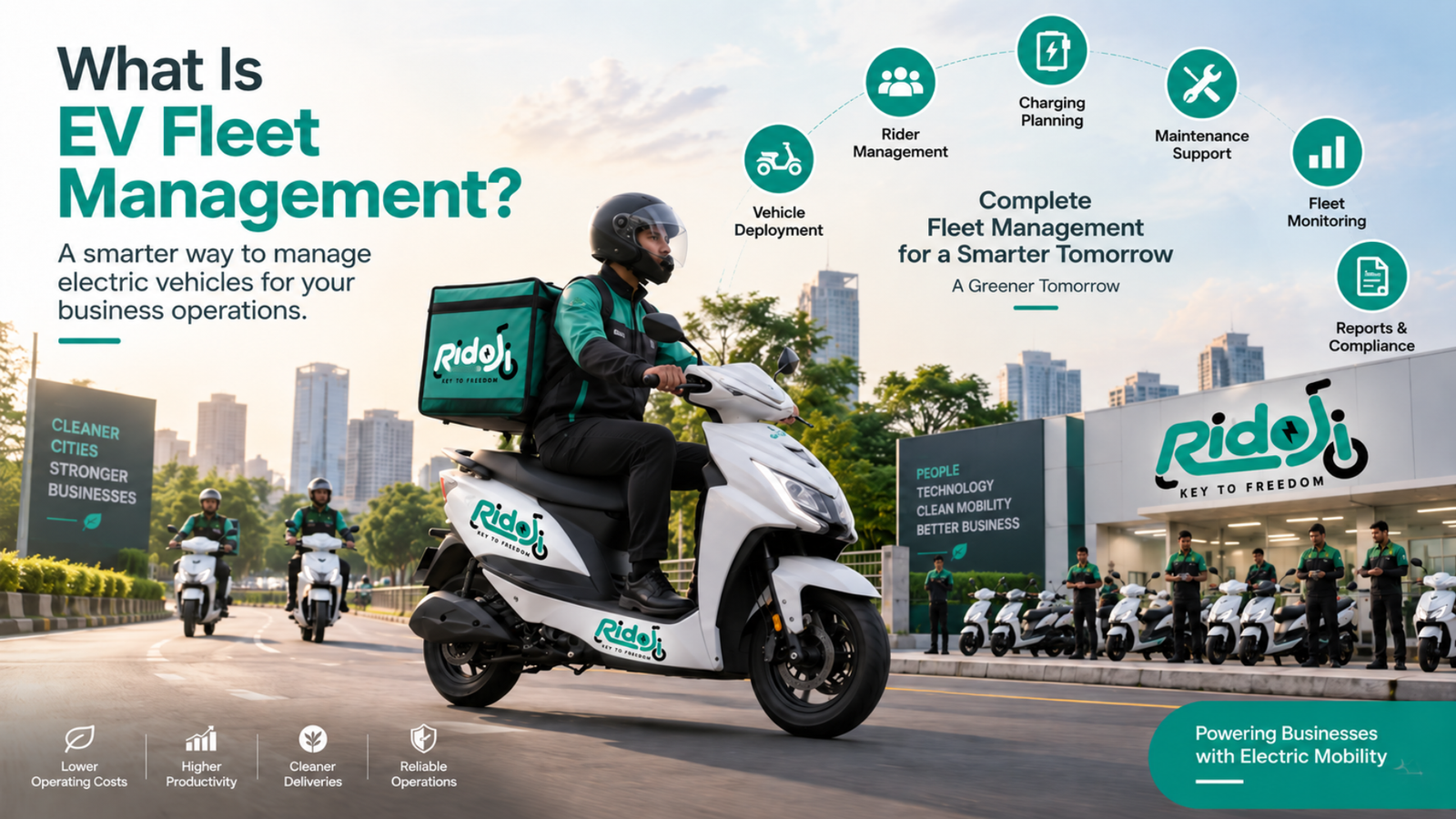
A complete EV Fleet Management system helps businesses manage vehicle deployment, rider coordination, charging planning, maintenance support, fleet monitoring, and reporting.
What Does EV Fleet Management Include?
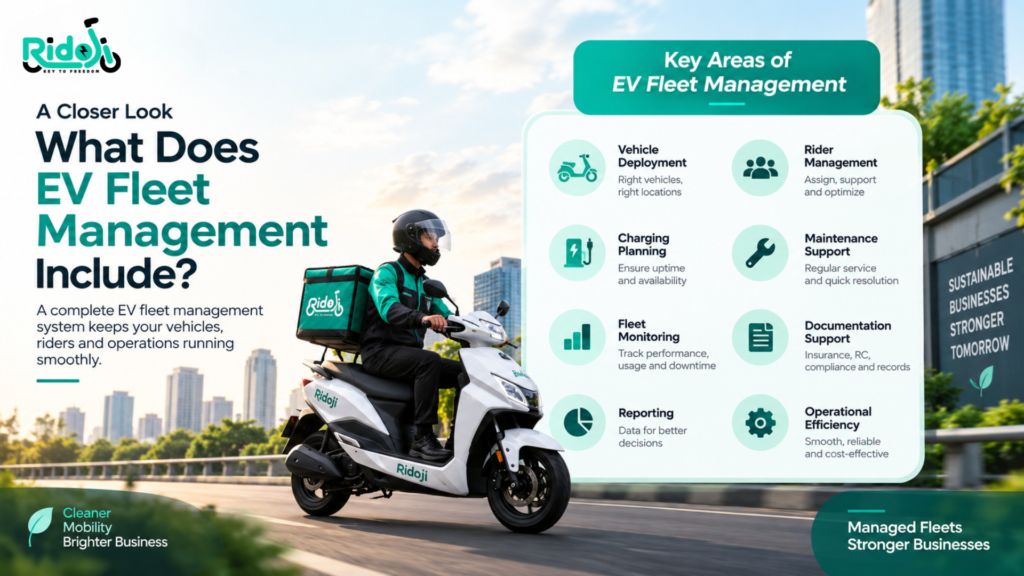
A complete EV fleet management system usually includes:
Vehicle deployment:
Making sure the right number of vehicles are available for business operations.
Rider coordination:
Assigning riders, managing usage, and ensuring vehicles are used properly.
Charging planning:
Ensuring vehicles are charged on time so delivery operations do not stop.
Maintenance support:
Managing regular servicing, repairs, inspections, and breakdown support.
Fleet monitoring:
Tracking vehicle status, usage, performance, downtime, and availability.
Documentation support:
Managing vehicle documents, insurance, service records, and compliance needs.
Reporting:
Providing businesses with data on vehicle usage, operational performance, and fleet health.
This is why EV Fleet Management is more than vehicle rental or vehicle ownership. It is an operational system.
F
Why EV Fleet Management Is Important for Indian Businesses
Indian businesses are under constant pressure to deliver faster, reduce costs, improve reliability, and meet customer expectations. Whether it is a restaurant, cloud kitchen, grocery brand, courier company, e-commerce seller, logistics operator, or quick commerce business, delivery operations can directly affect customer experience.
If deliveries are delayed, customers complain.
If vehicles break down, orders get affected.
If fuel costs rise, margins reduce.
If riders do not get reliable vehicles, productivity drops.
This is where EV Fleet Management becomes valuable.
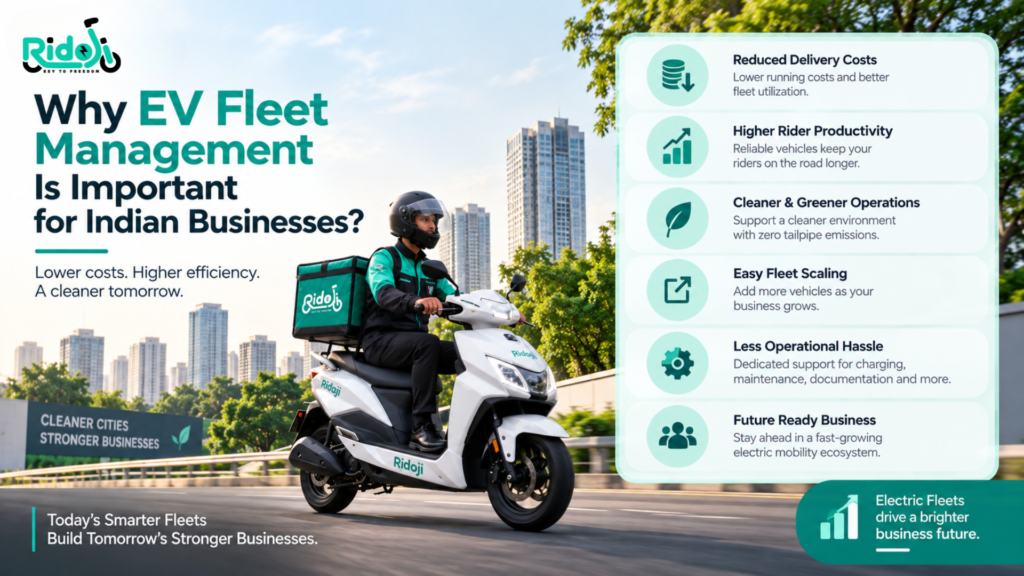
1. It Helps Reduce Delivery Operating Costs
One of the biggest reasons Indian businesses are exploring electric vehicles is cost control.
Petrol scooters depend on fuel prices and frequent engine maintenance. Electric scooters can help reduce running cost pressure, especially for short-distance and repeated urban delivery routes.
But cost savings do not come automatically.
A business needs proper charging planning, route discipline, maintenance control, and vehicle monitoring. If vehicles remain idle, break down often, or are not charged properly, the cost benefit reduces.
With managed EV fleet operations, businesses can improve vehicle utilization and reduce unnecessary downtime.
2. It Improves Rider Productivity
Delivery riders need vehicles that are available, charged, and reliable. If a rider starts the day with vehicle issues, the business loses time and orders.
A structured EV Fleet Management system helps ensure that riders get better vehicle access and operational support.
This can improve daily productivity because riders spend less time dealing with vehicle problems and more time completing deliveries.
3. It Supports Cleaner Last-Mile Delivery
Consumers, businesses, and regulators are becoming more conscious about cleaner mobility. Electric scooters produce zero tailpipe emissions during operation, which makes them suitable for dense urban delivery markets.
For restaurants, grocery brands, pharmacies, courier companies, and e-commerce businesses, EV fleets can support a cleaner brand image.
India’s electric mobility growth is also supported by public charging and EV ecosystem initiatives. The PM E-DRIVE scheme aims to accelerate EV adoption, charging infrastructure, and EV manufacturing ecosystem development.
4. It Makes Fleet Scaling Easier
A business may start with 5 vehicles, then need 20, 50, or 100 vehicles as demand grows.
Managing a small number of vehicles manually may be possible. But as fleet size grows, manual management becomes difficult.
Businesses need systems for:
vehicle allocation,
rider attendance,
service schedules,
charging status,
vehicle downtime,
fleet reports,
route-level performance,
and operational visibility.
A managed EV fleet partner helps businesses scale without building an internal fleet department from day one.
5. It Reduces Operational Hassle
Many businesses want the benefits of electric vehicles, but they do not want to handle every operational detail themselves.
They may not have time to manage repairs, rider coordination, vehicle documents, charging issues, or breakdown support.
This is why businesses prefer managed EV fleet solutions.
A good EV Fleet Management partner helps businesses focus on customers, orders, sales, and growth while the fleet side is professionally handled.
6. It Helps Businesses Stay Ready for the EV Shift
India’s EV market is expanding across multiple vehicle categories. Autocar Professional reported that India’s EV sales crossed 2.45 million units in FY2026, with all four key segments showing double-digit growth.
This indicates that EV adoption is not limited to personal vehicles. It is becoming relevant for commercial operations, delivery businesses, and fleet users as well.
For Indian businesses, EV Fleet Management is useful because it brings better control over delivery costs, rider productivity, downtime, and daily fleet operations.
How Ridoji Helps Businesses with EV Fleet Management
For many Indian businesses, the main question is not “Should we use electric scooters?”
The bigger question is:
“Who will manage the fleet properly?”
This is where Ridoji fits in.
Ridoji provides a managed EV fleet ecosystem where electric scooters are deployed for commercial use, and the operational side is handled through structured fleet management.
Ridoji supports businesses with electric scooter deployment, rider coordination, maintenance support, fleet monitoring, and daily operational management.
Instead of only providing vehicles, Ridoji focuses on making the fleet usable, active, and business-ready.
Ridoji’s EV Fleet Management Support Includes
Electric scooter deployment:
Helping businesses access electric scooters for delivery and mobility needs.
Rider coordination:
Supporting rider management so vehicles are used properly in daily operations.
Maintenance support:
Helping reduce downtime through servicing and operational support.
Fleet monitoring:
Keeping track of vehicle usage, availability, and performance.
Business support:
Helping businesses build cleaner and more cost-efficient delivery operations.
Which Businesses Can Use EV Fleet Management?
Ridoji’s EV fleet model can be useful for:
restaurants,
cloud kitchens,
grocery stores,
pharmacies,
courier companies,
quick commerce operators,
e-commerce sellers,
local delivery businesses,
logistics companies,
and delivery-based startups.
Any business that depends on daily rider movement or last-mile delivery can benefit from a managed EV fleet.
Ridoji supports EV Fleet Management by helping businesses with electric scooter deployment, rider coordination, maintenance support, fleet monitoring, and operational management.
EV Fleet Management vs Traditional Vehicle Ownership
Traditional vehicle ownership can look simple in the beginning. A business buys scooters and gives them to riders.
But after some time, challenges begin.
Who will manage service?
Who will track vehicle usage?
Who will handle breakdowns?
Who will check charging discipline?
Who will maintain reports?
Who will manage rider-related vehicle issues?
With managed EV Fleet Management, these problems are handled through a more structured system.
That is why managed EV fleets are becoming more practical for modern delivery businesses.
Why EV Fleet Management Matters for the Future
The future of Indian delivery operations will depend on three things:
cost efficiency,
cleaner mobility,
and operational reliability.
Electric scooters can support all three, but only when they are managed well.
A business cannot build a reliable EV delivery operation only by purchasing vehicles. It needs deployment planning, rider coordination, charging management, service support, and data visibility.
This is the real value of EV Fleet Management.
Final Thoughts
In the future, EV Fleet Management will become an important part of cleaner, smarter, and more cost-efficient delivery operations in India.
EV Fleet Management is becoming important for Indian businesses because delivery operations are changing. Customers want faster deliveries. Businesses want lower costs. Cities need cleaner mobility. Riders need reliable vehicles. And companies need better control over daily fleet performance.
Electric scooters can help businesses move toward cleaner and more cost-efficient delivery operations, but the real success depends on fleet management.
For Indian businesses, managed EV fleets offer a practical way to adopt electric mobility without taking on the full operational burden.
Ridoji helps businesses build and manage electric scooter fleets through deployment, rider coordination, maintenance support, fleet monitoring, and daily operations.
For businesses planning their next phase of delivery growth, EV fleet management is not just a mobility solution. It is an operational advantage.
Call to Action
Looking to build a cleaner and more cost-efficient delivery fleet?
Explore Ridoji EV Fleet Management Solutions and understand how managed electric scooter fleets can support your business operations.
Website: www.ridoji.com
Contact: 9991119652