


Section 1: Understanding EV Rental Business Investment
EV Rental Business Investment is becoming an interesting topic for investors who want to explore opportunities connected to electric mobility, delivery operations, and managed vehicle fleets.
India’s EV ecosystem is growing with policy support and rising commercial use cases. The PM E-DRIVE scheme was approved with an outlay of ₹10,900 crore to promote electric mobility, including support for electric two-wheelers, electric three-wheelers, e-buses, e-trucks, e-ambulances, and charging infrastructure. Prime Minister of India
Electric two-wheelers are also one of the strongest EV categories in India. JMK Research reported that India’s electric two-wheeler segment grew by about 21% in FY2026 compared with FY2025, showing stronger adoption of e-2Ws across the market.
A clear EV Rental Business Investment decision should be based on demand, vehicle utilization, fleet management, and agreement transparency.
For investors, this creates a new question:
How do you choose the right EV rental business to invest in?
The answer is not just about buying electric scooters. A good EV Rental Business Investment depends on demand, vehicle utilization, maintenance, rider management, charging planning, agreements, payout structure, and the company’s ability to manage day-to-day fleet operations.
What Is an EV Rental Business?
An EV rental business provides electric vehicles, usually electric scooters or electric two-wheelers, for commercial or daily usage. These vehicles may be rented to delivery riders, logistics partners, quick-commerce workers, courier riders, food delivery riders, grocery delivery riders, or businesses that need last-mile mobility.
In simple words, the business earns value when vehicles are deployed and used regularly.
For example, an electric scooter rental business may serve:
- Food delivery riders
- Grocery delivery riders
- Quick-commerce riders
- Courier and parcel riders
- Pharmacy delivery riders
- Local business delivery staff
- Logistics and last-mile operations
This makes the EV rental business different from personal vehicle ownership. The goal is not just to own vehicles. The goal is to keep vehicles active, rented, maintained, and commercially useful.
How Does an EV Rental Business Generate Revenue?
An EV rental business usually generates revenue through rental payments collected from riders or businesses that use the vehicles. The rental model may be daily, weekly, monthly, or long-term depending on the company.
The basic flow looks like this:
Investor participates in EV fleet assets.
The company deploys electric scooters for rental use.
Riders or businesses use the scooters for delivery work.
The fleet company manages operations, maintenance, and reporting.
The investor receives payouts as per agreement terms.
This is why EV Rental Business Investment can look attractive to people who want asset-backed participation instead of only market-linked investment options.
However, investors must understand one important point:
A vehicle does not create value by standing idle. It creates value only when it is properly deployed and managed.
That is why fleet management is the heart of this business.
Why EV Rental Businesses Are Getting Attention
EV rental businesses are getting attention because they connect with multiple growth areas at the same time:
- Electric mobility adoption
- Last-mile delivery growth
- Quick commerce expansion
- Rider demand for affordable vehicles
- Business demand for cleaner delivery fleets
- Lower fuel dependency
- Asset-backed investment interest
Delivery riders often need reliable vehicles but may not want to buy scooters upfront. Businesses want delivery fleets but may not want to manage every vehicle directly. EV rental businesses can solve this gap by providing vehicles and operational support.
For investors, EV Rental Business Investment is not only about buying electric scooters; it is about understanding how those scooters are deployed and managed.
Why Fleet Management Matters More Than Vehicle Ownership
Many investors focus only on the scooter cost and expected monthly payout. But the stronger question is:
Who is managing the fleet?
In an EV rental business, the vehicle is only one part of the system. The real performance depends on:
- Vehicle deployment
- Rider onboarding
- Rental collection
- Charging planning
- Maintenance support
- Vehicle tracking
- Downtime control
- Accident and damage handling
- Reporting transparency
- Agreement clarity
A poorly managed fleet can create problems even if the vehicles are good.
A well-managed fleet can improve utilization, reduce downtime, and create a more structured experience for riders, businesses, and investors.
This is why choosing the right EV rental business matters.
A successful EV Rental Business Investment depends on regular vehicle usage, strong rider demand, maintenance support, and operational discipline.

Section 2: How to Choose the Right EV Rental Business to Invest In
Before choosing any EV Rental Business Investment, investors should compare the company’s business model, rental collection process, and deployment strategy.
1. Check the Business Model
The first thing to understand is how the company earns revenue.
Ask these questions:
- Are scooters rented to riders or businesses?
- Is the rental daily, weekly, monthly, or long-term?
- Who collects rental payments?
- What happens if a rider does not pay?
- What happens if a scooter remains idle?
- How does the company maintain vehicle utilization?
- Is the revenue fixed, variable, or performance-linked?
A clear business model is important because payouts depend on how the company operates and manages its fleet.
2. Review Vehicle Deployment Strategy
In an EV rental business, deployment is everything.
A scooter should not sit unused. It should be placed in a location where riders or businesses need it.
Before investing, check:
- Where are the scooters deployed?
- Which cities or zones does the company operate in?
- Is there real rider demand?
- Does the company work with delivery riders, businesses, or platforms?
- How fast can a vehicle be redeployed if a rider leaves?
- Does the company have local operations teams?
A strong EV Rental Business Investment should be supported by a clear deployment strategy.
3. Understand Rider Demand and Utilization
Rider demand is one of the most important factors.
If riders need scooters regularly, the rental business has a better chance of keeping vehicles active. If demand is weak, the fleet may stay idle.
Ask the company:
- How many active riders are connected?
- What is the average utilization rate?
- How long does it take to rent a scooter?
- What is the rider retention rate?
- What happens when a rider returns the scooter?
- How does the company find new riders?
A good EV rental business should have a process for keeping vehicles in use.
4. Check Maintenance and Service Support
Electric scooters used for delivery work run daily. They need regular inspection, servicing, tyre checks, brake checks, battery health monitoring, and repair support.
Investors should ask:
- Who handles maintenance?
- Is maintenance included in the model?
- How often are vehicles inspected?
- What happens in case of breakdown?
- Is there replacement support?
- Who pays for damage caused by misuse?
- How is battery health monitored?
Maintenance directly affects vehicle uptime. Uptime affects business performance.
5. Study Charging and Battery Management
Charging is a major part of EV operations. A scooter without charge cannot work.
Before choosing an EV rental business, check:
- How are scooters charged?
- Is charging done by riders or company?
- Are there charging stations or battery support points?
- What is the daily range of the scooter?
- What happens if the battery performance drops?
- Who manages charging discipline?
- Is there downtime because of charging delays?
Charging planning is one of the biggest differences between a normal vehicle rental business and an EV rental business.
6. Review Payout Structure and Agreement Terms
Do not rely only on verbal promises.
Every investor should carefully read the agreement.
Check:
- Investment amount
- Payout amount
- Payout frequency
- Payout source
- Lock-in period
- Exit conditions
- Maintenance responsibility
- Vehicle ownership terms
- Insurance terms
- Damage responsibility
- Delay clauses
- Risk disclosures
- Tax implications
- Dispute process
A professional EV rental company should provide written terms, not only sales claims.
Avoid any company that gives unclear answers, avoids documentation, or promises unrealistic returns without explaining the business model.
7. Check Transparency and Reporting
A good EV rental business should provide regular reporting.
Investors should ask:
- Will I receive vehicle-level reports?
- Can I know whether my scooter is deployed?
- Are usage reports available?
- Are payout reports shared?
- Is maintenance history available?
- Is there a dashboard or monthly report?
- Who is the point of contact?
Reporting builds trust. Without reporting, investors may not know how the asset is performing.
8. Evaluate Company Experience and Local Presence
Local presence is important in fleet operations.
EV rental requires ground-level execution. The company should have people who can manage riders, service vehicles, solve breakdowns, handle documents, and keep scooters active.
Before investing, check:
- How long has the company been operating?
- Which cities does it serve?
- Does it have a local office?
- Does it have rider management experience?
- Does it understand delivery operations?
- Does it have service support?
- Does it work with real business use cases?
In a fleet business, execution matters more than presentation.
The right EV Rental Business Investment should give clear information about payout terms, lock-in period, exit conditions, and operational risks.
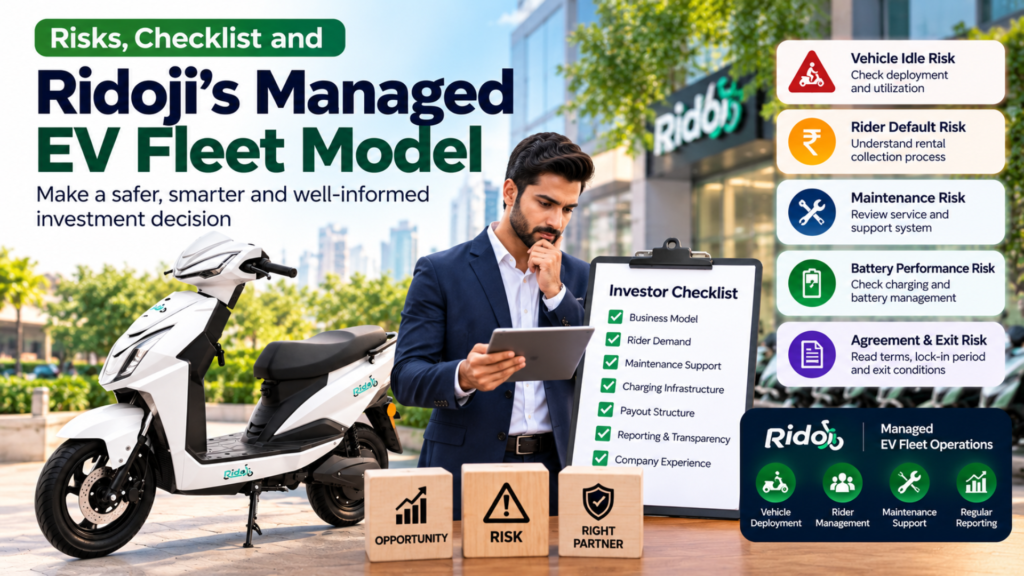
Section 3: Risks, Checklist and Ridoji’s Managed EV Fleet Model
Every EV Rental Business Investment carries business and operational risks, so investors should review all terms before making a decision.
Common Risks in EV Rental Business Investment
Here are the key risks investors should understand:
1. Vehicle Idle Risk
If the scooter is not deployed, rental revenue may be affected.
2. Rider Default Risk
If riders delay or miss rental payments, business cash flow may be affected.
3. Maintenance Risk
Daily usage can lead to wear and tear. Poor maintenance can reduce vehicle life.
4. Battery Performance Risk
Battery health affects range, rider usage, and vehicle availability.
5. Accident or Damage Risk
Vehicles used commercially may face damage, misuse, or accident-related issues.
6. Policy or Compliance Risk
EV rules, subsidies, permits, and local compliance requirements may change.
7. Company Management Risk
The company’s ability to manage operations directly affects the investment model.
8. Liquidity and Exit Risk
Investors should understand whether early exit is allowed and what conditions apply.
This is why investors should avoid thinking of EV rental business as a “risk-free” model. It is a business-linked, operations-driven opportunity.
Red Flags Investors Should Avoid
Avoid EV rental businesses that:
- Promise guaranteed returns without risk explanation
- Do not provide written agreements
- Avoid explaining how revenue is generated
- Have no clear deployment location
- Cannot explain maintenance responsibility
- Do not provide reporting
- Have unclear exit terms
- Do not disclose operational risks
- Push urgency without proper documentation
- Focus only on returns and not operations
A good company will explain both the opportunity and the risks.
Final Investor Checklist
Before choosing an EV rental business, check this list:
- Is the business model clear?
- Is there real rider or business demand?
- Where will the scooters be deployed?
- Who manages riders?
- Who handles maintenance?
- How is charging planned?
- What is the payout structure?
- Are all terms written clearly?
- What is the lock-in period?
- What are exit conditions?
- How are reports shared?
- What happens if the vehicle is idle?
- What happens if the vehicle is damaged?
- Is there local operational support?
- Does the company have fleet management experience?
A responsible EV Rental Business Investment should include transparent reporting, written agreements, maintenance clarity, and realistic risk disclosure.
EV Rental Business vs Traditional Investment Options
| Factor | EV Rental Business | FD | Real Estate | Mutual Fund |
| Asset Link | Electric scooter fleet | Bank deposit | Property | Market-linked units |
| Income Type | Payout as per agreement | Interest | Rent | Market returns |
| Risk Type | Operational/business risk | Low to moderate | Vacancy/liquidity risk | Market risk |
| Management Need | High, if self-managed | Low | Medium to high | Low to medium |
| Liquidity | Depends on agreement | Medium | Low | Medium to high |
| Best For | Investors exploring asset-backed EV models | Conservative investors | Property-focused investors | Long-term market investors |
This comparison does not mean one option is better for everyone. Each investor should choose based on age, risk comfort, goals, liquidity needs, and investment horizon.
Why Managed EV Fleet Models Can Be Easier for Investors
Some investors may not want to manage riders, vehicles, repairs, charging, or rental collection themselves.
A managed EV fleet model can reduce that burden because the company handles operations.
In this model, the investor focuses on asset participation, while the company focuses on:
- Vehicle deployment
- Rider management
- Maintenance
- Charging support
- Fleet monitoring
- Reports
- Payout processing
- Business operations
This structure can be useful for investors who want exposure to the EV rental ecosystem but do not want to run the day-to-day rental business personally.
How Ridoji Supports Managed EV Fleet Operations
Ridoji works as a managed EV fleet ecosystem. The company focuses on electric scooter deployment, rider coordination, maintenance support, fleet monitoring, and daily fleet operations.
For investors exploring an EV rental business model, Ridoji’s managed approach helps reduce operational involvement.
Instead of asking investors to manage scooters, riders, servicing, and deployment, Ridoji manages the fleet ecosystem.
This makes the model more structured for people who want to participate in the EV fleet space but prefer professional operations.
Ridoji supports:
- Electric scooter deployment
- Rider onboarding and coordination
- Maintenance support
- Fleet monitoring
- Reporting
- Commercial EV fleet operations
- Long-term EV fleet management
Final Thoughts
Choosing an EV rental business to invest in is not only about looking at the payout number.
It is about understanding the business behind the payout.
A strong EV Rental Business Investment depends on vehicle utilization, rider demand, maintenance quality, charging discipline, agreement clarity, risk management, and operational transparency.
Investors should carefully study the company, ask the right questions, review documents, and understand risks before making any decision.
The EV rental business can be a promising area because electric mobility, delivery operations, and last-mile logistics are growing in India. But like every business-linked opportunity, it needs professional management.
Ridoji’s managed EV fleet model gives investors a way to explore electric scooter fleet participation with operational support from a dedicated fleet management ecosystem.
Call to Action
Looking to explore a managed EV fleet opportunity?
Explore Ridoji’s Managed EV Fleet Program and understand how electric scooters are deployed, rented, maintained, monitored, and managed for commercial use.
Website: www.ridoji.com
Contact: 9991119652