

Introduction
As electric vehicles are becoming more popular in India, they are being used more in a commercial setting, as a means of delivery, employee transport, and shared transport.
This opportunity allows entrepreneurs to get involved in the EV market in ways aside from just selling vehicles. For an electric scooter rental business, this commercial shift makes local rider demand an important starting point. For a last-mile delivery business, dependable access to suitable vehicles can be essential to daily operations.
EV rental investment allows investors to purchase or lease EVs and rent them to delivery staff, businesses, commuter staff, and fleet operators. Earnings can be generated by daily, weekly, monthly, and long-term business rentals.
In 2027, due to increasing EV two-wheeler adoption and businesses looking to reduce transportation costs, this opportunity may be very prominent. However, to make this business profitable, other factors must be considered.
These include vehicle utilisation, rental pricing, maintenance, battery performance, and customer demand. EV fleet investment is another route for participants who prefer a structured vehicle-deployment arrangement. Effective EV fleet management involves deployment, tracking, maintenance coordination, and rental collections.
Facts and figures to support EV Rental Investment in India
Growth of the EV market in India
In 2025, approximately 23 lakh EVs were registered in India. This accounts for around 8% of new vehicle registrations. Out of these, approximately 12.8 lakh EV 2 wheelers were registered (57% of total EVs), and approximately 8 lakh EV 3 wheelers were registered (35% of total EVs).
[Note: Source: Akashvani News]
More recently, in 2026, between January and October, approximately 28.95 lakh new electric vehicles were registered in India. This indicates a 51.2% increase compared to the same period in 2025. During this period, EVs accounted for around 11.2% of total vehicle registrations.
[Note: Source: Vehicle Stats India] These registration figures provide context for the electric vehicle rental market but do not directly measure rental demand.
Within this growth, EV two-wheelers have been a large contributor. Between January and October 2026, approximately 17.98 lakh EV 2-wheelers were registered in India. This is a year-on-year increase of 61.6%. During this period, EV 2-wheelers accounted for around 62.1% of EV registrations.
[Note: Source: Vehicle Stats India] These figures suggest a growing vehicle base, but electric two-wheeler rental demand still requires local validation.
Key facts within the EV market in India:
India EV market: Key figures
| Key Indicator | Figure | Period |
|---|---|---|
| Total EV Registrations | 23 lakh | 2025 |
| Total EV Registrations | 28.95 lakh | Jan–Oct 2026 |
| Electric Two-Wheeler Share of EV Sales | 57% | 2025 |
| Growth in Electric Two-Wheeler Registrations | 61.6% | Jan–Oct 2026 |
(Sources: Vahan registration data reported by Akashvani News and 2026 registration data compiled from the Vahan dashboard. Figures refer to registrations, not rental-fleet additions.)
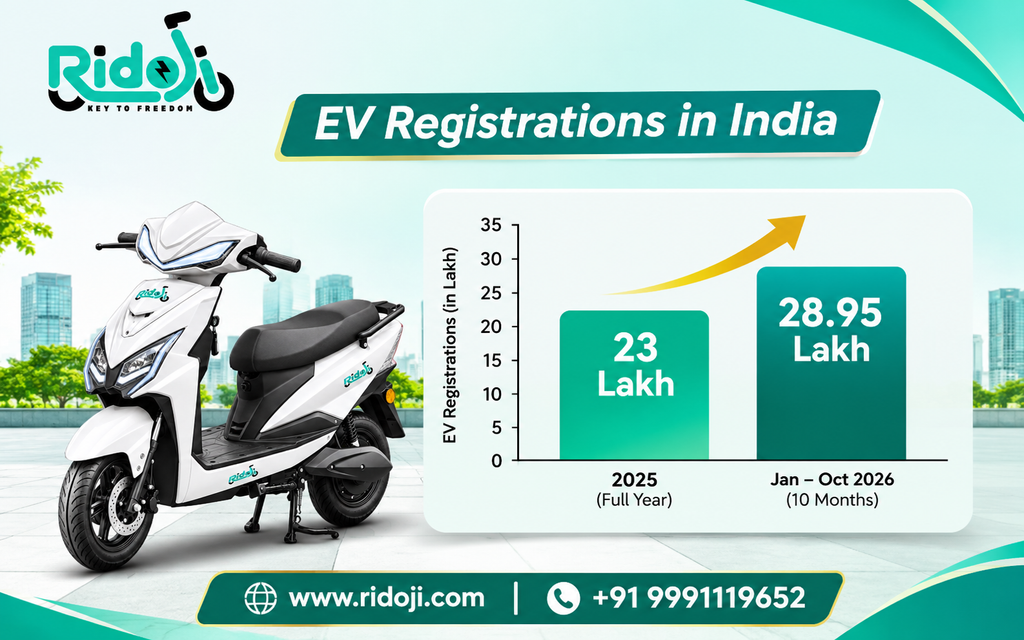
This shows that EV 2 wheelers are growing significantly within the vehicle market in India. Therefore, scooter rental could be attractive to businesses within this opportunity.
Whilst there is no guarantee of increased demand in EV rental as compared to EV registrations, there is a good market base to look into. In the electric vehicle rental market, local usage patterns matter more than registrations alone when setting prices.
Why Consider EV Rental Investment in 2027
Opportunities may be available for well-planned entrepreneurs to enter this market. EV rental business opportunities are best evaluated using documented local demand rather than market optimism alone.
Electric mobility and commercial vehicle rentals. A successful EV Rental Investment strategy requires an understanding of local rental demand, vehicle operating costs, fleet utilization, and long-term business planning.
Before beginning an EV rental investment, entrepreneurs should evaluate whether the selected business model matches their financial and operational capabilities.
1: Growing demand from delivery/logistics businesses
Delivery businesses (food, grocery, courier, quick commerce) all require regular transportation. In order for delivery partners to carry out deliveries, vehicles must be reliable and cost-effective. However, not all riders will wish to buy a scooter or take out a loan. The electric vehicle rental market can serve riders who need transport without taking on the cost of purchasing a scooter. A last-mile delivery business may use rental scooters to support riders without purchasing an entire fleet.
To meet this demand, an EV rental business in India can offer daily/weekly/monthly EV scooter rentals. By renting vehicles, delivery riders can enjoy using a vehicle at a reduced cost, and the EV rental business can earn regular income. One can reach out to restaurants, cloud kitchens, logistics businesses, grocery businesses, and local delivery businesses as well.
An electric scooter rental business should compare daily rider requirements with the cost of keeping vehicles available. EV rental business opportunities may arise near delivery hubs where riders need dependable short-term transport.
Businesses partnering with EV Rental Businesses (B2B) may result in more predictable demand; however, it is important to consider the terms of the contract and reliability of payments.
2: Increasing 2 Wheeler EV adoption
Within 2025 and Jan-Oct 2026, EV 2-wheelers made up the largest proportion of EV registrations in India. This indicates that they could be a great opportunity for commercial EV rental. Electric two-wheeler rental services may suit riders who make frequent short-distance trips.
Electric scooters can be useful for short-distance journeys, urban commuting, and final-mile delivery. Generally, they can be deployed in urban fleets more easily than larger commercial vehicles. Vehicle range, charging time, and load capacity should match the needs of the last-mile delivery business.
However, choices must be made based on range, load, charge time, service availability, and intended use. Therefore, starting with a focused fleet of electric scooter rentals can be a good way for an investor to get to know demand in the area and scale to other vehicle types later. Smaller fleets can help test EV rental business opportunities before larger capital commitments.
Before expanding an electric two-wheeler rental fleet, operators should compare vehicle range with actual rider routes.
3: Regular income
With EV rentals, regular income can be earned from customers. The duration of rental may vary depending on customer need. Customers may rent vehicles for daily, weekly, or monthly periods.
EV rental income depends on whether vehicles are actively rented and whether customers pay on time.
For example, delivery riders may be offered monthly rentals, or vehicles may be offered to businesses for a fixed period of time. If fixed-length contracts can be established with customers, regular income can be planned. Predictable EV rental income is easier to plan when rental periods, charges, and payment terms are clearly documented.
However, it is important to ensure that vehicles are being used and payments are made by customers. It is important to note that rental income does not necessarily indicate profitability.
Investors must consider depreciation of vehicles, maintenance, insurance, battery costs, charging, staffing, financing, and idle time. EV rental income should be distinguished from net profit after operating and ownership costs.
4: Reduced running costs for commercial purposes
Electric vehicles reduce running costs as they do not use petrol/diesel. In many situations, electric vehicles will have cheaper running costs per km than petrol vehicles. In addition, electric vehicles have fewer moving parts within them than petrol vehicles, meaning that certain maintenance costs may be reduced.
For EV Rental Businesses, this can mean reduced running costs. However, savings depend on the cost of electricity, charging efficiency, quality of vehicles, battery conditions, distance travelled daily, and maintenance requirements.
A realistic plan must be developed to compare total running costs for electric vehicles, compared to traditional vehicles, for the same usage.
Types of EV Rental Business Models in 2027
There are many options for entering the EV rental market. An investor should consider the capital available, experience in operations, and level of involvement in the business. The electric vehicle rental market includes independently operated fleets, franchise models, and business-to-business arrangements.
An EV rental franchise is one of several ways to enter the sector, depending on the support and obligations in the agreement.
Choosing the right business model is an important part of EV Rental Investment planning. Different EV Rental Investment models offer varying levels of ownership, operational responsibility, and rental income potential.
Entrepreneurs evaluating EV Rental Investment opportunities should compare self-managed fleets, franchise arrangements, company-managed programs, and B2B rental models before making a decision.
EV fleet investment differs from a self-operated rental business because the contract determines who performs daily fleet duties. EV fleet management arrangements may be more suitable for participants who do not wish to oversee each vehicle themselves.
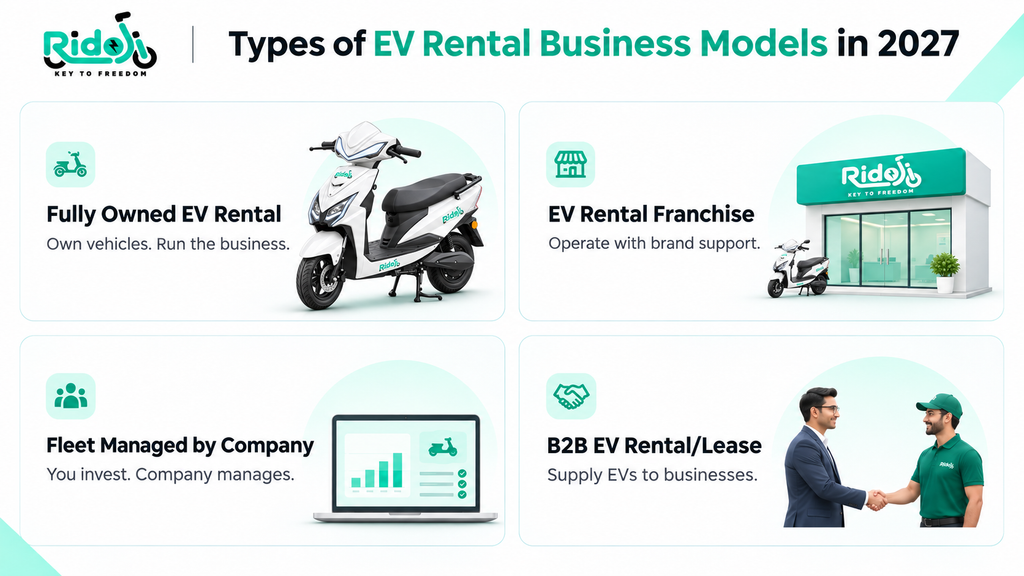
1: Fully owned EV rental
In this business model, the entrepreneur will own the electric scooters (or other EVs) and fully run the rental service. This includes buying vehicles, acquiring customers, putting rental agreements in place, maintaining vehicles, charging vehicles, collecting payments, and monitoring the fleet. This business gives the entrepreneur more control over pricing and daily operations.
However, it requires time, capital, and the ability to overcome operational challenges. In an electric scooter rental business, this direct control also means taking responsibility for customer service and collections. Electric two-wheeler rental operators must also consider servicing access and vehicle availability.
2: EV rental franchise
By entering an EV rental franchise, an entrepreneur may be able to operate under an existing brand and system. Depending on the franchise, support may include branding, training, vehicle provision, guidance, technology, and marketing.
Important considerations for an entrepreneur to make before investing in a franchise include: franchise costs, vehicle ownership, area of operation, revenue sharing, support provision, and exit conditions.
Benefits of the franchise will vary between different franchise agreements.
3: EV Fleet managed by company
An investor may provide capital/vehicles, and a company will manage certain operations.
These can include adding riders, deploying vehicles, coordinating maintenance, collecting payments, and managing the fleet. With EV fleet investment, vehicle ownership and maintenance responsibilities should be confirmed before funds are committed.
The responsibilities covered by EV fleet management must be clearly described in the operating agreement.
This option may be suitable for investors wishing to be less directly involved in daily operations.
However, this does not mean that it is effortless or risk-free. Investors should consider who owns vehicles, who pays for repairs and accidents, how revenue is calculated, when payments are made, and what happens if vehicles become idle.
4: B2B EV Rental/Lease
If a business requires multiple vehicles, it may be more beneficial to lease/rent rather than buy a whole fleet. EV Rental Businesses can provide vehicles to delivery businesses, restaurants, grocery businesses, and other businesses.
B2B may allow longer rental times and larger fleet sizes.
However, if a key client reduces their fleet or ends the contract with you, it may pose a risk to your business by reducing customer diversification. Agreements and credit checks are important in B2B. Long-term commercial contracts may create EV rental business opportunities, although relying on a single client adds risk. A last-mile delivery business considering a B2B rental contract should assess fleet availability and service commitments.
How much investment is required to start an EV rental business in India?
The amount of investment required for an EV rental business in India will depend on the size of the fleet, price of vehicles, location, charging requirements, and business model. There is no set amount of investment required. The budget for an electric scooter rental business should include more than the initial purchase price.
The total cost of EV Rental Investment can vary significantly depending on the number of electric scooters and the selected operating model. When calculating an EV Rental Investment budget, entrepreneurs should consider vehicle acquisition, charging infrastructure, insurance, maintenance, technology, and working capital.
Careful EV Rental Investment planning helps identify the financial requirements before launching a commercial rental fleet.
The scope of an EV fleet investment should be assessed against deployment requirements as well as upfront capital. EV fleet management tools can support maintenance scheduling and help identify vehicles that are not in use. For an EV rental franchise, the investor should check whether setup and recurring fees are included in the quoted cost.
Main investment costs
- Vehicle Purchase – Purchasing the correct number of scooters/ commercial EVs will be the highest initial cost for many.
- Registration/Insurance – The vehicles will need to be registered correctly and insured for their intended use.
- Charging – Depending on the fleet size, charging stations may be required. In addition, electrical systems may need to be upgraded. Parking spaces may be required, or external charging services may be required.
- Location/Parking – A secure place to store vehicles, deliver vehicles, check vehicles, and carry out basic maintenance.
- Maintenance – Tyres, brakes, servicing, accidental damage, and battery costs.
- Technology/Fleet Management – Technology to help manage the business, including vehicle tracking, rental management, payment processes, and vehicle maintenance.
- Marketing/Customer Acquisition – Local marketing, business partnerships, customer onboarding, and support.
- Working Capital – Money should be reserved for running costs, repairs, and times of low vehicle usage.
How Can Money Be Generated From an EV Rental Business in India?
- Daily rents– Useful for short-term users.
- Weekly rents– May be useful for temporary workers, seasonal demand, or short-term business requirements.
- Monthly rentals– Useful for delivery drivers or regular commuters.
- B2B rentals– Businesses may require several vehicles to be rented for a set period of time.
- Fleet-based Vehicles- May be deployed for commercial partners under set rental/service contracts.
A key consideration in this business is vehicle utilisation.
The more vehicles are rented, the more money can be earned. If vehicles are sitting idle for long periods of time, costs will still be incurred.
For example, with 20 vehicles and an assumed rental price of ₹4,500 per month (per vehicle), a monthly gross income of ₹90,000 could be reached if all rentals were made.
At 85% equivalent utilisation, a gross income of ₹76,500 could be achieved. This hypothetical EV rental income calculation assumes that active vehicles generate the stated monthly rental amount. An electric two-wheeler rental calculation is sensitive to both monthly pricing and the number of active vehicles.
This does not take into consideration costs, tax, financing costs, depreciation, or unexpected repair costs. This example should be seen as an example of how this calculation can be made, and not as an accurate forecast.
Fleet utilization is one of the most important factors influencing EV Rental Investment performance. Higher utilization can increase rental collections, while idle vehicles may affect the financial viability of an EV Rental Investment.
For this reason, every EV Rental Investment plan should include realistic utilization assumptions, expected rental collections, and ongoing operational expenses rather than relying only on the number of vehicles purchased. For EV fleet investment, a utilization scenario should be tested alongside realistic assumptions about expenses and downtime.
EV rental income may fall when utilization decreases, even if fleet size remains unchanged.
Risks to consider
Despite the potential opportunities in this business, there are still risks to be considered. Before purchasing vehicles, entrepreneurs should be aware of the following:
An electric scooter rental business should also plan for seasonal changes in rental demand. Competition in the electric vehicle rental market can affect both rental prices and customer retention.
- Low vehicle utilisation – If there is little demand, or difficulty attracting customers, vehicles may sit idle, meaning less money is collected.
- Battery performance – Battery performance will affect range, reliability and running costs. Investors should know what warranty is included, and what the cost of replacing batteries may be.
- Maintenance – Accidents, repairs and servicing can result in vehicles becoming out of action. A maintenance plan and reliable servicing providers are very important.
- Late payments, bad debt, poor usage and vehicle theft – This can affect cash flow. Good rental agreements, checks, and correct insurance are key.
- Competition – As more EV Rental Businesses enter a certain area, rental prices may decrease. To be competitive, businesses should be reliable, with good service and customer experiences.
- Regulations – Registration, insurance, permits, and other requirements will depend on the type of vehicle and business model. It is important to make sure that investors understand what central and state regulations apply before starting.
Preparing for EV rental investment in 2027
The following steps can help prevent unnecessary mistakes. Researching EV rental business opportunities should include conversations with potential customers about pricing and availability.
- Demand Research – Consider areas with delivery hubs, restaurants, warehouses, commercial markets, and regular commuter footfall. Talk to potential riders and businesses to understand what size of fleet may be needed.
- Decide on a business model – Decide if you will fully manage the fleet, enter a franchise, work with a fleet management company, or focus on B2B rental.
- Work out the total amount of investment required – This should include vehicle costs, setup costs, working capital, insurance, maintenance, and financing.
- Select suitable EVs – Consider real range, charging time, battery warranty, carrying capacity, comfort, availability of servicing, and total cost of ownership.
- Charging and Maintenance Plans – Decide where vehicles will be charged, and how breakdowns, checks, and repairs will be managed.
- Clear rental agreements – Decide on rental price, deposits, payment timing, conditions of use, responsibility for damage, late payment charges, and return instructions.
- Start with a manageable fleet – Understand demand and utilisation before scaling. Regularly review income and expenditure to understand how well individual vehicles are performing.
Future opportunities for EV rental investment in 2027 and onwards
Depending on how quickly EVs become common within commercial transport, there may be opportunities in the EV rental business in India in 2027 and onwards. The long-term outlook for an electric scooter rental business depends on local customers, cost control, and reliable servicing. Growth in the electric vehicle rental market should be assessed separately for each city and customer segment. Partnerships with local companies may reveal EV rental business opportunities that are not obvious from national statistics.
EV fleet management becomes particularly useful when an operator serves riders across several locations. Electric two-wheeler rental may be relevant to delivery use cases where the vehicles meet operational needs. A last-mile delivery business can benefit from rental arrangements when frequent short-distance trips are required. Agreements with a last-mile delivery business should address payment timing, maintenance, and vehicle replacement.
- Final Mile Delivery – With the popularity of online shopping, delivered food, delivered groceries, and quick commerce, vehicles are needed to make frequent short-distance deliveries. EV scooters are ideal for this application, so delivery fleets may be an important target market for EV Rental Businesses.
- Flexibility in mobility – Not all customers will want to purchase an EV. Students, employees, temporary workers, and delivery riders may prefer EV rental to reduce initial spending.
- Partnerships with businesses – EV Rental Businesses can partner with logistics businesses, restaurants, local businesses, and delivery businesses. This may lead to opportunities to deploy multiple vehicles under set contracts.
- Efficient fleet management – Using technology such as GPS, digital rental agreements, online payments, and fleet management, managing vehicles in multiple locations can be made easier. In addition, having better data means underutilised vehicles can be identified, and maintenance requirements can be understood. This means more efficient fleet management.
- Expand range of vehicles – Although EV two-wheelers may be a good start, as demand grows in local areas, electric three-wheelers or other commercial vehicles may be considered. Decisions should be made based on customer needs and cost-effectiveness. Whilst these opportunities may be present, demand in your target city should be validated. Investors should not scale too quickly beyond their operational capabilities.
How Can Ridoji Help In EV Rental Investment?
If an entrepreneur wishes to invest in EV rental, they may like to partner with an established electric mobility/fleet management business.
As an electric mobility and fleet management business, Ridoji may be suitable for entrepreneurs interested in EV rental and fleet-based businesses. Ridoji provides deployment of electric scooters, coordination of riders, maintenance support, and commercial fleet operations. Anyone evaluating an EV fleet investment with an operator should review the applicable agreement and reporting arrangements. Ridoji’s stated services include EV fleet management alongside vehicle deployment and rider coordination.
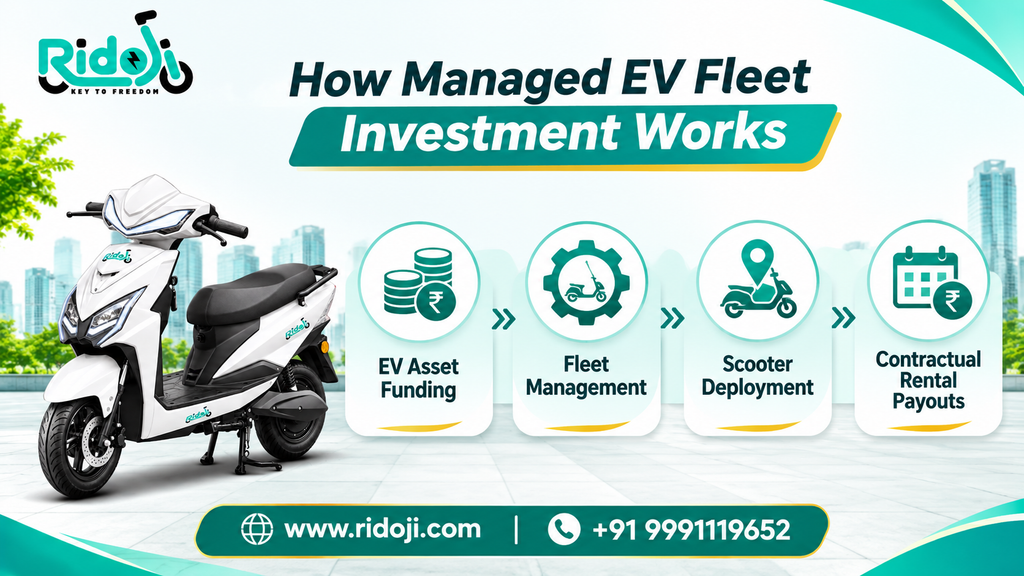
If considering a franchise with Ridoji, or any company-managed fleet, potential investors should ask for the most up-to-date official business information. Be sure to carefully consider the investment structure. Key points to consider include: Any EV rental franchise proposal should state the scope of fleet support, payment terms, and exit provisions.
- Initial investment and vehicle ownership.
- Size of fleet and how vehicles will be deployed.
- Responsibilities of the investor and company.
- Maintenance, insurance, and battery costs.
- Revenue sharing and payment timing.
- Length of contract, exit conditions, and financial risk.
Choosing a suitable partnership will mean clear responsibilities and transparent financial arrangements. Do not rely on verbal promises of returns, and be sure to carefully review the agreement before investing money.
For entrepreneurs considering EV Rental Investment in 2027, selecting a suitable fleet management approach can be as important as selecting the electric vehicles themselves. EV Rental Investment opportunities should be evaluated on the basis of rental demand, operational management, maintenance responsibilities, and financial agreements. By understanding these factors, individuals can make more informed EV Rental Investment decisions while exploring India’s growing electric mobility ecosystem.
Conclusion
As EV registrations in India are increasing rapidly, particularly EV 2-wheelers, there is a growing market for electric mobility services. In 2025, 23 lakh EVs were registered, and between Jan-Oct 2026, nearly 29 lakh EVs were registered. This indicates significant growth in the industry. Entrepreneurs may wish to consider investing in EV Rental Businesses, providing EV scooter rentals, commercial vehicle deployment, delivery partnerships, and B2B vehicle leases. This opportunity may be appealing as regular income can be gained, and affordable, flexible transport can be provided to customers.
Actual EV rental income can vary between cities and operating models, so projections should be treated cautiously.
However, simply having a growing market does not guarantee business success. To ensure an EV rental business is financially viable, consideration must be given to vehicle utilisation, vehicle choice, rental pricing, maintenance, customer acquisition, and working capital.
In 2027, researching local demand, deciding on a suitable business model, starting with a manageable fleet size, and basing operations on realistic financial calculations could make EV rental a promising opportunity within the growing electric mobility market in India.
Frequently Asked Questions (FAQs)
1. Is EV Rental Investment a profitable business opportunity in India in 2027?
EV Rental Investment can be a profitable business opportunity in India if vehicle utilization, rental demand, and operating costs are managed effectively. Profitability depends on fleet size, monthly rental collections, maintenance expenses, battery performance, and customer demand. Investors should carefully evaluate financial risks before starting an EV rental business in India.
2. How much capital is required to start an EV Rental Investment business in India?
The capital required for EV Rental Investment depends on the number of electric scooters, vehicle prices, charging infrastructure, insurance, maintenance, and operational requirements. A small fleet may require less initial capital than a large commercial operation. Investors should also maintain working capital for unexpected expenses and periods of low vehicle utilization.
3. How does EV Rental Investment generate monthly rental income?
EV Rental Investment generates rental revenue by deploying electric scooters to delivery riders, businesses, and commercial fleet operators. Vehicles can be rented on daily, weekly, monthly, or contractual terms. Actual rental income depends on vehicle utilization, rental pricing, payment collections, and operating expenses. Monthly revenue does not necessarily represent net profit.
4. What are the major risks associated with EV Rental Investment?
The major risks of EV Rental Investment include low vehicle utilization, battery degradation, maintenance expenses, unexpected repairs, delayed rental payments, and changing market demand. Investors should also consider insurance coverage, vehicle depreciation, contractual obligations, and regulatory requirements before participating in an EV rental business in India.
5. How does Ridoji support EV Rental Investment in India?
Ridoji supports EV Rental Investment through its managed EV fleet program, which includes electric scooter deployment, rider coordination, maintenance support, and fleet operations. This model allows participants to engage in commercial electric mobility without directly managing daily fleet activities. Interested individuals should review Ridoji’s official program details, vehicle ownership terms, contractual rental payouts, and associated risks before participating.