EV Franchise at a Glance
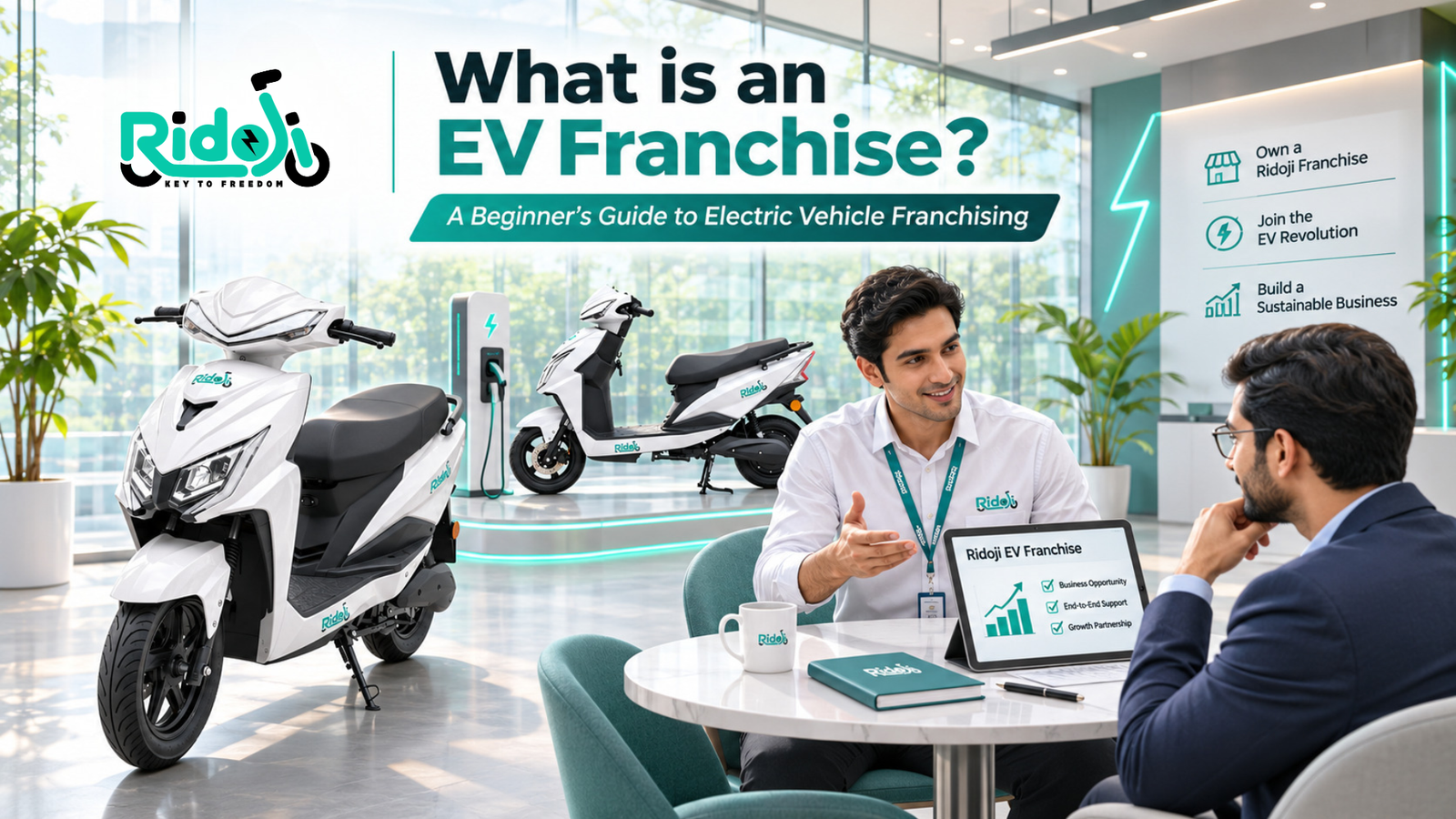
An EV franchise is a business arrangement that allows an entrepreneur to operate under an established electric mobility brand. Depending on the agreement, it may involve vehicle sales, rentals, fleet operations, servicing, or charging. This guide explains the models, setup costs, responsibilities, and checks to make before choosing a franchise in India.
As electric vehicles are gaining popularity in the transportation industry, the automobile sector is undergoing a massive change. Increasing prices of fuel, concerns about the environment, and changing tastes and preferences of customers, coupled with government policies, are driving people and businesses toward electric mobility. In India, the movement toward electric vehicle travel is creating new opportunities for entrepreneurs keen on contributing to the growing manufacturing sector. Entrepreneurs researching an EV Franchise can explore how this wider shift is creating business opportunities.
The EV franchise model is proving to be a great business opportunity that is catching almost everyone’s attention. It gives entrepreneurs a good chance to enter the electric vehicle industry by having a tested business model rather than developing a car brand or manufacturing setup from scratch. This is one reason the EV Franchise model is attracting attention from people exploring the electric mobility sector.
So, what is an EV franchise? What does it do? Is it a good option for the enterprising beginner? Can companies like Ridoji contribute to this sector?
This blog will help you to learn about EV Franchise, existing business models, investment queries, industry trends, market analysis and the daily problems that workers may face in the market. It also explains important considerations for anyone comparing EV Franchise opportunities.
Key Takeaways:
- An EV franchise can be defined as an arrangement through which a company can sell electric vehicles or provide other mobility services with the help of a tried business model.
- In India, the electric vehicle market has managed to reach annual sales of more than 23 lakh, as reported by Vahan.
- An electric vehicle franchise can operate on the basis of vehicle dealership, commercial fleet model, and servicing and charging businesses related to electric vehicles.
- The investment for starting any EV franchise will vary from company to company as it depends on the brand, type, location, and infrastructure requirements.
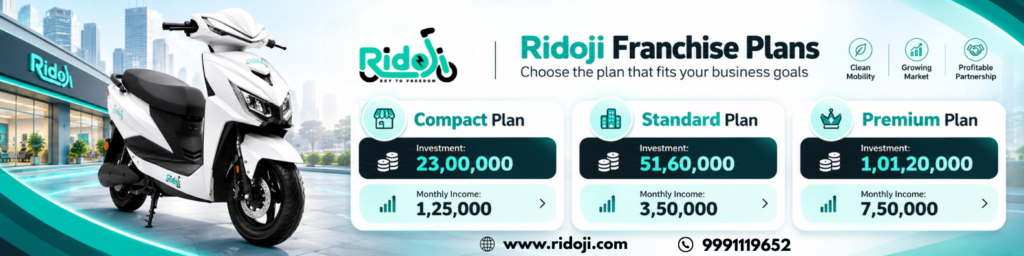
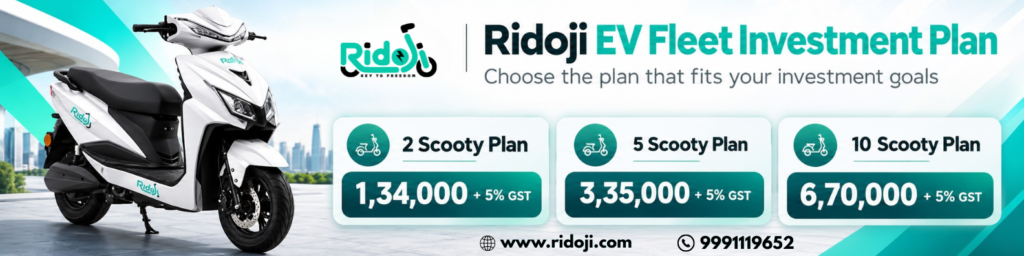
- Ridoji’s franchise investment plans come with three options and are framed on the basis of different space and investment needs.
What Is an EV Franchise?
An electric vehicle franchise is a type of arrangement where a person or company ties up with an electric vehicle firm to run the business using its products, brand, and other set parameters. Rather than setting up an independent firm, the franchisee works within the parameters created by the franchisor. These details are very necessary when reading an EV Franchise agreement.
An electric vehicle franchise can cover a variety of activities such as:
- Selling electric scooters and motorcycles
- Distributing electric automobiles
- Providing electric vehicles for transportation services
- Operating a fleet of electric vehicles
The terms electric vehicle franchise and electric vehicle dealership are sometimes used interchangeably. However, the two arrangements are different even though both technically relate to vehicle sales. Understanding this distinction can help entrepreneurs choose the right EV Franchise structure.
EV Franchise vs Dealership and Other Business Models
An electric vehicle franchise describes a commercial relationship with a brand. A dealership describes a distribution or retail arrangement. The two can overlap: a dealership may also operate under a franchise agreement. Fleet, service, and charging businesses may use different contracts. Compare the actual responsibilities and revenue arrangements rather than relying on the name alone.
| Business format | Typical customers | Potential revenue source | Main items to assess |
|---|---|---|---|
| Vehicle dealership | Individual buyers and business purchasers | Vehicle sales margins and agreed related services | Inventory, stock funding, sales targets, warranty support, and local demand |
| Rental or fleet hub | Riders, fleet users, and businesses | Vehicle rentals or contracted fleet services | Utilisation, vehicle availability, maintenance, collections, and allocation of operating responsibilities |
| Service and spare parts centre | EV owners and fleet operators | Repair labour, service charges, and parts sales | Technician capability, diagnostic access, spare parts, and warranty authorisation |
| Charging business | Compatible EV users and fleets | Charging services or contracted charging access | Electricity capacity, charger compatibility, utilisation, site permissions, and equipment maintenance |
These are general examples. Income, expenses, and operational duties depend on the specific contract and do not apply uniformly to all EV franchise opportunities.
Where Did the EV Franchise Opportunity Come From?
In the electric mobility sector, one can see a rapid growth in the rise of EV franchising. Initially, electric vehicles were mainly associated with a focus on environmental and technological advancements. After that, the enhancement of batteries, car operation, and manufacturing processes made EVs more applicable to commute tasks performed on a daily basis.
The rising demand in online shopping, food delivery services, and quick commerce has simultaneously brought a rise in the need for cost-effective last-mile commuting. Hence, there are multiple business opportunities for products that link electric transportation and business mobility needs. This wider demand is relevant to entrepreneurs considering an EV Franchise.
Moreover, an EV Franchise is not limited to just a showroom; it may include car distribution, fleet operations, maintenance, or any other electric mobility service depending on the business model.
How Does an EV Franchise Work?
How an EV franchise generally works involves the interaction of a corporation with an independent business owner.
A corporation provides an overall business solution while the franchisee handles daily activities.
Mainly, there are five steps in this process:
1. Choosing an Electric Vehicle Company
First of all, sort out all the electric vehicle companies, do a research about their products and reputation in the market and as well as about their franchise, investment opportunities and return on investment by them.
2. Sending Franchise Enquiry
The person who is interested in acquiring the franchise shall now make contact with the respective company and ask for all the necessary details about the product, location, and prices.
3. Know About the Relationship and Investment Model
The company will then have to brief about them, their products, their investment plans as well as the requirements for infrastructure, revenue distribution and contract conditions.
4. Building the Business
After getting approval from the business, the franchisee will then prepare everything for the business, like arranging a place to rent, required infrastructure, and staff.
5. Launching the Business
After all of this, the setup is complete, and the franchise starts operating.
Whatever the steps taken during the process, one should know that the exact procedure may differ from company to company. The requirements for an EV Franchise should therefore be confirmed directly with the chosen company.
Understanding India’s EV Market: Why Is It Growing?
Conducting market research is critical to assess any business opportunity. It cannot be assumed that just because there is new growth in an industry, it is profitable. However, information about the direction of the growth helps businesses target the right customers.
As strong manufacturing influence and positive business policies support the development of electric transportation in India, the market keeps showing promising growth potential.
1. The Levels Of EV Sales Surpassed 2.3 Million Units
According to the Vahan Portal, India’s EV market managed to sell 2.3 million units in 2025, which makes up 8% of all newly sold vehicles.
It shows that the mobility industry is not at the peak of its growth but keeps expanding due to different factors.
The increase in the sales of vehicles creates different possibilities for franchising businesses that can develop in the spheres of distribution, customer attraction, maintenance, and commercial transport.
2. Electric Two-Wheelers Take Over The Sector
In 2025, around 1.28 million electric two-wheelers were sold, accounting for around 57% of the total sales.
- They are perfect for daily commuting in cities.
- They cost less than gasoline-powered scooters.
- There was a rise in demand due to the delivery segment.
- Electric scooters are easily accessible in the market.
- People are interested in affordable means of transport.
The two-wheelers segment is more attractive to business owners as it gives the opportunity to have a potential client base, delivery professionals, and small businesses. These customer groups may be important for an EV Franchise focused on electric two-wheelers.
3. Electric three-wheelers are gaining most of the attention
Electric three-wheelers contribute a major part to the Indian electric mobility ecosystem. They are used for transporting passengers and goods as well as local commerce. The International Energy Agency considers India the largest electric three-wheeler market in the world. In 2025, the sale of electric three-wheelers reached 800,00 in India, which is about a 15% increase compared to the previous year. This proves the importance of commercial mobility for India’s transition to electric vehicles. Commercial demand is therefore an important factor to evaluate when considering an EV Franchise.
4. Government Policies Are Promoting Electric Mobility
Government policies have been able to bring about an increase in electric car usage among people. PM E-DRIVE project has objectives to achieve electric mobility, manufacture domestically, and create a complete ecosystem of electric vehicles. Apart from the central government’s involvement, local governments have introduced EV initiatives where various incentives and help in building infrastructure are offered. In the end, one can say that the standards of the subsidies and their eligibility vary from vehicle to vehicle, from one state to another, and within the program. Entrepreneurs should check the regulations applicable to them instead of assuming them when planning their businesses.
5. The Delivery Sector Opens New Business Opportunities
The rapidly growing e-commerce and food delivery sectors in India require efficient and cost-effective delivery logistics.
The electric two-wheeler sector provides a significant contribution to this area, as various companies aim to cut the costs of fuel and operations, which opens up business opportunities based on combining electric vehicles with the infrastructure of delivery businesses.
Quick revision: India’s EV market is being driven by three important segments: personal electric two-wheelers, commercial electric three-wheelers, and electric vehicles used for delivery and logistics.
EV Market Analysis: Understanding the Numbers
A detailed market analysis helps us to understand why electric mobility is gaining attention of entrepreneurs and investors. The following figures represent a helpful picture of India’s EV market.
EV Sales Growth in India
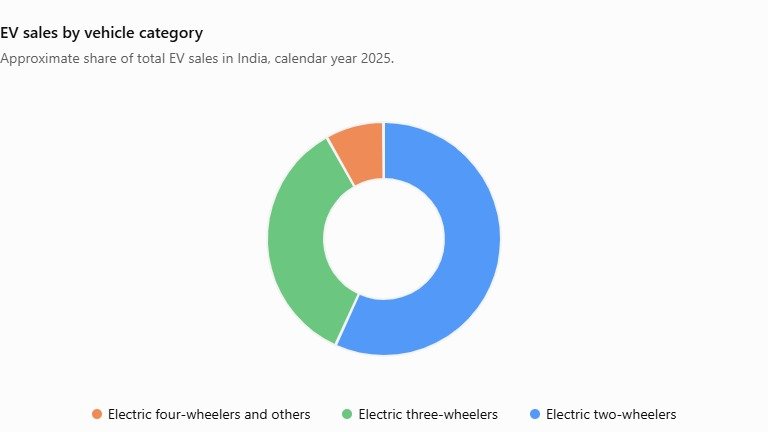
(Source: EV Reporter, Vahan Portal Dashboard Data)
Vehicle Category-Wise Market Share
Based on Vahan-based reporting for calendar year 2025, the approximate distribution of India’s EV sales was:
| Vehicle category | Approximate market share |
| Electric two-wheelers | 57% |
| Electric three-wheelers | 35% |
| Electric four-wheelers and other categories | 8% |
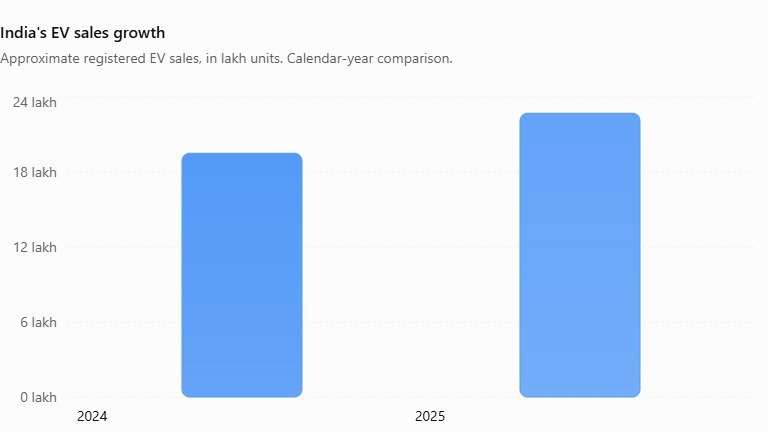
(Source: Vahan Portal-based 2025 registration reporting.)
(These are rounded figure estimates and are intended to illustrate the broad market structure.)
What Can Be Deduced from this Market Analysis?
According to the information provided, the analysis gives three key points. The first one is that two-wheeler vehicles are helpful for a big number of consumers as personal mode of transport and delivery vehicles.
Secondly, three-wheeler vehicles provide a chance for commercial mobility through passenger services and delivery services, creating demand not just for the vehicle but for more.
Lastly, remaining segments of the EV industry provide a chance for diversification, as other EVs, including cars and commercial vehicles, can be utilized in the future with advancing technology.
However, market size is not the only factor to check before starting a business in a certain location. Other factors like local competition in that area, the buying power of customers for the vehicle, the quality of the vehicle, the after-sales service of the vehicle, and the costs of business operations would have to be considered. These factors should also be reviewed before selecting an EV Franchise location.
What are different types of EV Franchise Business?
Franchising does not have a single business model; there are different options for entrepreneurs to consider based on their investments and the marketplace they operate in. The right kind of EV Franchise model depends on the market’s demand and the investment capacity.
1. Electric 2-wheeler Franchise
This model focuses on selling electric scooters to customers as well as commercial riders. It can be good for entrepreneurs targeting urban and semi-urban markets. An EV Franchise in this aspect can be helpful for local commuting and delivery requirements.
2. Electric 3-Wheeler Franchise
This model deals with electric passenger vehicles and freight carriers. The targeted customers include auto-rickshaw operators, regional transport companies, and logistics providers.
3. EV Fleet Business
A fleet business model implies providing electric vehicles for commercial mobility and transportation. The business can earn from the deployment of vehicles, depending on the business model and customers’ agreements. This is one possible commercial approach within the broader EV Franchise ecosystem.
4. EV Services and Spare Parts
Electric vehicles need service, spare parts, and support. Providers of quality service can be essential elements for the EV ecosystem.
5. EV Charging
Charging infrastructure is another developing segment. Business people can pursue various charging solutions; however, the model needs a proper site, availability of electricity, equipment, and compliance with the law.
These requirements should be considered when evaluating an EV Franchise connected with charging infrastructure.
How Much Investment Is Required for an EV Franchise?
The cost required for getting started with an EV franchise business is based on the franchise brand, format of business, location, and infrastructure conditions.
As an illustration, some franchise businesses offer a shop and inventory, while other enterprises may operate fleets or mobility-based business lines.
Below is the list of components that are included in the total investment:
Before entering the franchise world, everybody who wishes to build the EV franchise should identify the total cost structure, including recurring payments. A clear cost assessment is essential before proceeding with any EV Franchise.
| Investment component | What it refers to |
| Investment in franchise | Cooperation with brand and franchise agreement |
| Infrastructure | Space, electricity and infrastructure |
| Vehicles or fleet | Initial number of vehicles (if any) |
| Equipment | Operational and maintenance requirements |
| Employees | Sales and operational staff |
| Working capital | Ongoing business expenses |
| Marketing | Local promotion and customer acquisition |
Before entering the franchise sphere, everybody who wishes to build the EV franchise should identify the total cost structure, including recurring payments.
Planning the Full Cost of an EV Franchise Business in India
Separate the initial amount needed to open the business from the money required to keep it operating. Ask the provider to identify refundable deposits, applicable taxes, recurring charges, and expenses already covered by the company. Avoid counting an included item twice.
| Cost group | Questions for the written quotation |
|---|---|
| Initial setup | What covers the franchise fee, vehicles, fit-out, signage, tools, deposits, and electricity connection? |
| Recurring operations | Who pays rent, salaries, electricity, servicing, software, insurance, and local marketing? |
| Working capital | How much cash is needed while collections begin, and who funds delays or unexpected repairs? |
| Exit and renewal | Are there renewal fees, lock-in conditions, restoration costs, asset transfer terms, or refundable balances? |
Illustrative Budget Calculation
If an independently operated business has a setup quotation of ₹20,00,000, a refundable premises deposit of ₹2,00,000, and estimated operating expenses of ₹1,00,000 per month, reserving three months of operating expenses would bring its initial cash requirement to ₹25,00,000 before any additional taxes or excluded items.
This example explains the calculation only. It is not a Ridoji quotation, a typical market price, or a forecast of earnings. The appropriate reserve depends on the payment cycle and operating model.
What Is Ridoji and How Does Its EV Franchise Model Work?
Ridoji is an electric vehicle mobility firm that seeks to bridge electric vehicles with India’s emerging delivery economy. The goal of the firm is to connect electric vehicle fleets with delivery needs and commercial mobility.
In contrast to viewing electric vehicles as only an opportunity to purchase vehicles, Ridoji presents its business model in the form of taking part in a structured electric mobility ecosystem.
According to the franchise page of the company, there are now three types of investment offered by Ridoji. Entrepreneurs researching an EV Franchise can review these Ridoji EV franchise plans and confirm the latest terms with the company.
Clarifying Ridoji’s Role in Commercial Mobility
Ridoji manages electric scooter fleets and EV business hubs that support commercial mobility. Its connection with the delivery economy comes through the vehicles and operational support used by riders and businesses. Ridoji is not a vehicle manufacturer or a delivery company. References to commercial mobility in this article should be read in that context.
Responsibilities differ between an owner-operated dealership and a company-managed hub. For a Ridoji franchise, request the current written scope for staffing, interiors, maintenance, day-to-day operations, premises arrangements, payment terms, and exit conditions. The applicable agreement determines the obligations of each party.
For the current offering, review the Ridoji franchise programme and request the detailed scope and agreement.
What Makes the Ridoji Model Relevant?
There are three crucial elements of Ridoji’s services that entrepreneurs need to learn.
The Three Different Business Models
These three business models have different requirements for the site and the investment, which helps future business owners choose the best option for their needs.
The Significance of Commercial Electric Mobility
Ridoji specializes in electric vehicles and delivery and, as a result, relies on using commercial cars as one of its basic business principles.
The System of the Training Process
The training includes making a request, defining the goals of the training, studying the investment data, and assessing the site of the business.
The only thing an entrepreneur has to do is study the content of each plan and learn how the company earns money. It is necessary to perform this research before selecting an EV Franchise or investing money.
Reasons to Launch Your Own EV Franchise
There are numerous benefits of launching an EV franchise, such as:
Explore an Emerging Industry
Nowadays, electric mobility is becoming more recognized in transportation in India. Therefore, it is indeed a favorable chance to venture into the industry and earn handsome revenues from it.
Existing Business
While working in already existing companies, you acquire many advantages, such as no requirement to build a brand/advertisement for your business.
Big Customer Segment
EV firms can attract clients such as individual buyers, professional drivers, fleet operators, and companies involved in logistics.
Scope for growth
Depending on the business model, the business owners can expand the range of vehicles, geographical coverage, or the types of mobility services.
Benefit for the environment
Electric mobility helps reduce carbon footprint, but environmental sustainability also depends on the source of electricity and battery life cycle.
Access to Operational Guidance
Where included in the agreement, a franchise can provide operating procedures, staff guidance, and a defined process for handling enquiries or service issues. Ask for the actual training schedule, support contacts, and responsibilities before treating this as a benefit of a particular plan.
Defined Brand and Service Standards
A documented framework can help a new operator understand branding, reporting, and service expectations. Its usefulness depends on how clearly those standards are explained and how consistently support is provided. Access to a brand does not remove the need for customer acquisition or careful cost control.
Entrepreneurs can gain many benefits from starting their business as an EV franchise.
An EV franchise can offer several potential advantages to entrepreneurs.
What Challenges Should You Consider Before Investing?
EV franchising has many advantages, yet it also brings some risks with it.
- Battery Technology: As EV vehicles only run on batteries, the performance of batteries and the cost of replacement are some major issues that customers face.
- Charging Setup: The availability of charging stations can highly impact their implementation in certain areas.
- Competition: In the EV market, there are many automotive companies and new EV makers, so one has to compete with them as well.
- After-sales service: Sometimes after-sales services like availability of spare parts and repair services, warranty work, and other types of support can have a huge impact on customers’ credibility
- Financial risk: In this business, revenue, risks, and profit are not the same; hence, calculating the expenses should be done very carefully.
- Changes in legislation: Government policies may change, affecting car prices and demand among customers.
It is important to keep an eye on these issues before actually signing a franchise agreement.
How to Choose the Right EV Franchise Partner?
Choosing a franchise partner is as important as choosing the business segment. The same principle applies when comparing one EV Franchise opportunity with another.
Before investing, evaluate:
- Reputation of a brand and the background of a company.
- Quality, safety, and battery technology of vehicles.
- Reality of customer demand for your proposed location.
- Investment and recurring costs associated with being a franchise.
- Revenue and pay-out agreements in writing.
- Warranty and after-sales service.
- Training and operational support.
- Contract terms, exit conditions, and territorial rights.
A credible franchise arrangement should have clear financial terms and clearly defined responsibilities. These are also key considerations when selecting an EV Franchise partner.
Questions to Resolve Before Signing
- Who owns the vehicles, batteries, charging equipment, and other assets?
- Who recruits staff and pays operating expenses?
- What local demand evidence supports the proposed location?
- How are revenue, contractual payouts, and operating profit distinguished?
- What triggers payment, and what happens if deployment or collections are delayed?
- Who bears battery replacement, insurance deductibles, damage, and downtime costs?
- What are the agreement period, exit conditions, renewal terms, and territory arrangements? For a broader selection framework, read how to choose the right EV franchise in India. To understand operational responsibilities, explore EV fleet management.
Conclusion
The electric vehicle industry is playing an important role in changing India’s transport sector. The gap between the electric vehicle sector and other sectors is widening as more and more electric vehicle technologies are being implemented, new delivery channels are being established, battery technologies are being developed, and government policies are being introduced.
Starting an electric vehicle franchise requires no undertaking of building an individual car brand.
At the same time, it is essential to choose a good franchised company, familiarize oneself with investment processes, evaluate the market, and understand the actual revenue model.
There is a franchise opportunity for those willing to do business with electric vehicles offered by Ridoji.
The future of transportation is developing rapidly. For entrepreneurs following this transition, the EV Franchise sector is one area worth researching carefully.
Frequently Asked Questions (FAQs)
1. What do you mean by an EV Franchise?
An EV franchise is a kind of business in which people can involve themselves into sales of electric vehicles, distribution, fleet services or similar services through an established company.
2. Is an EV franchise a profitable business opportunity?
It is a good business opportunity due to the increasing demand for electric vehicles and growing demand for commercial mobility. But the profitability factor depends on many things, like how much funding is available for investment, what the location is, what the operational costs are, etc.
3. How much money is required to build an EV franchise?
There is no set amount that is needed to start this business. The investment required depends on the business partner involved and the business model.
4. Can novices start an EV franchise?
Yes, novices can participate in the process of obtaining an EV franchise. The only condition for making the right choice is that they understand the essence of the contract, including financial, technical, and customer service specifications.
5. What segment of the EV market is the most developed in India?
Electric two-wheelers account for the largest share of India’s EV sales.
6. Does Ridoji offer EV franchise opportunities?
Yes. Ridoji offers many different franchise plans with different investment and space requirements. Those who are interested can visit their website to check the eligibility criteria and business details.