Starting an EV rental business in India can create opportunities for entrepreneurs interested in electric mobility, commercial transportation, and last-mile delivery services. With electric scooters being used by riders working across food delivery, grocery delivery, and quick-commerce platforms, businesses are exploring different electric vehicle rental models.
However, how much investment is required to start an EV rental business in India? The answer depends on several factors, including electric scooter prices, fleet size, charging infrastructure, registration, insurance, maintenance, technology, and working capital.
For example, purchasing five electric scooters at an illustrative cost of ₹90,000 per vehicle would require ₹4.5 lakh for the vehicles alone. A larger fleet of 20 scooters, including illustrative setup and working capital expenses, could require approximately ₹25 lakh. Actual costs may differ significantly depending on the operating model, location, and equipment chosen.
In this guide, we’ll explore eight major investment components, estimated startup costs, different EV rental business models, and the factors that influence long-term business profitability.
What is an EV Rental Business?
Basically, in the EV rental business, electric vehicles are given to individuals, delivery partners, and businesses in return for rental payments. People who take the vehicle can give it to delivery riders or any other person on a daily, weekly, monthly, or contractual basis for rent. Today, more and more people are opting for occupations like last-mile delivery, quick commerce services, food delivery, grocery delivery, and courier services, but not every individual can afford a personal electric vehicle. And that’s where the EV rental business comes into the picture. Those who can not afford it, they can simple take a vehicle on rent. No hassles, no load on your pocket! And this creates an opportunity for EV rental operators.
An entrepreneur can simply purchase a fleet of electric scooters and rent them to individuals and businesses, onboard riders, and offer rental plans. But it’s not that simple; running this business is not just about renting out vehicles and collecting rent. It’s also about handling operations and maintenance, insurance, charging costs, vehicle acquisition, and customer acquisition as well.
EV Rental Business in India: Market Growth and Opportunities
India’s electric mobility market is supported by increasing interest in electric two-wheelers and the development of supporting infrastructure. Entrepreneurs researching an EV rental business can explore official registration trends through the VAHAN Dashboard, review government electric mobility initiatives under the PM E-DRIVE Scheme, and consult the IEA Global EV Outlook 2026 for broader electric vehicle industry trends.
However, national EV adoption trends should not be treated as evidence of guaranteed rental demand or profitability in a particular city.
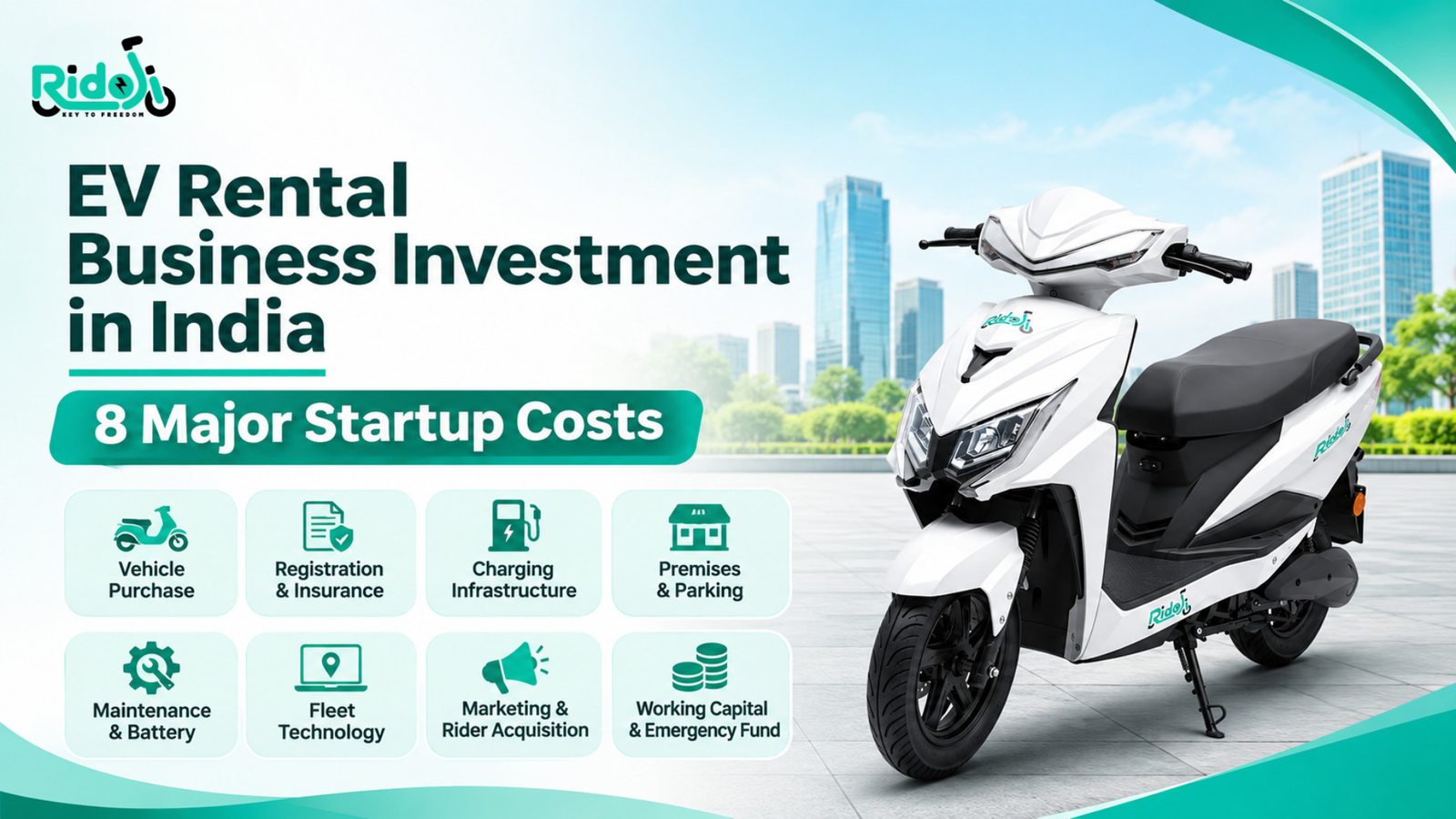
8 Major Costs of Starting an EV Rental Business in India
Investment is not a joke. You are putting your hard-earned money somewhere, so it’s important to take into account where your money will go. Here are some major expenses involved in setting up an EV rental business in India.
1. Electric Scooter Purchase Costs
The first and foremost expense is the cost of the vehicle. There is no single specific cost; the total cost depends on the brand of the scooter, battery capacity, specifications, and intended commercial usage. For example, let’s take an illustrative purchase price of 90,000 for one electric vehicle.
| Fleet Size | Illustrative Vehicle Cost |
| 5 electric scooters | ₹4,50,000 |
| 10 electric scooters | ₹9,00,000 |
| 20 electric scooters | ₹18,00,000 |
| 30 electric scooters | ₹27,00,000 |
However, before purchasing, compare all the prior factors like battery performance, charging time, warranty, service network, spare part availability, and sustainability for daily commercial commutes. It is very necessary to choose the right vehicle to maintain expenses and fleet management over time.
2. Vehicle Registration and Insurance
Another important investment component of the EV business is maintaining the proper documentation and registration of all vehicles before purchasing anything. Depending on the vehicle category and the type of business model you choose, you may need to look into these things:
1- Terms and conditions of the business model
2- Registration of the vehicles
3- Business-related documents
4- Rental agreements and customer verification
5- Mandatory licenses and local permissions
The exact cost will depend on the vehicle, location, insurance policy, and applicable regulations.
3. EV Charging Infrastructure
Just purchasing and giving the vehicle on rent is not enough to ensure that this business runs smoothly; one needs to take care of some other things as well. One of the most common factor that most people ignore is- Charging Facility. One needs to have a practical arrangement so that the electric vehicle customers don’t go away. Depending on the type of business model, the charging infrastructure can be managed differently, such as:
1- Managed by the pre-existing brand itself
2- Choosing a third party to rent the charging station.
3- Renting out an entire charging station for their use.
4- Making a whole new charging station for your customers.
The investment will depend on how many scooters you have, electrical needs, compatibility with chargers, premises, and charging. If you are running a small fleet, you may just need a basic solution, but if you’re looking to run a larger business, you may need a specialist.
4. Commercial Premises and Parking
You may need to have a place to park your vehicles, inspect them, charge them, and coordinate maintenance and onboard riders. Ideally, your premises should be easily accessible to your target market.
For example, this could be close to delivery hubs, commercial markets, restaurants, cloud kitchens, grocery warehouses, and logistics centres. Costs may include:
- Rent/Security deposit.
- Parking.
- Electrical.
- Basic office setup.
- Security & storage.
Costs will vary greatly depending on the city and size.
5. Vehicle Maintenance and Battery Costs
It’s not easy to maintain electric scooters, as they require maintenance from time to time and regular checks as well. For this, you’ll need to have a budget for:
- Tire changes.
- Brake servicing.
- Battery checks.
- Electrical repairs.
- Accident damage.
- Regular servicing.
- Vehicle recovery.
Battery replacements can also be an expensive long-term cost.
Even if you purchase your scooters, there will still be costs whilst they are not being rented. This is why having working capital and a maintenance fund is important.
6. Fleet Management Technology
Over time, when your fleet expands, it can be a bit hard to keep track of everything manually. Hence, using a fleet management service can assist you in tracking vehicle allocations, payments, maintenance, and performance. According to the type of setup, you may have to invest in:
- GPS
- Tracking
- Payment
- Fleet management services
Having a system in place can help reduce confusion and identify vehicles that are not being fully used.
7. Marketing and Rider Acquisition
Marketing is another important expense that entrepreneurs should consider. As long as your product is not visible in the market, nobody’s going to rent it. Potential customers may include delivery riders, businesses, and logistics operators. So, one may need to invest in:
- Digital Marketing
- Local Marketing
- Business Partnerships
- Rider Onboarding
- Word of Mouth
8. Working Capital and Emergency Funds
Another forgotten investment you will be going to need. Every business takes time to gain its pace; whilst you have purchased electric scooters, it may still take some time to get rented. In mean time, you do have to pay for its maintenance, insurance, administrative,and service charges. Hence, it is necessary to have an emergency fund that can help your business with any unexpected costs and times of low usage.
EV Rental Business Investment Breakdown: 20 Scooters
Let’s look at an example. Say you want to start an EV Rental Business with 20 electric scooters.
Below is an example of how you could break down your initial costs.
INVESTMENT BREAKDOWN – 20 ELECTRIC SCOOTERS
| Investment component | Estimated amount |
|---|---|
| 20 electric scooters at ₹90,000 each | ₹18,00,000 |
| Registration and insurance allowance | ₹1,00,000 |
| Charging and electrical setup | ₹1,50,000 |
| Premises and basic infrastructure | ₹1,00,000 |
| Technology and onboarding | ₹50,000 |
| Initial marketing and administration | ₹50,000 |
| Working capital reserve | ₹2,50,000 |
| Total estimated investment | ₹25,00,000 |
Important: The ₹25 lakh estimate is an illustrative planning example for a 20-scooter rental business. It is not a fixed industry startup cost or a quotation from Ridoji. Actual investment requirements depend on vehicle specifications, fleet size, location, insurance, charging arrangements, operating model, and applicable taxes.
Do You Need to Invest a Lot?
No, it will depend on how large you’d like to start. Some entrepreneurs may want to start with a smaller fleet to understand the local demand. Whilst others may want to start larger.
Below are 3 examples of how you could plan:
| Business Scale | Fleet Size | Illustrative Vehicle Cost at ₹90,000 Each |
| Small | 5 scooters | ₹4.5 lakh |
| Medium | 10 scooters | ₹9 lakh |
| Large | 20 scooters | ₹18 lakh |
These are just the costs of the vehicles. You’ll also need to budget for registration, insurance, charging, premises, technology, marketing & working capital. Starting with a smaller fleet can help you understand customer demand, pricing, maintenance, and vehicle usage.
However, you should decide on how large your fleet should be based on the actual demand and economics of your location.
How Does Your Business Model Affect Investment?
Alongside the number of scooters you may want to run, your business model can also affect your investment.
There are 4 main options entrepreneurs can look at:
1. Run Your Own EV Rental Business
You’ll purchase or finance your electric scooters and run your business yourself. This means you’ll be responsible for purchasing your vehicles, onboarding riders, receiving payments, maintenance, customer acquisition, and running your business.
This gives you more control but will involve more work.
2. EV Rental Franchise
By running an EV Rental Franchise, you’ll be able to run your business using the framework of an established company. Depending on your franchise agreement, the company may offer help with sourcing vehicles, branding, processes, fleet management, maintenance, and customer acquisition. The franchise partner will invest the agreed amount and follow the responsibilities outlined in your contract. Before investing, you’ll want to understand what the franchise fee, vehicle ownership, support, revenue sharing, and exit clauses are.
3. Company Managed EV Fleet
By investing an agreed amount/capital or an asset, an entrepreneur/investor will have a company run specific parts of their fleet. This can include deploying your scooters, onboarding riders, coordinating maintenance, receiving payments, and managing your fleet. This may mean less hands-on work, but there will still be financial and operational risks.
4. B2B EV Rental
Electric scooters will be supplied directly to businesses.
This could include delivery companies, restaurants, grocery businesses, couriers, and logistics.
The investment will depend on how many vehicles you have, the contract, maintenance, and payment.
What Is the Difference Between Vehicle Cost and Total Business Investment?
Vehicle purchase cost is only one component of the total investment required to start an EV rental business. Entrepreneurs must also consider registration, insurance, charging arrangements, maintenance, commercial premises, fleet management technology, customer acquisition, and working capital.
For example, a fleet of five electric scooters purchased at an illustrative cost of ₹90,000 each would require ₹4.5 lakh for vehicle acquisition. However, the complete business investment would be higher after including setup and operational expenses.
Similarly, starting with 20 electric scooters may involve ₹18 lakh in vehicle acquisition costs alone, while the illustrative total business setup budget in this guide is ₹25 lakh.
Understanding this difference helps entrepreneurs avoid underestimating the capital required to establish and operate a rental fleet.
How Ridoji Supports EV Fleet Operations
When looking at starting an EV Rental Business in India, it’s important to choose the right partner to work with.
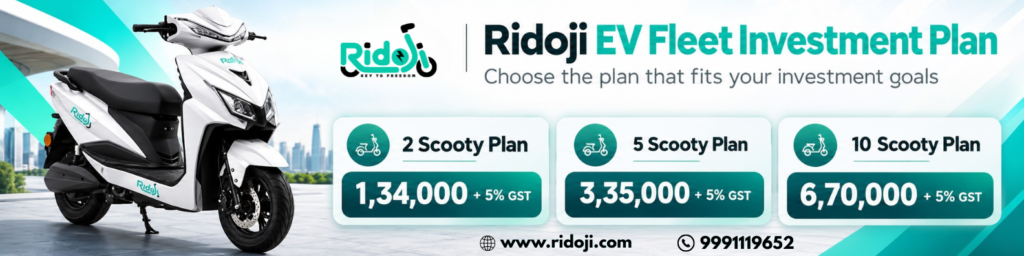
Ridoji specialises in electric mobility and fleet management. They offer a managed electric scooter fleet, rider hire, and deployment of commercial vehicles.
Their business ecosystem helps connect electric scooters with delivery riders and businesses.
Looking at their published information, you can see they offer:
- Deployment of electric scooters.
- Onboarding of riders.
- Maintenance support.
- Fleet management.
- Rider-focused.
This means entrepreneurs can look at running an EV Rental Business using a managed fleet and franchise model.
However, the actual investment will depend on what their current franchise model is.
You’ll want to ask for the latest information on their franchise. What is the minimum investment? Who will purchase the electric scooters? How many scooters will be included in the fleet? Who will onboard riders and handle maintenance? What support will they offer? What will the payment process be? How long will the agreement last, and what are the exit clauses?
You can look at their franchise opportunity here: Ridoji EV Franchise Program
How to Calculate EV Rental Business Profitability
Alongside investing, you’ll want to understand how much revenue you’ll receive from your rentals.
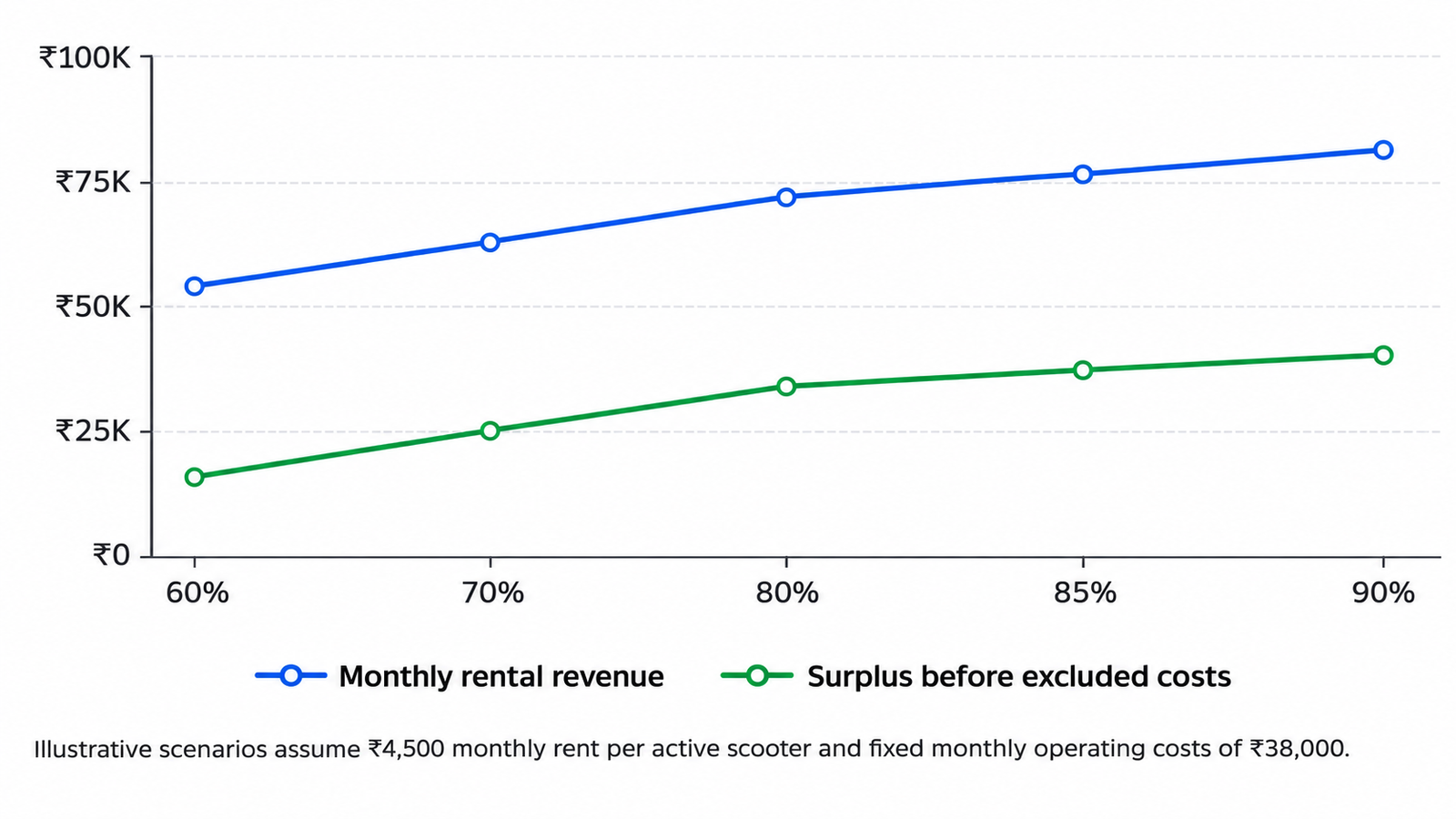
Let’s say you have a total of 20 scooters in your fleet. Each active scooter will earn you ₹4,500 per month. On average, your fleet will be used 85% of the time.
20 x ₹4,500 x 85% = ₹76,500
If your monthly costs are ₹38,000, you will have an example surplus of ₹38,500.
This is before considering depreciation, financial costs, large battery replacements, tax, and other costs. This is not a net profit or guaranteed payment. This is just an example.
Ultimately, it will depend on how much demand there is for your rentals, how quickly you can collect payments, how much maintenance you have, downtime, and costs.
The key thing to remember is that if you have a fleet that is being used regularly, then you’ll be creating value.
Things to Consider Before Investing
- Research how many delivery riders and businesses there are locally who may need to rent scooters.
- Compare battery range, warranty, durability, and after-sales.
- Check what licences you need for rentals, vehicle permits, registration, insurance, and tax.
- Understand battery costs, servicing and breakdowns.
- Identify how you’ll acquire your customers.
- Ensure you have enough working capital. Don’t rely on optimistic revenue.
- Look at the experience of the company, agreement, asset ownership, support, and payment.
A well-planned investment will start with understanding the opportunities and risks.
Conclusion
Should I Look at Starting an EV Rental Business?
An EV Rental Business is a new opportunity for entrepreneurs who are interested in the electric mobility industry, commercial transport, and last-mile delivery.
However, there are many things to consider when investing. Alongside purchasing electric scooters, you’ll need to consider charging, insurance, maintenance, technology, customer acquisition, and working capital.
If you are looking to run your own business, you may want to start with a smaller fleet to test the market. If you prefer to run a structured business, then you can look at EV Rental Franchises and managed fleets.
If you are looking to get into the electric mobility industry, then Ridoji is one option to look at.
Ridoji specialises in deploying electric scooters, onboarding riders, maintenance support, and fleet management. This provides an ecosystem for entrepreneurs interested in running an EV Rental Business.
Understand your investment and business model, and make an informed decision.
Want to look at an EV Rental Business opportunity with Ridoji?
Visit www.ridoji.com to find out more about their electric mobility solutions and franchise opportunities.
Frequently Asked Questions
1. How much do I need to invest to start an EV Rental Business in India?
This will depend on how many scooters you want, the price of the scooters, charging, insurance, premises, and working capital. For example, if you wanted a 20-scooter fleet, you may need to invest around ₹25 lakh. This will vary.
2. How much does it cost to start an EV rental business with 10 electric scooters?
The investment depends on vehicle prices and other setup requirements. At an illustrative vehicle cost of ₹90,000 per scooter, purchasing 10 electric scooters would require ₹9 lakh. Registration, insurance, charging arrangements, maintenance, business infrastructure, and working capital would increase the total startup cost
3. Is an EV Rental Business profitable?
You can earn from rentals; however, this will depend on how much your vehicles are used, rental price, maintenance, insurance, depreciation, payments, and other costs. Profit is not guaranteed.
4. Is an EV rental franchise different from starting an independent rental business?
Yes. In an independent EV rental business, the entrepreneur generally manages vehicle acquisition, customer onboarding, rental collections, maintenance, and operations. Under an EV rental franchise or company-managed fleet model, some responsibilities may be handled by the partner company, depending on the agreement. Costs, asset ownership, operational control, and financial risks can differ between these models.
5. Can I start an EV Rental Business with Ridoji?
Ridoji offers franchises related to its electric mobility and managed fleet. Interested entrepreneurs should contact Ridoji to find out what the latest investment requirements, support, vehicle ownership, and agreement are.
6. Does Ridoji offer support?
Ridoji publishes information about their business and shows that they offer deployment of electric scooters, onboarding of riders, maintenance support, and fleet management. The actual support will depend on what your franchise agreement says.