

Introduction: Delivery Costs Are Becoming a Serious Business Challenge
For many Indian businesses, delivery is no longer a support function. It has become a core part of customer experience.
Restaurants, cloud kitchens, grocery brands, courier companies, pharmacies, e-commerce sellers, and hyperlocal businesses all depend on fast and reliable last-mile delivery. Customers want orders to reach quickly. Businesses want lower costs. Riders need dependable vehicles. Operations teams need better control.
This is where the challenge begins.
Running a delivery fleet is not only about having vehicles on the road. It involves fuel expenses, rider coordination, maintenance, breakdowns, route planning, vehicle availability, daily monitoring, documentation, and cost control.
For businesses using petrol two-wheelers, fuel cost is one of the biggest recurring expenses. Along with fuel, regular servicing, engine-related repairs, downtime, and unpredictable maintenance can increase the total cost of operations.
That is why many businesses are now exploring EV Fleet Management in India.
Electric scooters are becoming practical for commercial delivery because they are suitable for short-distance urban movement, daily rider usage, and last-mile operations. But simply buying electric scooters is not enough. Businesses also need a proper fleet management system to deploy, maintain, monitor, and manage those vehicles effectively.
A well-managed EV fleet can help businesses reduce delivery costs, improve rider productivity, and build a cleaner mobility model.
Why Electric Two-Wheelers Fit Indian Delivery Operations
India’s delivery economy runs heavily on two-wheelers.
Two-wheelers are compact, easy to move through traffic, affordable compared to larger vehicles, and suitable for short and medium-distance routes. For food delivery, grocery delivery, courier movement, pharmacy deliveries, and field operations, electric scooters can be a strong fit.
The electric two-wheeler segment is also growing fast. Recent reports show that India’s electric two-wheeler registrations rose strongly in August 2026, with Autocar Professional reporting 180,569 registrations, up 65% year-on-year. Another Autocar Professional report said August 2026 electric two-wheeler retail sales reached 182,936 units, up 67% year-on-year.
This growth matters for businesses because it shows that electric scooters are moving from early adoption to wider practical use. More models, stronger competition, better awareness, and expanding support infrastructure can make EV adoption easier for commercial users.
For delivery businesses, electric two-wheelers offer several practical advantages:
- Lower running cost compared to petrol scooters
- Better suitability for city routes
- Reduced dependence on fuel price fluctuations
- Lower tailpipe emissions
- Quieter operation
- Easier deployment for short-distance delivery
- Potential branding benefit as a cleaner mobility choice
However, the real benefit does not come from the vehicle alone.
It comes from how the vehicle is managed.
What Is EV Fleet Management?
EV fleet management is the professional management of electric vehicles used for business or commercial operations.
For electric scooter fleets, this may include:
- Vehicle deployment
- Rider allocation
- Maintenance scheduling
- Charging coordination
- Battery health monitoring
- Daily vehicle tracking
- Downtime management
- Documentation support
- Usage reporting
- Operational supervision
In simple words, EV fleet management helps businesses ensure that their electric scooters are not just purchased, but actively used, maintained, and monitored.
This is important because a delivery vehicle creates value only when it is available and productive.
A scooter sitting idle does not reduce cost.
A scooter under repair does not complete deliveries.
A scooter without proper rider coordination creates operational confusion.
A scooter without maintenance planning can increase downtime.
That is why fleet management is the system behind the vehicle.
For a wider view of India’s clean mobility roadmap, businesses can refer to NITI Aayog’s E-Mobility resources.
Why Businesses Should Not Treat EV Adoption as Only a Purchase Decision
Many businesses make the mistake of thinking EV adoption means buying electric scooters and handing them to riders.
But commercial EV adoption is more complex than that.
A business must answer practical questions:
- Where will the scooters be deployed?
- Which riders will use them?
- How many kilometres will each scooter run daily?
- Where will charging happen?
- Who will handle maintenance?
- How will breakdowns be resolved?
- How will vehicle performance be tracked?
- How will downtime be reduced?
- How will reports be reviewed?
Without answers to these questions, the business may not get the full benefit of EV adoption.
This is why managed EV fleet models are becoming important. They help businesses move from vehicle ownership to vehicle performance.
The goal is not only to add electric scooters to the fleet.
The goal is to make the fleet more cost-efficient, trackable, reliable, and easier to operate.
Why Delivery Cost Reduction Depends on Fleet Discipline
Delivery costs are affected by many factors, not just fuel.
A business must consider:
- Vehicle running cost
- Maintenance cost
- Rider productivity
- Vehicle downtime
- Delivery delays
- Route efficiency
- Repair frequency
- Replacement vehicle availability
- Operational supervision
- Fleet utilization
Electric scooters can reduce running costs, but poor fleet discipline can reduce those savings.
For example, if scooters are not charged on time, deliveries may get delayed. If maintenance is ignored, downtime may increase. If riders are not coordinated properly, vehicle usage may become inefficient. If there is no monitoring, the business may not know which vehicles are performing well and which ones need attention.
This is why EV fleet management is important.
It connects electric scooters with daily operational control.
How Government Policy Is Supporting EV Fleet Growth
India’s EV ecosystem is also being supported by government policy and infrastructure planning.
The Government of India’s PM E-DRIVE scheme has an outlay of ₹10,900 crore over two years and aims to promote electric mobility, reduce range anxiety, and support public charging infrastructure. The official PM India release states that the scheme promotes installation of electric vehicle public charging stations and supports sustainable transportation goals.
The Press Information Bureau has also stated that ₹2,000 crore has been allocated under PM E-DRIVE for setting up public EV charging infrastructure, including EV public charging stations, battery swapping stations, and battery charging stations.
For businesses, this matters because charging infrastructure is one of the biggest factors in fleet confidence. As infrastructure improves, electric scooter fleets can become more practical for commercial delivery operations.
Government initiatives such as the PM E-DRIVE scheme are supporting India’s electric mobility transition through demand incentives and charging infrastructure support.
Why This Topic Matters for Ridoji’s Business Audience
For businesses, the question is no longer only:
Should we use electric scooters?
The better question is:
How can we use electric scooters in a managed way that reduces cost and improves operations?
That is where companies like Ridoji become relevant.
Ridoji focuses on managed EV fleet solutions where electric scooters are deployed, maintained, monitored, and supported through a structured operating model. For businesses, this can reduce the burden of managing vehicles internally while still helping them move toward cleaner and more cost-efficient delivery operations.
As delivery demand grows and businesses look for better cost control, EV fleet management can become an important part of India’s last-mile mobility future.
Businesses looking to reduce delivery costs can explore Ridoji’s EV Fleet Management Program for managed electric scooter deployment and operations.
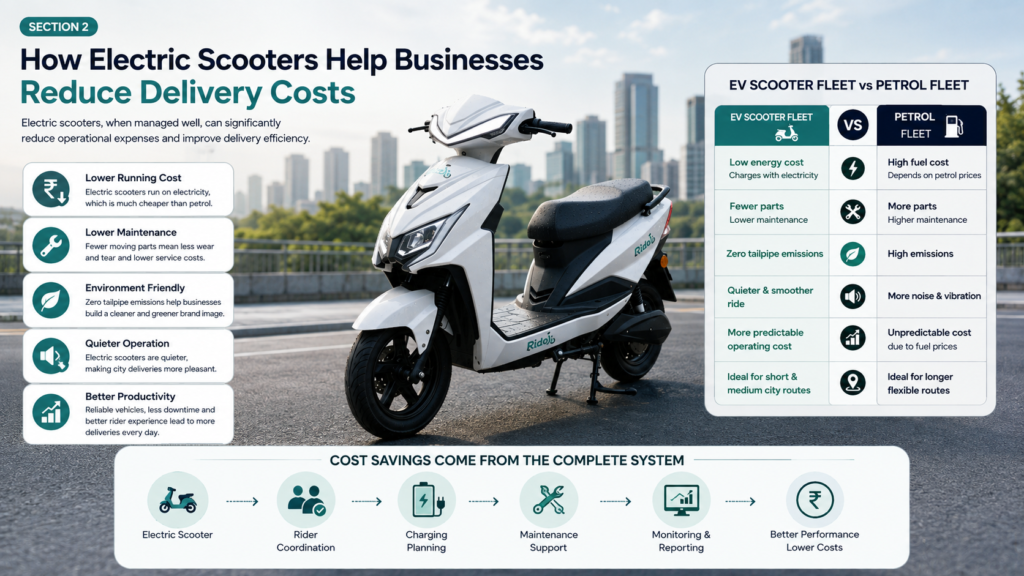
How Electric Scooters Help Businesses Reduce Delivery Costs
How EV Scooters Reduce Running Costs
For delivery businesses, running cost is one of the biggest daily expenses.
Every order, every rider shift, and every delivery route adds to the total cost of movement. When a business uses petrol scooters, the cost is directly affected by fuel prices, traffic conditions, rider usage, and vehicle efficiency.
Electric scooters change this cost structure.
Instead of depending on petrol, EV scooters run on electricity. This can help businesses reduce daily energy expenses, especially when vehicles are used regularly for short-distance and medium-distance delivery routes.
For businesses with frequent deliveries, even a small saving per kilometre can become meaningful over time.
Electric scooters can help reduce running costs through:
- Lower energy cost compared to petrol
- Better suitability for short urban routes
- Reduced dependence on fuel price changes
- Lower maintenance needs due to fewer moving parts
- More predictable operating costs
- Cleaner and quieter delivery operations
However, the cost advantage works best when the fleet is managed properly.
If charging is not planned, maintenance is ignored, or vehicles are not deployed efficiently, the expected savings may reduce. That is why electric scooters and EV fleet management must work together.
Petrol Fleet vs Electric Scooter Fleet
A petrol fleet and an electric scooter fleet may look similar from the outside because both are used for delivery. But operationally, they are very different.
| Factor | Petrol Scooter Fleet | Electric Scooter Fleet |
| Fuel / Energy Cost | Depends on petrol prices | Depends on electricity cost |
| Maintenance | Engine oil, filters, clutch, engine parts | Fewer moving parts, battery and electrical checks |
| Emissions | Tailpipe emissions | Zero tailpipe emissions |
| Noise | Higher engine noise | Quieter operation |
| Cost Predictability | Fuel prices can fluctuate | More predictable charging cost |
| Fleet Monitoring | Often manual or basic | Can be integrated with digital fleet systems |
| Best Use Case | Longer flexible routes | Short and medium urban delivery routes |
| Business Image | Conventional mobility | Cleaner and modern mobility |
This comparison shows why many businesses are considering electric scooters for last-mile delivery.
The advantage is not only environmental. It is also operational.
Electric scooters can help businesses build a cleaner, more trackable, and more cost-efficient delivery model when supported by the right fleet management system.
Maintenance Savings: Why EVs Can Be Easier to Manage
Maintenance is another area where electric scooters can help businesses control costs.
Petrol scooters have many mechanical parts that require regular service. These may include engine oil, spark plugs, filters, clutch systems, exhaust parts, and other engine-related components.
Electric scooters are mechanically simpler. They do not have a petrol engine, fuel tank, exhaust system, or engine oil requirement. This can reduce the number of routine service items.
For fleet businesses, this matters because maintenance is not only a cost issue. It is also an uptime issue.
When a vehicle goes for service, it is not available for delivery.
A well-maintained EV scooter can help reduce:
- Frequent breakdowns
- Unexpected service delays
- Rider complaints
- Vehicle downtime
- Operational disruption
- Replacement vehicle pressure
But EVs still need proper care.
Electric scooters require regular checks for:
- Tyres
- Brakes
- Battery health
- Charging system
- Suspension
- Lights
- Software or controller issues
- General vehicle condition
This is why preventive maintenance is important in EV fleet operations.
A managed EV fleet partner can schedule maintenance before small issues become expensive problems.
Rider Productivity and Vehicle Availability
In delivery operations, rider productivity is directly linked to vehicle availability.
If the scooter is unavailable, the rider cannot complete deliveries. If the vehicle breaks down during working hours, orders may be delayed. If the rider spends too much time solving vehicle issues, productivity drops.
Electric scooters can support rider productivity when:
- Vehicles are charged on time
- Maintenance is planned in advance
- Breakdowns are handled quickly
- Riders receive reliable vehicles
- Daily vehicle allocation is organized
- Fleet managers track usage and issues
This is where EV fleet management becomes valuable.
A business may own multiple electric scooters, but without coordination, the fleet can become difficult to control. Riders may face charging confusion. Vehicles may be used unevenly. Some scooters may run more than others. Maintenance may be delayed. Reporting may be unclear.
A managed system brings discipline.
It helps ensure that vehicles are assigned, monitored, maintained, and kept ready for daily operations.
Delivery partners who need electric mobility support can also learn about Ridoji’s EV scooter rental for riders.
Fleet Monitoring: The Hidden Advantage of EV Operations
Fleet monitoring is one of the biggest advantages of modern EV fleet management.
For businesses, visibility matters.
Without monitoring, it becomes difficult to know:
- Which vehicle is active
- Which rider is using which scooter
- How much the vehicle is being used
- Whether the vehicle needs maintenance
- Whether downtime is increasing
- Whether the fleet is being used efficiently
Fleet monitoring helps businesses move from guesswork to data-based decisions.
A good EV fleet management system can help track:
- Vehicle usage
- Route performance
- Maintenance alerts
- Charging status
- Rider allocation
- Downtime patterns
- Fleet utilization
- Operational reports
This helps businesses understand the real performance of their fleet.
Instead of only asking, “How many scooters do we have?” businesses can ask:
How many scooters are actually productive every day?
That is the question that improves delivery operations.
How EV Fleets Improve Cost Predictability
One of the biggest pain points for businesses is unpredictable cost.
Fuel prices change. Repairs come suddenly. Vehicles break down. Riders report issues late. Maintenance gets delayed. These small problems can increase monthly operational expenses.
A managed electric scooter fleet can improve cost predictability because the major cost areas become easier to track.
Businesses can plan:
- Charging schedules
- Service intervals
- Vehicle allocation
- Rider usage
- Maintenance cycles
- Fleet expansion
- Replacement planning
This gives management teams better control over monthly delivery operations.
Cost reduction is not only about spending less.
It is also about knowing where money is being spent and how efficiently assets are being used.
Investors interested in EV-based asset opportunities can also review the Ridoji Investment Program.
Why Managed EV Fleets Help Businesses Scale
A business may start with a few delivery vehicles. But as order volume grows, fleet complexity increases.
Managing 5 vehicles is different from managing 50.
Managing 50 is different from managing 500.
As the fleet grows, businesses need systems, not guesswork.
Managed EV fleet solutions help businesses scale because they bring structure to:
- Vehicle deployment
- Rider onboarding
- Maintenance planning
- Daily tracking
- Issue resolution
- Reporting
- Fleet expansion
This allows businesses to focus on their core work, such as sales, customer service, product quality, and delivery growth, while the fleet partner manages vehicle operations.
For restaurants, cloud kitchens, grocery businesses, pharmacies, and logistics companies, this can be a major advantage.
They do not have to become fleet experts.
They can work with a fleet management partner that already understands EV operations.
Commercial EV Fleet Use Cases
Electric scooter fleets can be used across many business categories.
1. Restaurants and Cloud Kitchens
Food businesses need fast, reliable, and cost-efficient delivery. EV scooters can support regular delivery routes while helping reduce running costs.
2. Grocery and Quick Commerce
Grocery delivery requires frequent short-distance trips. Electric scooters fit this use case well because they are designed for urban movement.
3. Pharmacies and Healthcare Deliveries
Medicine delivery requires timely and dependable mobility. A managed EV fleet can help maintain vehicle availability for daily delivery needs.
4. Courier and E-Commerce Sellers
Local courier and e-commerce sellers need affordable vehicles for last-mile movement. EV scooters can help reduce delivery expenses.
5. Field Service Teams
Businesses with technicians, sales executives, or service staff can use EV scooters for regular city movement.
6. Rider Rental Models
Many delivery riders need access to affordable vehicles for work. Managed EV rental fleets can support rider mobility without requiring every rider to buy a vehicle.
Why Businesses Need a Fleet Partner, Not Just Vehicles
Buying vehicles is simple.
Managing them every day is the real challenge.
A business may purchase electric scooters, but if there is no system for charging, rider coordination, maintenance, monitoring, and reporting, the fleet can become difficult to handle.
That is why businesses need more than EVs.
They need a fleet partner.
A good EV fleet partner helps businesses answer practical questions:
- How many vehicles are needed?
- Where should they be deployed?
- Which riders will use them?
- How will charging be managed?
- Who will handle maintenance?
- How will breakdowns be resolved?
- What reports will be shared?
- How will fleet performance be reviewed?
This is where Ridoji’s managed EV fleet approach becomes relevant for businesses.
Ridoji supports commercial EV operations by helping manage vehicle deployment, rider coordination, maintenance support, fleet monitoring, and operational reporting.
For businesses, this means they can adopt electric scooters without carrying the full operational burden internally.
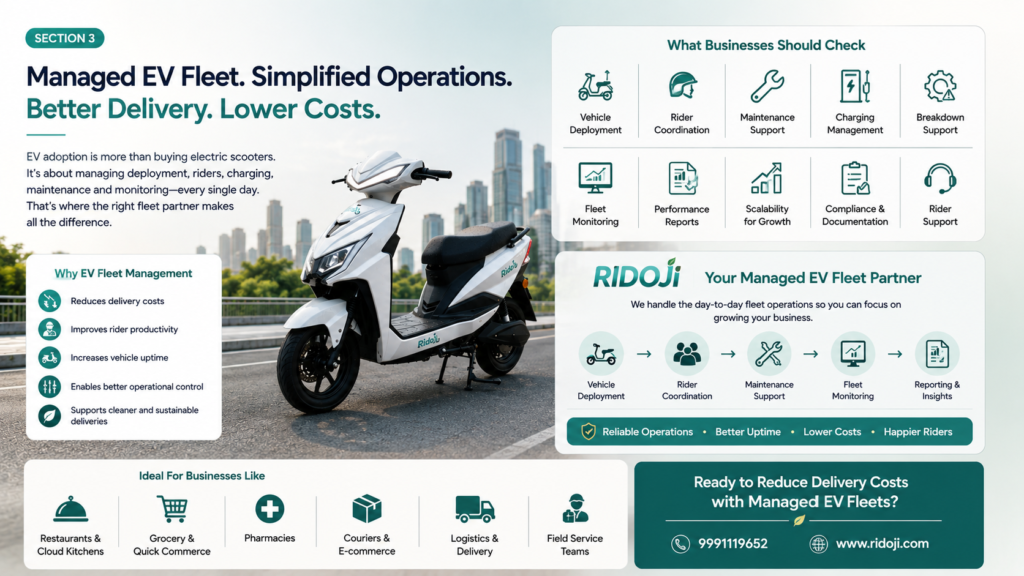
Choosing the Right EV Fleet Partner, Ridoji Model and Final CTA
What Businesses Should Check Before Choosing an EV Fleet Partner
Electric scooters can reduce delivery costs, but the final result depends heavily on how the fleet is managed.
Before choosing an EV fleet management partner, businesses should not only compare vehicle prices. They should evaluate the full operating model.
A good EV fleet partner should help answer these questions:
- How will vehicles be deployed?
- How will riders be assigned?
- Who will handle maintenance?
- How will charging be managed?
- What happens if a vehicle breaks down?
- How will downtime be reduced?
- What reports will the business receive?
- How will fleet performance be monitored?
- What support is available for riders?
- How will the fleet scale as order volume grows?
The right partner should not only provide vehicles. It should provide a system.
That system should help the business improve vehicle uptime, rider productivity, cost control, and operational visibility.
Risks Businesses Should Understand Before Shifting to EV Fleets
EV fleet adoption can be highly useful for businesses, but it should be planned properly.
Here are the key risks businesses should understand.
1. Charging Risk
If charging is not planned well, riders may face delays during working hours. Businesses should understand whether the fleet will use public charging, private charging, battery swapping, or a mixed model.
2. Downtime Risk
A scooter that is not available cannot complete deliveries. Downtime may happen due to maintenance, damage, battery issues, accidents, or documentation delays.
3. Rider Coordination Risk
A business may have vehicles but still struggle if riders are not properly assigned, trained, or supported.
4. Maintenance Risk
Electric scooters need regular care. Tyres, brakes, suspension, lights, battery health, and electrical systems must be checked properly.
5. Operational Visibility Risk
Without monitoring and reporting, businesses may not know which scooters are being used efficiently and which ones are creating issues.
6. Scale Risk
Managing 5 electric scooters is very different from managing 50 or 100. Businesses should choose a model that can scale with their delivery demand.
Understanding these risks helps businesses make better decisions before moving toward EV fleet adoption.
How Ridoji Supports Businesses with Managed EV Fleet Solutions
Ridoji helps businesses adopt electric scooters without carrying the full operational burden internally.
Instead of asking businesses to purchase vehicles, find riders, manage maintenance, track usage, and solve daily operational issues on their own, Ridoji brings a structured EV fleet management approach.
Ridoji supports businesses through:
- Electric scooter deployment
- Rider coordination
- Maintenance support
- Fleet monitoring
- Operational reporting
- Documentation coordination
- Day-to-day fleet management
This makes Ridoji relevant for businesses that want cleaner delivery operations but do not want to build an internal fleet management department.
For restaurants, cloud kitchens, grocery brands, pharmacies, local delivery businesses, logistics companies, and rider-based operations, Ridoji’s managed EV fleet model can help reduce complexity.
The goal is simple:
Businesses focus on growth. Ridoji manages the EV fleet.
Why Managed EV Fleets Are Better Than Unstructured Vehicle Renting
Many businesses try to solve delivery vehicle problems through unstructured renting.
They rent vehicles from different sources, assign them to riders, and manage problems as they come. This may work at a small scale, but it can become difficult as operations grow.
Unstructured renting can create challenges such as:
- No clear maintenance process
- No proper reporting
- Rider coordination issues
- Vehicle condition problems
- Delayed repairs
- Lack of tracking
- Poor downtime control
- Confusion over responsibilities
Managed EV fleet solutions offer a more organized approach.
With a managed model, businesses get better clarity on:
- Which vehicles are active
- Which riders are assigned
- When maintenance is needed
- How downtime is handled
- How performance is reported
- How fleet operations are supervised
This structure becomes important when delivery is a core part of the business.
Why EV Fleet Management Is Important for Restaurants and Cloud Kitchens
Restaurants and cloud kitchens depend heavily on timely delivery.
A delayed order can affect customer satisfaction, ratings, repeat orders, and brand reputation. For food businesses, delivery is not just logistics. It is part of the customer experience.
Electric scooter fleets can support restaurants and cloud kitchens by offering:
- Lower running cost for frequent local deliveries
- Better suitability for short-distance routes
- Cleaner brand image
- Reduced dependency on petrol prices
- Easier daily movement in city traffic
But the fleet must be reliable.
If vehicles are not charged, riders are not coordinated, or maintenance is ignored, delivery performance can suffer.
A managed EV fleet partner helps bring discipline to this process.
Why EV Fleet Management Matters for Grocery and Quick Commerce
Grocery and quick commerce businesses operate on speed and frequency.
Their delivery model depends on multiple short trips throughout the day. Electric scooters are well-suited for this because they work efficiently in city routes and dense delivery zones.
For such businesses, EV fleet management can help with:
- Regular vehicle availability
- Rider allocation
- Charging planning
- Maintenance control
- Usage monitoring
- Delivery cost management
As order volumes grow, managed EV fleets can help businesses avoid operational confusion and maintain better control over daily delivery movement.
Why Rider Support Is a Key Part of Fleet Success
A fleet is only as strong as the people using it.
Even if the vehicle is good, poor rider coordination can reduce fleet performance.
Riders need:
- Reliable vehicles
- Clear allocation
- Quick issue resolution
- Maintenance support
- Charging clarity
- Basic usage guidance
- Operational assistance
When riders are supported well, vehicle usage becomes smoother. Breakdowns are reported faster. Maintenance becomes easier to plan. Delivery operations become more predictable.
This is why Ridoji’s model includes rider coordination as an important part of fleet management.
How Businesses Can Start with EV Fleet Management
Businesses do not need to electrify their entire fleet in one day.
A practical approach is to start in phases.
Step 1: Review Current Delivery Costs
Understand current spending on petrol, maintenance, repairs, rider delays, and vehicle downtime.
Step 2: Identify Suitable Delivery Routes
EV scooters are especially useful for short and medium-distance urban routes.
Step 3: Start with a Small Managed Fleet
Businesses can begin with a limited number of electric scooters and review operational performance.
Step 4: Track Performance
Monitor cost savings, rider feedback, downtime, delivery performance, and maintenance frequency.
Step 5: Scale Gradually
If the model works well, the fleet can be expanded in a structured way.
This phased approach reduces risk and gives businesses time to understand the benefits of EV fleet management.
Final Thoughts: EV Fleet Management Is Not Just About Vehicles
EV fleet management in India is becoming important because delivery businesses need more than vehicles.
They need reliability.
They need cost control.
They need rider coordination.
They need charging planning.
They need maintenance support.
They need visibility.
They need a system that helps them scale.
Electric scooters can help reduce delivery costs, but only when they are deployed and managed properly.
For businesses, the real opportunity is not only switching from petrol to electric.
The real opportunity is building a cleaner, more organized, and more cost-efficient delivery operation.
That is where managed EV fleet solutions can make a difference.
CTA: Partner with Ridoji for Managed EV Fleet Solutions
Looking to reduce delivery costs and simplify fleet operations?
Explore Ridoji’s EV Fleet Management Solutions for businesses.
Ridoji helps manage vehicle deployment, rider coordination, maintenance support, fleet monitoring, reporting, and day-to-day EV fleet operations.
Whether you run a restaurant, cloud kitchen, grocery business, pharmacy, logistics company, or delivery-based operation, Ridoji can help you explore a structured electric scooter fleet model.