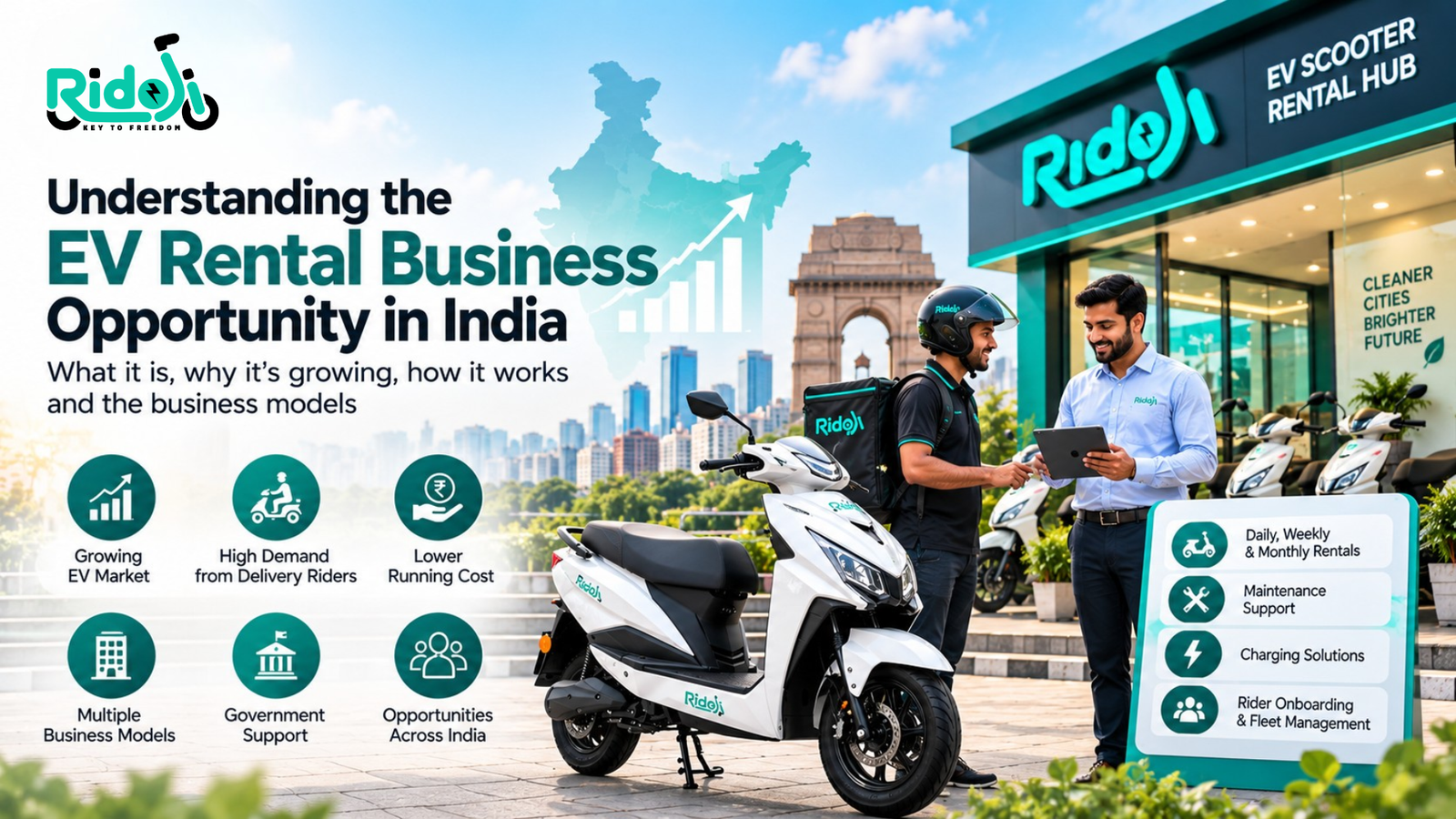
Understanding the EV Rental Business Opportunity in India
Introduction: Is Starting an EV Rental Business in India a Good Opportunity?
EV Rental Business in India is emerging as a business opportunity for entrepreneurs who want to enter the electric mobility industry through electric scooter rentals, commercial fleet deployment, and last-mile delivery services.
Traditionally, entrepreneurs interested in the automobile industry have explored dealerships, vehicle sales, servicing, and transportation businesses. However, the increasing adoption of electric vehicles is opening additional opportunities in commercial rentals and fleet management.
Today, many delivery riders need reliable scooters for daily work. Food delivery, grocery delivery, courier services, pharmacy deliveries, and quick-commerce operations all depend on efficient two-wheeler mobility.
But not every rider wants to purchase a scooter or commit to a vehicle loan.
This creates a business opportunity for entrepreneurs who can provide electric scooters through rental plans while managing vehicle availability, maintenance, charging arrangements, and rider support.
For someone exploring how to start an EV rental business in India, the first step is understanding how the industry works.
An electric scooter rental business is more than purchasing vehicles and collecting rent. Its success depends on customer demand, vehicle utilization, rental pricing, operational efficiency, and fleet management.
A business with a large number of scooters may still struggle if vehicles remain idle, maintenance expenses increase, or rental collections become inconsistent.
On the other hand, a smaller fleet operating in the right location with reliable customers and disciplined management may have stronger business fundamentals.
This guide explains the different EV rental business models, investment considerations, operating requirements, revenue opportunities, and risks involved in starting an electric scooter rental business.
It also explores how managed EV fleet operators such as Ridoji fit into this evolving business ecosystem.
What Is an EV Rental Business in India?
An EV Rental Business in India is a business model where electric vehicles are provided to individuals, riders, or companies for temporary or ongoing use in exchange for rental payments.
Depending on the business structure, vehicles can be rented on daily, weekly, monthly, or contract-based arrangements.
An EV rental business may operate different types of electric vehicles, including electric scooters, electric motorcycles, and electric three-wheelers.
However, electric scooters are particularly relevant for businesses focused on urban mobility and last-mile delivery.
For example, a delivery rider may need an electric scooter to work with a food delivery or grocery delivery platform but may not want to purchase the vehicle immediately.
An EV rental company can provide access to a scooter under an agreed rental plan.
The rider uses the vehicle for permitted commercial activities and pays rent according to the agreement.
The rental company, meanwhile, manages responsibilities such as vehicle availability, maintenance, documentation, and customer support according to its business model.

What Services Does an Electric Scooter Rental Business Provide?
A professionally managed electric scooter rental business may offer:
- Electric scooters for delivery riders.
- Daily, weekly, or monthly rental plans.
- Electric vehicles for commercial delivery operations.
- Vehicle onboarding and handover.
- Maintenance and servicing arrangements.
- Charging or battery support, where available.
- Fleet monitoring and operational reporting.
- Rental agreement and documentation management.
- Customer and rider support.
- Vehicle return and redeployment services.
The exact services depend on the company, location, rental agreement, and operational capabilities.
A successful EV Rental Business in India should focus on providing reliable vehicle access while maintaining clear rental terms and controlling operating costs.
Why Is the EV Rental Business Growing in India?
India’s electric two-wheeler market has expanded significantly, creating an increasingly established ecosystem of electric scooters, manufacturers, service providers, and charging solutions.
According to Autocar Professional’s analysis of VAHAN registration data, approximately 14 lakh electric two-wheelers were sold in FY2026, representing roughly 22% growth compared with the previous financial year.This growth shows increasing adoption of electric two-wheelers, although it does not automatically establish demand or profitability for an individual rental business.
Several factors make electric scooter rentals a relevant area for entrepreneurs to explore.
1. Rising Adoption of Electric Two-Wheelers
Electric scooters are becoming increasingly familiar on Indian roads.
Their appeal includes reduced petrol dependency, quieter operation, zero tailpipe emissions during use, and suitability for many urban commuting routes.
Consumers also have access to a wider selection of electric two-wheeler models than in the early stages of EV adoption.
The expansion of the electric two-wheeler market can support related services such as maintenance, charging infrastructure, vehicle rentals, and commercial fleet management.
For entrepreneurs, this creates opportunities beyond traditional vehicle dealerships.
Instead of earning revenue only through vehicle sales, an electric scooter rental business can offer vehicles for repeated commercial use.
However, purchasing more scooters does not guarantee business success. Customer demand and fleet management must support the investment.
2. Growing Demand from Delivery Riders
Delivery riders are an important potential customer segment for an electric scooter rental business.
Riders working in food delivery, grocery delivery, courier services, pharmacy delivery, and local logistics often need a vehicle every working day.
Some riders may already own scooters, while others may prefer rental arrangements because they want to avoid a large upfront vehicle purchase.
Renting can be useful for people who are starting delivery work, working temporarily in a particular city, or testing whether electric mobility suits their daily routes.
This creates potential demand for rental providers who can offer reliable electric scooters with transparent pricing and appropriate maintenance support.
For an EV Rental Business in India, attracting and retaining riders is one of the most important operational challenges.
The company must understand where riders work, what they can afford, how many kilometres they travel, and what support they expect from a rental provider.
3. Quick Commerce and Last-Mile Delivery Opportunities
Quick commerce and last-mile delivery are important use cases for electric scooters.
Businesses involved in grocery delivery, food delivery, e-commerce, courier services, and hyperlocal logistics require two-wheelers for frequent urban trips.
Electric scooters can be suitable for many of these routes because they are compact and practical in congested city environments.
Potential customer groups include:
- Food delivery riders.
- Grocery delivery riders.
- Quick-commerce delivery workers.
- Courier and parcel delivery providers.
- Pharmacy delivery businesses.
- Restaurants and cloud kitchens.
- E-commerce delivery operators.
- Local businesses with delivery requirements.
An EV rental company can serve individual riders or establish commercial rental arrangements with businesses.
However, customer acquisition and fleet deployment should be based on demonstrated local demand rather than assumptions about the wider delivery industry.
4. Lower Running Costs Compared with Petrol Scooters
One reason electric scooters attract attention is their potential to reduce running costs.
Petrol scooters require regular fuel purchases and engine-related servicing.
Electric scooters use electricity instead of petrol and generally have fewer drivetrain components requiring routine maintenance.
For riders covering substantial daily distances, the difference in energy cost can be meaningful.
However, overall operating expenses depend on several factors:
- Electricity tariffs.
- Charging efficiency.
- Battery condition.
- Daily distance travelled.
- Vehicle maintenance.
- Tyre and brake replacement.
- Rental charges.
- Scooter purchase price and depreciation.
For an EV rental business, lower running costs can make electric scooters appealing to customers.
But rental pricing must still allow the business to recover vehicle costs and cover operating expenses.
5. Government Support for Electric Mobility
Government initiatives are also supporting India’s transition toward electric mobility.
The PM E-DRIVE scheme was initially approved with an outlay of ₹10,900 crore to support eligible electric vehicle categories and charging infrastructure.
The official scheme website also lists subsequent extensions and amendments, including changes affecting electric two-wheelers.
Entrepreneurs can review the official PM E-DRIVE scheme for the latest eligibility conditions and notifications.
Government support can help strengthen the wider EV ecosystem, but franchise investors and rental operators should not assume that subsidies automatically apply to commercial rental purchases.
Before including an incentive in business projections, confirm whether the specific vehicle, buyer, transaction, and intended use qualify.
How Does an Electric Scooter Rental Business Work?
Understanding the operating process is essential before starting an EV Rental Business in India.
The business must coordinate several activities to ensure vehicles are available for customers while controlling expenses and maintaining rental collections.
1. Electric Scooter Procurement and Fleet Setup
The first stage involves selecting electric scooters suitable for the intended rental customers.
A business targeting delivery riders should evaluate vehicles differently from a business offering casual personal rentals.
Important considerations include:
- Vehicle purchase price.
- Real-world battery range.
- Charging time.
- Battery warranty.
- Service network availability.
- Spare parts availability.
- Rider comfort.
- Carrying capacity.
- Vehicle durability.
- Insurance and permitted commercial use.
Entrepreneurs should also determine how many scooters to deploy initially.
Starting with a smaller fleet may allow the business to test customer demand before committing to a larger investment.
2. Rider Onboarding and Vehicle Allocation
Once vehicles are available, the rental company must identify eligible customers and complete onboarding.
This process may involve identity verification, driving licence checks where applicable, rental documentation, security deposits, and payment arrangements.
The company should also explain vehicle usage conditions, accident responsibilities, charging requirements, and return procedures.
After onboarding, scooters can be assigned according to the availability of vehicles and customer requirements.
Proper rider coordination helps reduce disputes, improve accountability, and support fleet utilization.
3. Daily, Weekly and Monthly Rental Plans
An EV rental business can offer different rental durations depending on customer demand.
Daily rentals may suit customers requiring short-term mobility.
Weekly rentals may be useful for riders testing delivery work or working on temporary assignments.
Monthly rentals may appeal to riders who require regular vehicle access.
Commercial contracts may be appropriate for businesses deploying multiple vehicles.
Before establishing rental prices, the company must calculate the costs associated with ownership, maintenance, charging responsibilities, insurance, depreciation, collection risk, and fleet management.
A low rental price may attract enquiries but can weaken profitability if it does not cover the business’s full costs.
4. Charging, Maintenance and Fleet Monitoring
The rental process does not end once the scooter is handed over.
Commercially used vehicles require ongoing attention.
A structured rental business should have arrangements for battery charging, regular inspections, servicing, breakdowns, accident reporting, and vehicle recovery.
Fleet monitoring can also help the operator understand vehicle availability, rental periods, maintenance status, and customer activity.
For example, if a rider returns a scooter, the business should inspect it, identify required repairs, and prepare it for the next eligible customer.
This process of vehicle redeployment is important because idle scooters may continue generating expenses without producing rental revenue.
The real strength of an EV rental business lies in keeping vehicles available, appropriately maintained, and commercially utilized.
Different EV Rental Business Models in India
Entrepreneurs exploring an EV Rental Business in India can choose from several operating structures.
Each has different capital requirements, management responsibilities, and business risks.
1. Self-Owned and Self-Managed EV Rental Business
In this model, the entrepreneur purchases or finances electric scooters and independently manages rental operations.
The owner may handle customer acquisition, vehicle allocation, maintenance, payments, and administration.
This model provides greater direct control over pricing and operating decisions.
However, the entrepreneur must build an operational system and take responsibility for daily business management.
Best suited for: Entrepreneurs with hands-on operational experience and the ability to manage riders and vehicles.
2. EV Rental Franchise Business
An EV rental franchise involves operating under an established company’s brand and contractual business model.
Depending on the agreement, the franchise provider may offer vehicle sourcing, branding, operating procedures, fleet technology, maintenance support, and customer acquisition assistance.
The franchise partner contributes the agreed capital and performs the responsibilities assigned under the contract.
The extent of operational support varies between franchise providers.
Best suited for: Entrepreneurs who prefer an existing business framework and access to defined support services.
3. Company-Managed EV Fleet Rental Model
A company-managed rental model involves delegating specified operational responsibilities to a fleet management company.
The entrepreneur or investor may contribute capital or assets, while the operating company manages agreed activities.
These may include:
- Scooter deployment.
- Rider onboarding.
- Maintenance coordination.
- Rental collection.
- Vehicle monitoring.
- Fleet reporting.
- Day-to-day operational management.
This arrangement can reduce the need for the investor to personally operate the fleet.
However, company-managed does not mean guaranteed payouts, risk-free ownership, or a completely passive business.
All financial, operational, and legal responsibilities must be confirmed through the agreement.
This is where managed EV fleet businesses such as Ridoji become relevant to entrepreneurs exploring rental and franchise opportunities.
4. Business-to-Business Electric Scooter Leasing
Under a business-to-business rental or leasing arrangement, an EV fleet operator provides vehicles to organizations rather than relying only on individual riders.
Potential customers include logistics companies, delivery service providers, restaurants, grocery businesses, and other commercial mobility users.
These arrangements may involve fleet-level contracts, agreed service responsibilities, and specified payment terms.
Business contracts can help structure demand, but customers may still delay payments, reduce fleet requirements, or terminate agreements according to contractual conditions.
A successful B2B fleet rental business must therefore evaluate customer reliability, contract terms, vehicle utilization, and servicing commitments.
Comparison of EV Rental Business Models in India
| Business Model | Main Responsibility | Operational Involvement | Main Revenue Source |
| Self-Owned EV Rental Business | Entrepreneur | High | Direct rental payments |
| EV Rental Franchise | Contract-defined | Medium to high, depending on agreement | Rental revenue or franchise-defined share |
| Company-Managed EV Fleet | Operating company manages agreed activities | Lower direct involvement, with continued oversight | Contract-defined payouts or revenue sharing |
| B2B EV Scooter Leasing | Fleet operator | Medium to high | Commercial leasing or rental contracts |
The best model depends on the entrepreneur’s budget, operational experience, risk tolerance, customer access, and business objectives.
Who Can Start an EV Rental Business in India?
An EV Rental Business in India may be relevant to several groups of entrepreneurs.
First-Time Entrepreneurs
People entering the mobility business for the first time may consider starting with a small fleet or evaluating a managed franchise model.
They should focus on understanding costs, rental demand, legal requirements, and customer acquisition before making a significant investment.
Existing Business Owners
Business owners with experience in logistics, delivery services, vehicle rentals, or related operations may be able to use their existing infrastructure and customer relationships.
However, they must still evaluate whether EV rental economics work in their chosen location.
EV Franchise Investors
Investors interested in joining an established EV company may consider a franchise arrangement.
They should review the franchise provider’s operational experience, investment requirements, revenue model, financial position, contractual responsibilities, and exit conditions.
Entrepreneurs Interested in Commercial Mobility
Individuals interested in electric vehicle adoption, fleet operations, or last-mile delivery may find EV rentals an area worth researching.
The opportunity should be evaluated as a business requiring active operational performance, rather than as an assured-income product.
Why Ridoji Is Relevant to the EV Rental Business Ecosystem
Ridoji operates in the electric mobility and fleet management space, with a business model involving electric scooter deployment, rider coordination, maintenance support, and commercial fleet operations.
For someone researching how to start an EV rental business in India, Ridoji provides an example of a managed fleet approach.
Rather than treating electric scooters only as products for sale, the managed fleet model focuses on commercial vehicle use.
This includes coordinating the vehicles, riders, maintenance processes, and operations required to support rental activity.
Entrepreneurs exploring Ridoji’s EV franchise opportunities should request its current official franchise brochure and examine the investment structure, fleet size, asset ownership, operational responsibilities, financial terms, and contractual risks.
A franchise should be selected only after these details are clearly understood.
Conclusion: Understanding the EV Rental Opportunity
Starting an EV Rental Business in India can provide entrepreneurs with a way to participate in the country’s expanding electric mobility ecosystem.
Electric scooter rentals may serve delivery riders, commercial mobility users, and businesses requiring last-mile transportation.
However, business success is not determined only by electric vehicle adoption or the number of scooters purchased.
It depends on selecting a viable market, attracting reliable customers, managing rental collections, maintaining vehicles, and controlling operational expenses.
Entrepreneurs can choose between self-managed businesses, EV rental franchises, company-managed fleet models, and commercial leasing arrangements.
Each approach has different requirements and risks.
For people considering a structured franchise or managed fleet opportunity, Ridoji’s business model is one option to evaluate alongside alternatives.
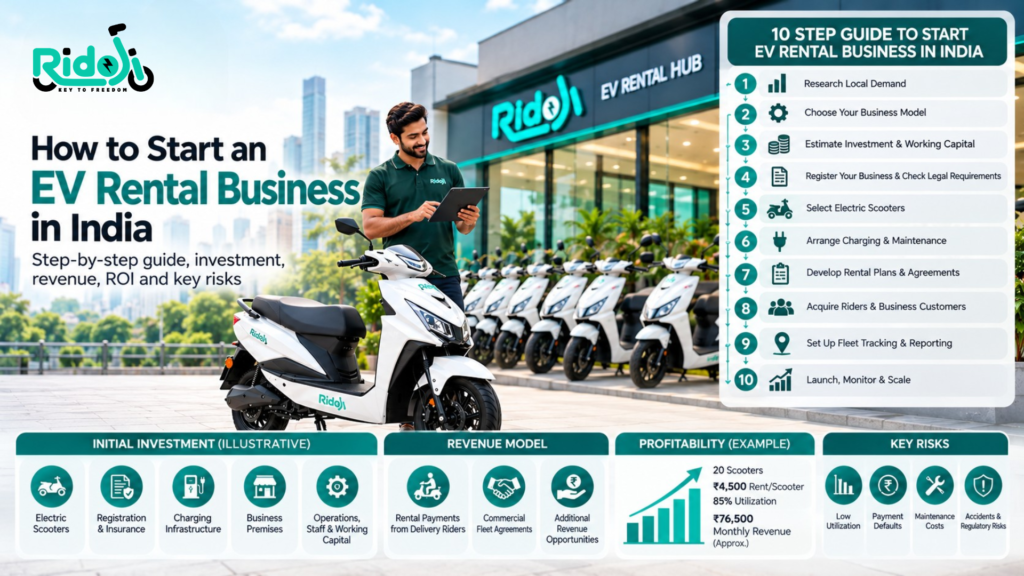
How to Start an EV Rental Business in India — Step-by-Step
Starting an EV Rental Business in India requires more than purchasing electric scooters and offering them to delivery riders. Entrepreneurs must understand local demand, select suitable vehicles, estimate business expenses, comply with applicable regulations, and establish a reliable operational system.
Electric mobility presents opportunities in commercial rentals and last-mile delivery, but the success of an EV rental business depends on how efficiently vehicles are deployed, maintained, monitored, and rented.
A well-planned rental operation should focus on three important objectives:
- Maintaining consistent demand for rental scooters.
- Controlling vehicle ownership and operating expenses.
- Keeping electric scooters commercially active with minimum avoidable downtime.
Whether you are planning to start an independent electric scooter rental business or exploring a company-managed EV rental franchise, the following steps can help you evaluate the opportunity.
How to Start an EV Rental Business in India: 10 Essential Steps
Step 1: Research Local EV Rental Demand
The first step in starting an EV Rental Business in India is identifying where customers genuinely need electric scooters.
For a commercial scooter rental business, delivery riders can be an important customer segment.
Riders working in food delivery, grocery delivery, quick commerce, courier services, pharmacy deliveries, and other last-mile operations often require reliable two-wheelers for daily work.
However, demand differs between cities and neighbourhoods.
For example, rental demand in areas with restaurants, cloud kitchens, grocery warehouses, commercial markets, and high delivery activity may differ from demand in residential areas with limited commercial movement.
Before selecting a location, research:
- Number of active delivery riders in the area.
- Existing electric scooter rental providers.
- Average daily distances travelled by riders.
- Typical rental budgets.
- Access to charging facilities.
- Local competition and its pricing.
- Demand from businesses requiring commercial fleets.
- Maintenance and servicing availability.
Practical tip: Speak with at least 20–30 potential rental customers before purchasing your initial fleet. This is a market-research suggestion, not a guaranteed threshold for business success.
The goal is to establish whether riders are willing to rent electric scooters at a price that can support your operating costs.
Step 2: Choose Your EV Rental Business Model
After identifying local demand, select the operating model.
Entrepreneurs can generally explore four approaches.
Self-managed EV rental business
You purchase or finance electric scooters and personally manage customers, rental collections, maintenance, and daily operations.
EV rental franchise
You operate under an established company’s brand and follow its contractual business structure.
Company-managed EV fleet model
You contribute agreed capital or assets while an operating company manages specified fleet activities.
Business-to-business EV leasing
You provide electric scooters to businesses through commercial rental agreements.
The right approach depends on capital availability, operating experience, desired involvement, and acceptable business risk.
For entrepreneurs looking for structured fleet operations, a managed model such as Ridoji’s EV rental and franchise ecosystem may be worth evaluating.
However, all responsibilities, expenses, payout terms, and ownership arrangements should be verified through the written agreement.
Step 3: Estimate Initial Investment and Working Capital
Before investing in electric scooters, calculate the complete startup cost.
The initial budget should include more than vehicle purchase prices.
Potential startup expenses include:
- Electric scooter procurement.
- Vehicle registration and insurance.
- Charging arrangements.
- Business premises and security deposit.
- Fleet management software.
- Maintenance tools and equipment.
- Staff recruitment.
- Marketing.
- Legal and accounting support.
- Working capital.
Many first-time entrepreneurs underestimate the money required to operate the fleet after launch.
Working capital is especially important because customer acquisition may take time, scooters may remain unused, and maintenance expenses may arise before rental collections stabilize.
A well-prepared budget should cover both initial investment and recurring expenses.
Step 4: Register Your Business and Check Legal Requirements
Before launching a commercial electric scooter rental business, entrepreneurs must establish a suitable legal structure and determine which registrations, licences, permissions, and insurance arrangements apply.
Common business structures include:
- Sole proprietorship.
- Partnership.
- Limited Liability Partnership (LLP).
- Private Limited Company.
The appropriate structure depends on ownership, liability, taxation, financing, and business objectives.
Depending on location and operations, entrepreneurs may also need business registrations, applicable tax registrations, local permissions, vehicle registration, suitable insurance, and rental-specific authorizations.
For self-drive motorcycle rentals, the Rent a Motor Cycle Scheme, 1997 establishes an operator licensing framework. Its applicability and implementation must be checked with the relevant State Transport Authority, particularly when operating electric scooters for commercial rental purposes.
Businesses can review the official Ministry of Corporate Affairs portal for company-related registration information and consult their state transport authority about rental operations.
Important: Do not assume that registering a business or purchasing ordinary road-registered electric scooters is sufficient authorization to operate a rental fleet. Vehicle classification, intended use, permits, and applicable state-level requirements should be confirmed before launch.
Step 5: Select Electric Scooters for Commercial Rental
Selecting the right electric scooter is one of the most important decisions in an EV Rental Business in India.
A vehicle suitable for occasional personal commuting may not necessarily be ideal for daily commercial delivery operations.
Delivery riders may cover substantial distances, stop frequently, operate in traffic, and require dependable vehicle availability.
Before buying scooters, evaluate:
Battery range: Can the vehicle support the intended daily rental usage?
Charging time: How long will the vehicle remain unavailable during charging?
Vehicle durability: Are the suspension, tyres, brakes, and other components suitable for frequent use?
Battery warranty: What conditions apply to battery replacement and degradation?
Service support: Are authorised technicians and spare parts available nearby?
Rider comfort: Is the scooter suitable for repeated city trips?
Payload and storage: Does the vehicle meet the intended use and manufacturer requirements?
Total ownership cost: What will the scooter cost to operate and maintain over its expected service life?
Before committing to a large purchase, consider testing a small number of vehicles in real operating conditions.
Step 6: Arrange Charging and Maintenance Infrastructure
Charging arrangements directly affect fleet availability.
A scooter without sufficient battery charge cannot support the intended rental operation.
Entrepreneurs should decide whether charging will be handled by riders, the rental company, charging partners, or through an agreed battery-swapping arrangement.
Important considerations include electricity availability, charging equipment compatibility, safe electrical installations, charging time, battery health, and emergency support.
Maintenance planning is equally important.
Commercially used electric scooters require regular inspection of brakes, tyres, suspension, lights, electrical connections, and battery systems.
Before starting operations, define:
- Service schedules.
- Approved repair facilities.
- Breakdown response procedures.
- Damage inspection processes.
- Battery health checks.
- Spare-parts availability.
- Vehicle recovery arrangements.
A reliable servicing system helps limit avoidable vehicle downtime.
Step 7: Develop Rental Plans and Agreements
An electric scooter rental business should offer clear and commercially sustainable pricing.
Depending on demand, rental plans may be daily, weekly, monthly, or contract-based.
Before setting rental prices, calculate:
- Vehicle acquisition cost.
- Depreciation.
- Financing costs, if applicable.
- Insurance.
- Maintenance.
- Charging responsibility.
- Fleet management expenses.
- Expected utilization.
- Customer acquisition costs.
- Taxes and applicable fees.
Rental agreements should define vehicle handover conditions, customer responsibilities, payment dates, deposit terms, permitted usage, damage liability, insurance arrangements, maintenance responsibilities, and return procedures.
Clear terms reduce disputes and improve operational transparency.
Step 8: Build Rider Partnerships and Acquire Customers
After establishing the fleet, the next challenge is attracting reliable rental customers.
An EV Rental Business in India should not depend entirely on walk-in enquiries.
Potential customer acquisition channels include delivery rider communities, local business partnerships, online enquiries, referrals, and commercial fleet agreements.
Businesses can also approach restaurants, cloud kitchens, grocery stores, courier operators, and other organizations requiring regular delivery mobility.
For effective customer acquisition, communicate:
- Rental plan duration.
- Vehicle specifications.
- Charging arrangements.
- Maintenance support.
- Deposit requirements.
- Vehicle availability.
- Agreement terms.
Avoid promising riders guaranteed delivery earnings. Rental providers generally do not control the work allocation, incentive structure, or earnings of third-party delivery platforms.
Step 9: Establish Fleet Tracking and Reporting
As fleet size increases, manual tracking becomes more difficult.
A fleet management system can help monitor vehicles, rental periods, servicing, payment status, and operational performance.
Useful indicators include:
- Number of active rental scooters.
- Fleet utilization rate.
- Average rental revenue per vehicle.
- Vehicle downtime.
- Maintenance expense per vehicle.
- Rental collection efficiency.
- Customer retention.
- Vehicle availability.
These indicators help operators identify operational problems early.
For example, if several scooters remain idle while others experience frequent breakdowns, the company may need to review customer demand, maintenance practices, and fleet allocation.
This is where professionally managed EV fleet systems become especially valuable.
Step 10: Launch, Monitor and Scale Operations
Once vehicles, documents, customers, and operational processes are ready, the rental business can begin operations.
However, launching a fleet should be treated as the beginning of the learning process.
Entrepreneurs should monitor performance before adding more vehicles.
A sensible approach is to evaluate a pilot fleet’s utilization, operating expenses, maintenance needs, customer feedback, and cash collections.
If the results demonstrate sustainable demand and positive operating economics, the business can consider expansion.
Adding vehicles before establishing reliable demand may increase financial pressure.
The objective is not to operate the largest electric scooter fleet immediately. It is to build a fleet that can remain commercially useful and financially sustainable.
How Much Does It Cost to Start an EV Rental Business in India?
The investment required depends on scooter prices, fleet size, business location, infrastructure requirements, and the selected operating model.
A self-managed rental business may require direct funding for vehicles, premises, personnel, maintenance, and technology.
A franchise or company-managed model may include different fees, cost-sharing arrangements, and operational responsibilities.
Electric Scooter Purchase and Registration Costs
Vehicles often represent a major part of fleet startup expenses.
Entrepreneurs should request quotations covering the complete on-road acquisition cost, including applicable taxes, registration, and insurance.
Costs can vary substantially between models and battery configurations.
Charging Infrastructure and Premises Costs
A rental fleet may need a suitable location for vehicle parking, inspection, charging, customer onboarding, or servicing.
The costs will depend on the business location, power requirements, and charging arrangements.
Maintenance, Insurance and Staffing Expenses
An EV rental business should budget for routine servicing, tyre replacement, brake maintenance, accidental repairs, insurance, employee expenses, and customer support.
Major battery replacement costs should also be considered in long-term financial planning.
Marketing, Technology and Working Capital
Customer acquisition, payment systems, fleet tracking, administrative costs, and emergency operating reserves can affect the overall financial requirement.
Working capital should not be ignored merely because the vehicles have already been purchased.
EV Rental Business Startup Cost: Illustrative Example
The following example shows how an entrepreneur might prepare an initial budget for a fleet of 20 electric scooters.
These are hypothetical planning assumptions, not verified market quotations or Ridoji franchise prices.
| Cost Component | Illustrative Amount |
| 20 electric scooters at ₹90,000 each | ₹18,00,000 |
| Registration and insurance allowance | ₹1,00,000 |
| Charging and electrical setup | ₹1,50,000 |
| Premises and basic infrastructure | ₹1,00,000 |
| Technology and onboarding | ₹50,000 |
| Initial marketing and administration | ₹50,000 |
| Working capital reserve | ₹2,50,000 |
| Illustrative Total Investment | ₹25,00,000 |
This example is intended to explain how startup costs are organized. Actual expenses may be higher or lower depending on city, vehicles, commercial registration requirements, and operating arrangements.
Entrepreneurs should obtain written vendor quotations and calculate applicable taxes before creating a final budget.
An EV Rental Business in India primarily generates revenue by providing electric scooters or other electric vehicles to customers under rental or commercial leasing agreements.
Unlike a traditional vehicle dealership, where revenue usually comes from selling a vehicle, the rental business focuses on earning revenue from repeated commercial use of its fleet.
Understanding the difference between revenue and profit is important because rental collections must cover expenses before the business can generate a financial surplus.
1. Rental Payments from Delivery Riders
Delivery riders can be an important customer segment for electric scooter rental businesses.
Riders working in food delivery, grocery delivery, courier services, and quick commerce may need electric scooters for daily commercial work.
A rental company may offer daily, weekly, or monthly plans based on customer requirements.
For example, a rider may rent a scooter for an agreed monthly fee instead of purchasing a vehicle.
The rental company receives the payment while remaining responsible for the services and obligations specified in the rental agreement.
However, rental revenue can be affected by payment delays, vehicle downtime, customer churn, and periods when scooters remain unused.
2. Commercial Fleet Rental Agreements
Another potential revenue source is providing electric scooter fleets directly to businesses.
Commercial customers may include:
- Restaurants and cloud kitchens.
- Grocery delivery companies.
- Courier and logistics operators.
- E-commerce businesses.
- Pharmacy delivery providers.
- Hyperlocal delivery services.
These businesses may require multiple vehicles for regular operational use.
A rental operator can explore commercial agreements covering fleet size, rental duration, maintenance responsibilities, and payment terms.
Such arrangements may help structure customer demand, although contract renewals and payment collections are not guaranteed.
3. Additional Revenue Opportunities
Depending on the operating model, an electric scooter rental company may offer additional services, including fleet management, maintenance, charging services, and related commercial mobility solutions.
These opportunities should only be included in financial projections when the company has the legal ability, operating capacity, and customer demand to provide them.
How to Calculate EV Rental Business Profitability and ROI
Profitability is one of the most important considerations when evaluating an EV Rental Business in India.
An entrepreneur should not calculate earnings simply by multiplying the number of scooters by the advertised rental rate.
The calculation must also account for vehicle utilization, collection losses, recurring operating expenses, depreciation, and other applicable costs.
Example: Monthly Revenue from a 20-Scooter EV Rental Fleet
Assume a hypothetical EV rental business with the following operating conditions:
| Business Metric | Illustrative Value |
| Total electric scooters | 20 |
| Monthly rent per active scooter | ₹4,500 |
| Average fleet utilization | 85% |
| Potential revenue at 100% utilization | ₹90,000 |
| Estimated monthly rental revenue | ₹76,500 |
The revenue calculation is:
20 scooters × ₹4,500 × 85% = ₹76,500 per month
This assumes that the stated rent is the operator’s revenue excluding applicable GST and that the 85% utilization factor reasonably reflects billable rental activity.
It is an illustrative calculation, not a verified Ridoji rental rate or financial projection.
Illustrative Monthly Operating Expenses
| Expense Category | Monthly Amount |
| Premises and utilities | ₹10,000 |
| Staffing and administration | ₹12,000 |
| Maintenance and repairs | ₹6,000 |
| Fleet software and monitoring | ₹2,000 |
| Insurance provision | ₹3,000 |
| Marketing and customer acquisition | ₹2,000 |
| Other operating expenses | ₹3,000 |
| Total Monthly Operating Expenses | ₹38,000 |
Estimated monthly operating surplus:
₹76,500 − ₹38,000 = ₹38,500
This is an illustrative operating surplus before depreciation, financing costs, major battery replacements, taxes, and any other expenses not included in the table.
It should not be interpreted as net profit or investor payout.
Understanding Return on Investment
A simplified annualized operating-surplus calculation using the illustrative startup investment of ₹25 lakh is:
₹38,500 × 12 = ₹4,62,000 annual operating surplus
Annual operating surplus ÷ Initial investment × 100
₹4,62,000 ÷ ₹25,00,000 × 100 = 18.48%
This 18.48% is not a net investment return or a forecast. It is a simplified operating-surplus-to-initial-capital ratio before depreciation, financing, major asset replacements, taxes, and other omitted costs.
Actual net ROI may be significantly lower or negative.
To assess profitability accurately, entrepreneurs should prepare monthly cash-flow statements, calculate asset depreciation, include battery replacement provisions, and model different utilization scenarios.
How Fleet Utilization Affects EV Rental Business Revenue
Fleet utilization is one of the most important operating metrics in an electric scooter rental business.
It measures how much of the available fleet is deployed for revenue-generating use.
For example, a fleet of 20 scooters may generate different monthly revenue depending on how many vehicles are actively rented.
| Fleet Utilization | Estimated Monthly Revenue |
| 50% | ₹45,000 |
| 60% | ₹54,000 |
| 70% | ₹63,000 |
| 80% | ₹72,000 |
| 90% | ₹81,000 |
| 100% | ₹90,000 |
Assumptions: 20 scooters and ₹4,500 monthly rent per active scooter, before collection losses and operating expenses.
This comparison demonstrates why vehicle utilization matters.
A larger fleet does not automatically create more profit. If additional scooters remain idle, the business may incur more capital costs without receiving corresponding rental revenue.
For this reason, entrepreneurs should monitor utilization and customer demand before expanding.
Common Risks of Starting an EV Rental Business in India
Every business carries risk, and electric scooter rentals are no exception.
A responsible entrepreneur should identify these challenges before investing capital.
1. Low Vehicle Utilization and Idle Scooters
If riders or businesses do not rent the available vehicles, rental revenue may decrease.
Idle scooters can still create expenses related to insurance, depreciation, storage, and maintenance.
2. Rider Payment Defaults and Collection Delays
Rental businesses may experience delayed payments or customer defaults.
A clear rental agreement, customer verification, appropriate deposits, and consistent payment management can help limit collection problems.
3. Battery Degradation and Maintenance Costs
Electric scooter batteries degrade over time.
Commercial usage may increase wear on tyres, brakes, suspension, and other components.
Unexpected servicing and battery replacement can affect profitability.
4. Accidents, Insurance and Vehicle Damage
Rental vehicles can experience accidents, damage, theft, or misuse.
Operators should maintain suitable insurance and clearly document customer responsibilities.
5. Charging Downtime and Operating Inefficiencies
Poor charging arrangements may reduce the number of scooters available for rental.
Charging compatibility, electricity availability, and battery maintenance are essential operational considerations.
6. Legal, Regulatory and Contractual Risks
Vehicle rental businesses must comply with applicable laws, licensing requirements, insurance conditions, and local transport rules.
Self-drive rental arrangements require particular attention to the applicable licensing framework.
Tax obligations also matter. For rental services, the standard GST registration threshold is generally ₹20 lakh in annual aggregate turnover, with lower thresholds in certain states and additional compulsory-registration rules in specified circumstances. Operators should confirm the current rules and the applicable tax treatment with a qualified tax professional.
A business should also confirm whether its vehicles are registered and insured for the intended rental activity.
How to Reduce Risks in an EV Rental Business
Although business risks cannot be eliminated, entrepreneurs can take steps to manage them.
Start with proven demand: Assess rider and commercial customer requirements before purchasing vehicles.
Choose suitable scooters: Select vehicles with dependable servicing, appropriate battery range, and available spare parts.
Maintain clear agreements: Define rental payments, responsibilities, insurance, damages, and return conditions.
Track operating performance: Monitor utilization, collections, maintenance, and downtime.
Maintain adequate reserves: Keep working capital available for repairs, expenses, and periods of weaker demand.
Expand gradually: Increase fleet size only when operational performance and customer demand justify it.
Verify regulatory requirements: Confirm applicable licences, permits, registrations, insurance, and tax obligations before operating.
These practices can help entrepreneurs make more informed decisions while building a commercially sustainable business.
Conclusion: Build a Sustainable EV Rental Business
Starting an EV Rental Business in India requires a combination of market research, financial planning, electric scooter selection, regulatory compliance, rental pricing, and fleet management.
The opportunity should not be evaluated solely on the number of scooters purchased or the revenue they might generate under ideal conditions.
The more important factors are actual rental demand, vehicle utilization, reliable collections, maintenance costs, and operational discipline.
Entrepreneurs who understand these elements are better positioned to evaluate whether an EV rental business is commercially viable.
For people who prefer not to independently manage riders, servicing, and daily vehicle operations, a company-managed EV rental model may offer another structure to explore.
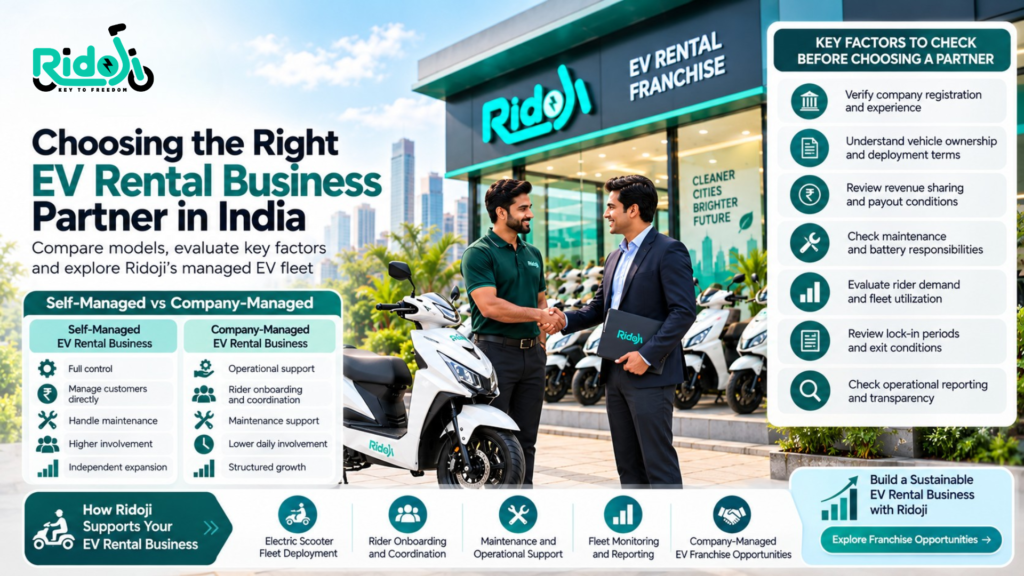
Choosing the Right EV Rental Business Model and Partner in India
Starting an EV Rental Business in India requires careful planning, but choosing the right operating structure is equally important for long-term business performance.
After understanding market demand, evaluating startup costs, selecting electric scooters, and calculating potential rental revenue, entrepreneurs must decide how they want to manage the business.
Some business owners prefer to control every aspect of their rental operations, from scooter procurement to rider onboarding and maintenance.
Others may prefer working with an established electric vehicle fleet management company that can handle specified operational responsibilities.
Both approaches have advantages and limitations.
The best choice depends on investment capacity, operational experience, available time, business objectives, and willingness to manage financial and operational risks.
Self-Managed vs Company-Managed EV Rental Business: Which Is Better?
One of the most important decisions when starting an EV Rental Business in India is whether to operate independently or explore a managed fleet arrangement.
What Is a Self-Managed EV Rental Business?
A self-managed electric scooter rental business is operated directly by the entrepreneur.
The business owner typically handles scooter purchases, customer acquisition, rental pricing, rider verification, collections, maintenance coordination, and everyday operations.
This approach provides greater control over business decisions.
However, it also requires time, staff, industry knowledge, and a dependable local operating system.
Advantages of a self-managed business:
- Greater control over rental pricing.
- Direct customer relationships.
- Freedom to select vehicles and suppliers.
- Flexibility to change business strategy.
- Independent control over expansion decisions.
Potential challenges:
- Higher daily operational involvement.
- Responsibility for customer acquisition.
- Maintenance and breakdown management.
- Rental collection and payment risks.
- Staffing and administrative requirements.
This model may be suitable for entrepreneurs who have experience in vehicle rentals, logistics, fleet operations, or related businesses.
What Is a Company-Managed EV Rental Business?
A company-managed EV rental business involves delegating agreed operational activities to an established fleet management company.
Depending on the agreement, the operating company may coordinate electric scooter deployment, rider onboarding, maintenance, rental collections, and fleet monitoring.
The entrepreneur or partner contributes agreed capital, assets, or infrastructure and receives the financial benefits defined in the contract.
This arrangement can reduce direct day-to-day management responsibilities.
However, it also creates dependence on the operating company’s performance, financial strength, and contractual commitments.
Potential advantages of a company-managed model:
- Reduced direct involvement in daily fleet operations.
- Access to existing operational processes.
- Support with rider coordination.
- Structured maintenance arrangements.
- Fleet monitoring and reporting.
- Potential for expansion through an established operating system.
Potential challenges:
- Less control over operational decisions.
- Dependence on the management company.
- Contractual restrictions.
- Management or franchise fees.
- Financial and counterparty risks.
A managed model should not be considered risk-free. Investors must still review expenses, asset ownership, payout conditions, financial reporting, and exit arrangements.
Self-Managed vs Company-Managed EV Rental Business Comparison
| Comparison Factor | Self-Managed EV Rental Business | Company-Managed EV Rental Business |
| Vehicle procurement | Usually managed by owner | As specified in agreement |
| Rider onboarding | Owner’s responsibility | May be handled by operator |
| Fleet maintenance | Owner arranges | May be coordinated by operator |
| Rental collections | Owner manages | Depends on agreement |
| Daily involvement | Generally high | Generally lower |
| Pricing control | Greater direct control | Contract-dependent |
| Technology and reporting | Owner must arrange | May be provided |
| Operational expenses | Owner generally bears costs | Allocated through agreement |
| Expansion | Independently managed | May receive company support |
| Financial risk | Present | Present |
Which model is better?
An independent EV rental business may be more suitable for experienced entrepreneurs who want direct control.
A company-managed EV rental model may appeal to investors and business owners who prefer operational support.
Neither model guarantees profitability. Both should be assessed through realistic costs, expected customer demand, and clearly defined responsibilities.
How to Choose the Right EV Rental Business Partner in India
Selecting a reliable business partner can influence the performance of an electric scooter rental operation.
An entrepreneur should evaluate more than promotional claims, franchise fees, or projected rental income.
The following factors deserve careful attention.
1. Verify Company Registration and Operational Experience
Before entering a franchise or management agreement, verify the company’s legal identity.
Check its registered name, Corporate Identification Number, office address, and available statutory records.
Company-related information can be reviewed through the official Ministry of Corporate Affairs portal.
Also assess the company’s practical experience in electric scooter rentals, commercial fleet deployment, and customer support.
A business partner should be able to explain its operating processes and provide suitable evidence of its capabilities.
2. Review Vehicle Ownership and Deployment Terms
Vehicle ownership is particularly important in asset-based rental arrangements.
Before investing, understand:
- Who purchases the electric scooters?
- Whose name appears on the registration documents?
- Who holds legal title to the vehicles?
- Who is responsible for insurance?
- Can the vehicles be transferred or sold?
- What happens to the vehicles after the agreement ends?
Ownership should be clearly established in the contractual documents.
3. Understand Revenue Sharing and Payout Conditions
Different EV rental business models use different payment arrangements.
An independent operator may receive rental payments directly from customers.
A franchise or managed fleet arrangement may involve revenue sharing, management fees, or contract-defined payouts.
Before selecting a partner, clarify whether projected income depends on actual rental collections, vehicle utilization, company performance, or separate contractual obligations.
Revenue, operating profit, investor payouts, and return on investment are different financial measures.
The business should explain each measure clearly.
4. Check Maintenance and Battery Responsibilities
Electric scooter maintenance affects vehicle availability and profitability.
A rental agreement should explain who pays for routine servicing, batteries, tyres, brakes, accident repairs, and unexpected breakdowns.
Investors should also understand the process for replacing damaged or unusable vehicles.
Unclear maintenance responsibilities can create financial disputes.
5. Evaluate Rider Demand and Fleet Utilization
A rental business needs customers who can make productive use of its vehicles.
Before partnering with an operator, ask how the company acquires riders, deploys vehicles, and manages returned scooters.
Useful operational indicators include fleet utilization, vehicle downtime, rental collection performance, and customer retention.
A company with many scooters is not necessarily more profitable than one with fewer but consistently deployed vehicles.
6. Review Lock-In Periods and Exit Conditions
Every franchise or business management agreement should explain how the relationship can end.
Review:
- Agreement tenure.
- Early termination conditions.
- Penalties or exit charges.
- Vehicle ownership after termination.
- Asset resale or transfer provisions.
- Outstanding payment obligations.
- Dispute resolution procedures.
Understanding exit conditions is as important as understanding projected income.
7. Check Operational Reporting and Transparency
Professional fleet management should be supported by reliable records.
Depending on the arrangement, investors may need access to vehicle deployment reports, maintenance records, rental collections, operating expenses, and payment statements.
Before signing, confirm which reports will be available and how frequently they will be provided.
How Ridoji Supports EV Rental Business Operations
Ridoji is an electric mobility business focused on managed electric scooter fleets, rider rentals, and commercial vehicle deployment.
Its business ecosystem connects electric scooter operations with the mobility requirements of delivery riders and businesses.
For entrepreneurs researching how to start an EV rental business in India, Ridoji represents a managed fleet approach that can be evaluated alongside independent rental operations.
According to Ridoji’s published service information, its operating model includes electric scooter rentals, rider onboarding, maintenance support, and fleet management.
1. Electric Scooter Fleet Deployment
Vehicle deployment is a central part of a commercial EV rental business.
Scooters must be made available to eligible riders or businesses requiring transport for daily operations.
Ridoji’s managed fleet ecosystem focuses on connecting electric vehicles with commercial mobility demand.
The aim of effective deployment is to minimize avoidable idle periods while maintaining appropriate vehicle availability.
2. Delivery Rider Onboarding and Coordination
Delivery riders form an important customer group within Ridoji’s rental ecosystem.
Ridoji’s rider onboarding process includes registration, document verification, and vehicle collection through its operating arrangements.
An organized onboarding system can help establish customer records and support rental operations.
For entrepreneurs, rider coordination is an important part of maintaining fleet utilization.
3. Maintenance and Operational Support
Regular maintenance helps keep electric scooters available for rental use.
Ridoji describes maintenance and rider support as part of its scooter rental offering.
Its published rider information refers to servicing, tyre replacement, and roadside support under applicable rental plans.
Prospective franchise partners should separately verify which maintenance expenses are included in their particular agreement and which remain their responsibility.
4. Fleet Monitoring and Reporting
A professionally managed rental fleet requires information about vehicle activity, servicing, and operational performance.
Fleet monitoring processes can help identify underutilized vehicles, maintenance issues, and deployment challenges.
Prospective partners should request details about the reporting systems and performance information available under Ridoji’s current agreement.
5. Company-Managed EV Franchise Opportunities
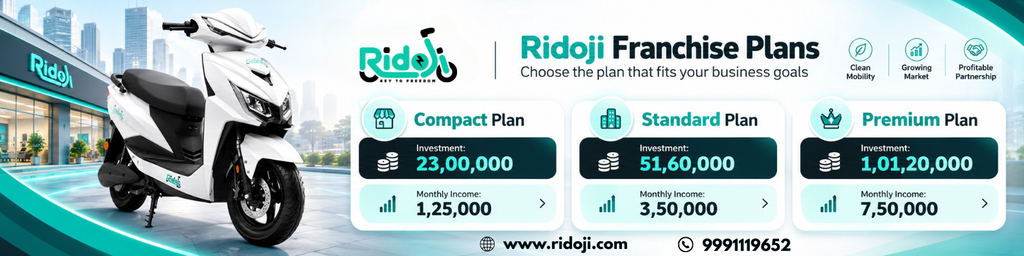
Ridoji also offers franchise opportunities for entrepreneurs interested in participating in its electric mobility ecosystem.
Its published franchise offering includes different configurations based on investment amounts and premises requirements.
These plans should be evaluated separately from a conventional self-owned rental startup because the franchise investment structure, business responsibilities, and payout arrangements may be different.
Investors should request the latest franchise brochure and agreement before making any commitment.
Explore Ridoji’s franchise opportunities: https://ridoji.com/franchise/
Who Should Consider Ridoji’s EV Rental Franchise Model?
A managed EV fleet franchise may be relevant to different categories of entrepreneurs.
First-Time EV Entrepreneurs
Individuals who want to enter the electric mobility industry but do not have experience managing vehicle rentals may consider a structured franchise model.
They should verify the operating company’s capabilities and review every contractual obligation before investing.
Existing Business Owners
Entrepreneurs already operating businesses may explore EV fleet rental opportunities as a form of business expansion or diversification.
The investment should be evaluated according to available capital, business objectives, and acceptable risks.
Entrepreneurs Interested in Commercial Mobility
Business owners interested in delivery logistics, electric scooter rentals, and fleet operations may find Ridoji’s commercial mobility model relevant.
They should assess the actual services, infrastructure, and business responsibilities included in the partnership.
Investors Seeking Reduced Operational Involvement
A company-managed model may appeal to investors who prefer not to personally coordinate riders and vehicle servicing.
However, reduced daily involvement does not remove financial risks, contractual responsibilities, or the need for ongoing oversight.
Questions to Ask Before Starting an EV Rental Business with Ridoji
Before selecting a Ridoji franchise or managed fleet arrangement, request clear written answers to the following questions.
- What is the complete investment amount?
- What is included in the selected plan?
- How many electric scooters are involved?
- Who legally owns and registers the vehicles?
- What space or infrastructure is required?
- Who manages rider onboarding and vehicle deployment?
- Who pays for charging, maintenance, and battery replacement?
- How are business payouts calculated?
- Are payments based on operations or separate contractual commitments?
- What expenses and deductions apply?
- What operational reports are available?
- What is the agreement duration?
- Are there lock-in or early termination conditions?
- What happens to vehicle assets at the end of the agreement?
- What remedies are available if either party fails to meet its obligations?
These questions can help entrepreneurs evaluate whether the proposed arrangement matches their financial and operational expectations.
Final Checklist for Starting an EV Rental Business in India
Before launching an EV Rental Business in India, review the following essential requirements.
| Business Requirement | What to Check |
| Local market research | Rider demand and commercial customers |
| Business model | Independent, franchise, managed fleet, or B2B |
| Investment planning | Vehicle costs, infrastructure, working capital |
| Legal compliance | Business registrations and applicable rental permissions |
| Vehicle selection | Battery range, durability, servicing support |
| Insurance | Coverage appropriate to the intended rental use |
| Charging infrastructure | Safe and reliable charging arrangements |
| Rental pricing | Costs, utilization, and customer affordability |
| Customer onboarding | Verification, documentation, rental agreements |
| Fleet management | Tracking, maintenance, deployment |
| Business profitability | Revenue, expenses, depreciation, cash flow |
| Risk management | Defaults, breakdowns, downtime, liquidity |
| Business partnership | Responsibilities, reporting, contractual terms |
| Expansion plan | Evidence of sustainable demand and operations |
A business should move forward only when its operating plan, financial assumptions, and compliance requirements have been properly evaluated.
Final Thoughts: Is an EV Rental Business a Good Opportunity in India?
An EV Rental Business in India can offer entrepreneurs a way to participate in the country’s electric mobility and last-mile delivery ecosystem.
Electric scooters may serve delivery riders, logistics businesses, restaurants, grocery delivery operations, and other commercial customers.
However, entering the EV rental market requires more than purchasing electric vehicles.
Business performance depends on vehicle utilization, customer demand, operating expenses, maintenance quality, payment collections, and effective management.
Entrepreneurs can start independently, join a franchise, or evaluate company-managed EV fleet arrangements.
The most suitable model depends on how much capital they can invest, how actively they want to participate, and how comfortable they are with the associated risks.
Ridoji’s managed EV fleet ecosystem offers one model for entrepreneurs to explore.
Before selecting any franchise or rental business partner, review the company’s operations, verify its documentation, and understand the complete commercial agreement.
The right approach to starting an EV rental business is to build around real demand, realistic financial assumptions, and dependable operations.
Start Your EV Rental Business Journey with Ridoji
Interested in exploring electric scooter rentals and managed EV fleet opportunities?
Ridoji works within India’s commercial EV mobility ecosystem, supporting electric scooter deployment and rider rental operations.
Learn about its franchise opportunities, available business models, premises requirements, and operating arrangements.
Explore Ridoji Franchise Plans: https://ridoji.com/franchise/
Ridoji Website: https://ridoji.com/
Contact: +91 9991119652
Contact the Ridoji team to request the latest official franchise brochure and clarify the investment, operating, and agreement terms before deciding.