Introduction: Is an EV Franchise Business in India a Good Opportunity?
EV Franchise Business in India is becoming an increasingly relevant opportunity for entrepreneurs who want to participate in the country’s electric mobility sector without necessarily building a completely new business from the ground up.
For decades, people looking to start a franchise business in India have explored restaurants, retail stores, automobile dealerships, education centres, and service businesses. Today, electric mobility is creating another category of business opportunities.
Electric scooters are being used for personal transportation, delivery services, courier operations, grocery delivery, and last-mile logistics. As businesses and riders explore electric vehicles, demand is developing not only for EV sales but also for rental services, charging, maintenance, and professionally managed vehicle fleets.
This is where the EV franchise model becomes interesting.
An entrepreneur may not have the experience or operational infrastructure to independently manage electric scooters, riders, batteries, maintenance teams, and rental collections. Working with an established EV business can provide access to an existing business model, brand identity, technology, and operational support, depending on the franchise agreement.
However, not every EV franchise is the same.
Some franchises focus on selling electric vehicles. Others provide electric scooters on rent, operate charging stations, or manage commercial EV fleets.
The important question is not simply which EV franchise offers attractive projected income. It is which business model has genuine demand, clear responsibilities, realistic economics, and reliable operational management.
In this guide, we will explore how EV franchises work, the different business models available, investment considerations, potential benefits, and the questions entrepreneurs should ask before choosing a franchise partner.
We will also explain how company-managed EV fleet models, including Ridoji’s franchise offering, fit into India’s evolving electric mobility ecosystem.
What Is an EV Franchise Business in India?
An EV Franchise Business in India is a commercial partnership in which an entrepreneur or investor works with an established electric vehicle company to operate, fund, or participate in an EV-related business under an agreed brand and operating structure.
Unlike starting an independent business, a franchise may provide access to an established brand, operational systems, business processes, technology, and supplier relationships.
The exact responsibilities depend on the franchise model.
For example, one EV franchise owner may operate a showroom and sell electric scooters directly to customers. Another may invest in electric scooters that are rented to delivery riders. A third may own charging infrastructure, while a company handles day-to-day operations.
An EV franchise business may involve:
- Electric vehicle sales and dealership operations.
- Electric scooter rental services.
- Commercial EV fleet deployment.
- Battery charging or swapping services.
- Maintenance and servicing support.
- Rider onboarding and coordination.
- Fleet monitoring and operational reporting.
The franchise company and franchise partner agree on their respective responsibilities through a written agreement.
For investors, understanding these responsibilities is extremely important.
A business where the investor manages daily operations is fundamentally different from one where the company handles operations.
How Does an EV Franchise Business Work?
Although the exact process varies, an EV franchise generally follows these steps:
Step 1: Select the franchise model
The entrepreneur first decides whether to participate in EV dealerships, scooter rentals, charging infrastructure, or managed fleet operations.
Step 2: Evaluate the franchise company
The investor reviews company credentials, business experience, operational capabilities, investment requirements, and contractual terms.
Step 3: Review the investment structure
The franchise provider explains the capital required, infrastructure requirements, operating expenses, revenue model, and potential financial outcomes.
Step 4: Sign the franchise agreement
Both parties establish their legal rights, financial responsibilities, agreement tenure, support obligations, and exit conditions.
Step 5: Establish the business
Depending on the arrangement, the business may require a showroom, electric scooter fleet, charging facilities, office, or operations hub.
Step 6: Begin commercial operations
The business starts generating revenue through its chosen activity, such as vehicle sales, scooter rentals, fleet deployment, or charging services.
Step 7: Monitor performance
Operational reports, revenue, expenses, asset utilization, and agreement obligations should be reviewed regularly.
A franchise agreement can provide operational structure, but business performance still depends on actual demand, costs, execution, and the responsibilities assigned to each party.
Why EV Franchise Opportunities Are Growing in India
India’s electric mobility ecosystem is creating opportunities for entrepreneurs across vehicle sales, fleet operations, infrastructure, and supporting services.
Several factors explain why EV franchise opportunities are receiving attention.
1. Increasing Adoption of Electric Two-Wheelers
Electric scooters are becoming an established vehicle category in India.
Their appeal includes lower dependence on petrol, quieter operation, zero tailpipe emissions, and suitability for many daily urban trips.
For entrepreneurs exploring an EV franchise business, this creates opportunities beyond simply selling vehicles.
Electric scooters also require distribution, servicing, charging support, rental management, and fleet operations.
As the installed base of electric vehicles grows, businesses supporting their practical use may also find opportunities to serve customers.
However, national EV adoption does not automatically guarantee sufficient customer demand in every franchise location.
2. Growing Demand for Last-Mile Delivery
Last-mile delivery has become an important part of urban commerce.
Food delivery companies, grocery platforms, pharmacies, courier services, e-commerce businesses, and local retailers depend on two-wheelers to transport goods efficiently.
Delivery riders need reliable vehicles to perform their work.
However, not every rider wants to purchase a scooter or commit to a vehicle loan.
This creates a potential market for electric scooter rental businesses that make vehicles available for commercial use.
An EV rental franchise may serve riders who need a vehicle for daily or weekly work while providing maintenance and operational support according to its rental terms.
For franchise investors, the key consideration is whether the business can consistently attract riders and keep vehicles commercially active.
3. Government Support for Electric Mobility
Government policy is another factor influencing India’s EV industry.
The Government of India’s PM E-DRIVE scheme supports electric mobility through measures covering eligible electric vehicle categories and charging infrastructure.
The programme also reflects the government’s broader efforts to strengthen the electric mobility ecosystem.
Entrepreneurs can review the official PM E-DRIVE scheme for details about supported vehicle categories, eligibility, notifications, and current policy conditions.
Government initiatives can support the industry, but investors should not assume that subsidies are automatically available to every franchise, vehicle purchase, or commercial arrangement.
4. Demand for Professionally Managed EV Fleets
Operating an electric scooter fleet involves much more than purchasing vehicles.
A commercial fleet business may need to manage:
- Rider onboarding and verification.
- Vehicle allocation and deployment.
- Rental collections.
- Maintenance and repairs.
- Battery health.
- Charging arrangements.
- Vehicle availability.
- Accident and damage management.
- Fleet tracking and reporting.
These activities require staff, processes, technology, and operational experience.
A company-managed EV franchise can be relevant to entrepreneurs who want to participate in the business while delegating specified operational responsibilities to an experienced fleet operator.
However, investors must check exactly which responsibilities the company accepts in writing.
5. Interest in Asset-Backed Business Opportunities
Some entrepreneurs prefer businesses connected to identifiable physical assets rather than operations based entirely on inventory turnover or customer footfall.
Electric scooter rental models can involve tangible fleet assets that are commercially deployed.
However, owning or funding vehicles does not guarantee income.
The actual economics depend on vehicle utilization, rider payments, maintenance expenses, asset depreciation, battery replacement, insurance, downtime, management fees, and other costs.
This is why EV fleet investment requires careful financial evaluation, even when the business is professionally managed.
Different Types of EV Franchise Business Models
Before starting an EV Franchise Business in India, entrepreneurs should understand that several distinct models operate within the electric mobility industry.
Each model has different investment requirements, operational responsibilities, and revenue sources.
1. Electric Scooter Dealership Franchise
An electric scooter dealership sells vehicles to individual customers and businesses.
The franchisee or dealer may be responsible for setting up the showroom, maintaining vehicle inventory, employing salespeople, managing enquiries, and providing customer service.
Revenue generally comes from vehicle sales margins and, where applicable, associated services.
Who should consider it?
Entrepreneurs interested in automobile sales, retail operations, customer acquisition, and dealership management.
What should investors check?
Brand demand, inventory requirements, dealership margins, sales targets, warranty obligations, and after-sales support.
2. EV Rental Franchise Business
An EV rental franchise provides electric scooters to customers, delivery riders, or businesses for agreed rental periods.
Instead of selling the vehicle, the business makes the scooter available for commercial or personal use.
Revenue usually comes from rental payments.
For example, a delivery rider may rent an electric scooter to work in food delivery, grocery delivery, or courier operations.
The rental business must ensure the vehicle remains available, maintained, and suitable for its intended use.
Who should consider it?
Entrepreneurs interested in recurring rental operations and commercial two-wheeler mobility.
What should investors check?
Rider demand, rental pricing, vehicle utilization, maintenance costs, payment collections, and fleet downtime.
3. EV Charging Station Franchise
An EV charging franchise focuses on operating charging infrastructure for electric vehicles.
Depending on the arrangement, the investor may provide land, charging equipment, electrical infrastructure, or capital.
Revenue can be linked to paid charging services or an agreed commercial arrangement with the charging-network operator.
However, charging station economics depend heavily on location, electricity tariffs, customer demand, equipment availability, and station utilization.
A charging station in a low-demand location may struggle financially even when the overall EV market is growing.
Who should consider it?
Entrepreneurs with suitable commercial property, charging infrastructure interest, and the capital required for the selected charging setup.
4. EV Fleet Management Franchise
An EV fleet management franchise focuses on deploying and operating electric vehicles for commercial use.
Its customer base may include delivery riders, logistics companies, courier businesses, and other organizations requiring regular mobility.
The franchise model may include fleet ownership, rental deployment, rider coordination, and maintenance support.
Unlike a traditional dealership, the main objective is not necessarily to sell the vehicles.
The objective is to keep the fleet deployed and commercially productive.
Who should consider it?
Entrepreneurs interested in delivery mobility and electric fleet operations.
5. Company-Managed EV Franchise Model
A company-managed EV franchise is structured so that the franchise partner contributes capital or provides specified business assets, while the franchisor manages agreed operational activities.
Depending on the contract, those activities may include rider onboarding, scooter deployment, servicing, rental collections, staffing, fleet monitoring, and reporting.
In some arrangements, the company may also manage premises and local infrastructure.
This model is attractive to entrepreneurs who want to avoid personally operating a fleet every day.
However, company-managed does not mean risk-free or completely passive.
The investor must still understand the financial obligations, ownership structure, management responsibilities, contractual protections, and circumstances that may affect payouts.
Ridoji’s franchise offering is particularly relevant to this category because its broader business model is focused on professionally managed EV fleet operations.
The specific Ridoji franchise terms, investment amounts, company responsibilities, and payout commitments should always be verified against the current franchise brochure and written agreement.
EV Franchise Models Compared
| Franchise Model | Main Revenue Source | Typical Operational Focus |
| Electric Scooter Dealership | Vehicle sales margins | Showroom, sales and customer service |
| EV Rental Franchise | Vehicle rental payments | Riders, rentals, servicing and collections |
| EV Charging Franchise | Charging services | Infrastructure, electricity and utilization |
| EV Fleet Management Franchise | Commercial fleet services and rentals | Deployment, fleet operations and reporting |
| Company-Managed EV Franchise | Contract-defined payouts or revenue share | Operations delegated under agreement |
These models are not interchangeable. A franchise investor should select a model based on the level of capital available, operational involvement preferred, local market demand, and tolerance for business risk.
Why Entrepreneurs Are Exploring EV Rental and Fleet Franchises
Among the different EV franchise opportunities, electric scooter rental and managed fleet businesses offer a distinct approach.
Rather than depending primarily on one-time vehicle sales, these models are built around commercial vehicle usage.
A scooter may be rented repeatedly or deployed under business agreements, creating a recurring revenue opportunity.
For example, an EV fleet rental business can serve delivery riders who need vehicles for daily work.
If vehicles are consistently rented, maintained, and available, the fleet can support ongoing commercial activity.
However, there are operational realities to consider.
A vehicle may remain unused between rental periods. Riders may delay payments. Maintenance expenses may increase. Batteries may need replacement. Vehicle damage may create additional costs.
These factors influence the financial performance of the franchise.
Therefore, when evaluating an EV rental franchise, investors should look beyond the number of vehicles and focus on the company’s ability to manage them.
Why Fleet Utilization Matters
Fleet utilization describes how effectively available vehicles are being used commercially.
A business with 100 electric scooters does not necessarily earn more than one with 60 scooters.
If many of those 100 scooters remain idle, operating efficiency and profitability may suffer.
A smaller fleet with reliable demand, disciplined maintenance, and higher utilization may perform more efficiently.
For this reason, utilization, downtime, rider retention, and operating costs are important indicators when evaluating an EV fleet franchise.
Where Ridoji Fits into the EV Franchise Ecosystem
Ridoji focuses on managed electric scooter operations, including vehicle deployment, rider coordination, maintenance support, fleet monitoring, and day-to-day fleet management.
For entrepreneurs exploring a company-managed EV franchise, this type of operating structure offers a different proposition from a traditional vehicle dealership.
Instead of building a sales-focused showroom business, the partnership can be structured around commercial EV fleet operations.
The key questions are who owns the vehicles, who manages operations, how revenues and payouts are calculated, and what responsibilities are assigned under the franchise agreement.
Understanding these details helps potential Ridoji franchise partners make more informed decisions.
How Much Investment Is Required for an EV Franchise Business in India?
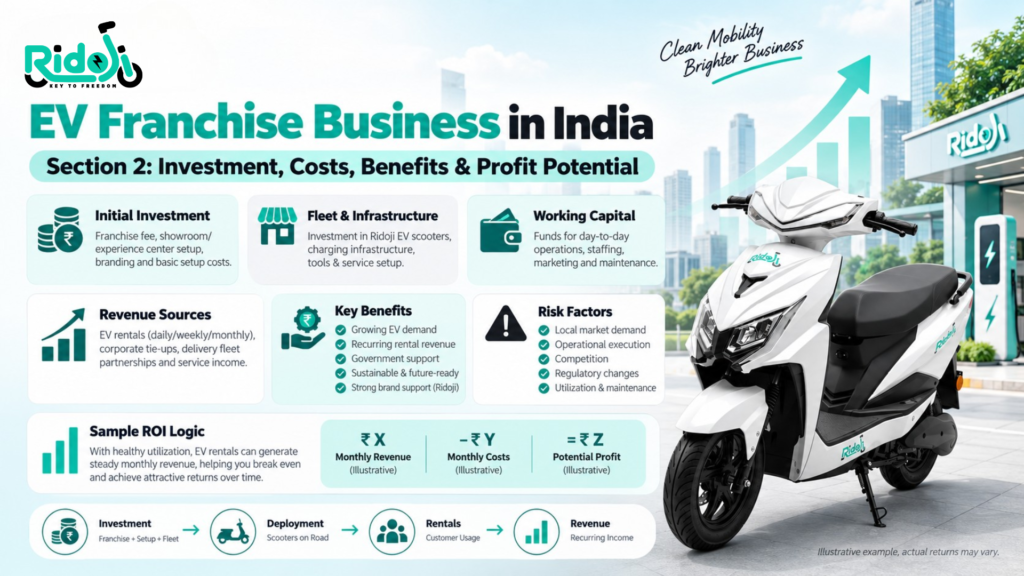
Starting an EV Franchise Business in India requires careful financial planning. While electric mobility offers several business opportunities, the actual investment depends on the franchise model, fleet size, location, infrastructure requirements, and level of operational involvement.
An electric scooter dealership, EV charging station, scooter rental business, and company-managed EV fleet franchise have different cost structures.
For example, an EV dealership may require showroom infrastructure, inventory, salespeople, and after-sales support. An electric scooter rental business may require vehicles, charging arrangements, maintenance facilities, and rider onboarding systems.
A company-managed EV franchise may follow a different structure, with the franchise partner providing the agreed capital while the company manages specified operational activities.
Before selecting any franchise, entrepreneurs should understand the total capital required rather than focusing only on the advertised starting investment.
1. Initial Franchise Investment and Setup Costs
The initial investment is the amount required to establish the franchise.
Depending on the selected EV franchise model, this may include:
- Franchise or brand licensing fees.
- Electric scooter or fleet acquisition costs.
- Office or showroom setup expenses.
- Furniture, branding, and interiors.
- Charging equipment and electrical installations.
- Registration, insurance, and documentation.
- Technology and fleet management systems.
- Initial working capital.
Some franchise providers include several of these expenses in a single package, while others charge separately.
Therefore, an investor should request a detailed, itemized investment proposal before making any payment.
Important: A lower advertised franchise fee does not necessarily mean a lower total business investment.
2. Electric Scooter Fleet and Infrastructure Costs
For an electric scooter rental or fleet management franchise, vehicles are often a significant part of the investment.
The total fleet cost depends on vehicle specifications, procurement price, fleet size, registration, insurance, and related equipment.
For example, a franchise operating 20 electric scooters has different funding requirements from one operating 60 or 100 vehicles.
However, simply purchasing more scooters does not automatically increase profitability.
Every additional vehicle may also create expenses related to maintenance, depreciation, insurance, charging, and operational management.
Before deciding on fleet size, investors should check whether there is enough customer or rider demand to support the planned number of vehicles.
3. Working Capital and Operational Expenses
One of the most common mistakes entrepreneurs make when starting an EV franchise is calculating only the initial investment.
Running a business also requires working capital.
Depending on the franchise structure, recurring expenses may include:
- Employee salaries.
- Office or showroom rent.
- Electricity and charging costs.
- Vehicle servicing and repairs.
- Tyres, brakes, and replacement parts.
- Insurance renewals.
- Technology subscriptions.
- Rider onboarding expenses.
- Marketing and customer acquisition.
- Administrative and compliance costs.
In a company-managed franchise, some of these expenses may be handled by the franchisor under the agreement.
Investors should confirm exactly which expenses are included, which are excluded, and who bears unexpected costs.
4. Hidden Costs Investors Should Consider
An EV Franchise Business in India may involve expenses that are not immediately visible in promotional brochures.
Examples include battery replacement, vehicle damage, insurance deductibles, unexpected repairs, charging infrastructure upgrades, downtime, tax obligations, and early termination charges.
An investor should request clear written information about potential additional expenses.
A good franchise proposal should explain not only the initial investment but also the financial responsibilities throughout the agreement period.
How Does an EV Franchise Business Generate Revenue?
Understanding how revenue is generated is essential before investing in any franchise.
An EV franchise may generate revenue through vehicle sales, rental collections, charging services, fleet deployment contracts, or other EV-related services.
The actual revenue model depends on the type of franchise.
1. Electric Scooter Rental Income
An EV rental franchise can generate revenue by renting electric scooters to delivery riders, commercial users, and other eligible customers.
Rental arrangements may be daily, weekly, monthly, or contract-based.
For example, a scooter rented to a delivery rider may generate recurring rental payments while it remains deployed.
However, gross rental revenue is not the same as profit.
The business must account for operating expenses, maintenance, charging responsibilities, collections, depreciation, financing costs, and downtime.
2. Commercial Fleet Deployment Revenue
Some EV fleet businesses provide electric scooters to businesses requiring delivery or employee mobility.
Potential customers include:
- Restaurants and cloud kitchens.
- Grocery delivery businesses.
- Courier companies.
- E-commerce logistics providers.
- Pharmacy delivery operations.
- Hyperlocal delivery businesses.
- Quick-commerce operators.
These arrangements may involve commercial rental agreements or managed fleet service contracts.
For franchise investors, business-to-business demand can offer opportunities for recurring commercial relationships.
However, the financial outcome depends on contract pricing, payment collection, fleet utilization, and service commitments.
3. Additional Services and Revenue Opportunities
Depending on the franchise agreement, an EV business may earn revenue from additional services.
These could include:
- EV charging services.
- Vehicle maintenance.
- Fleet management support.
- Battery-related services.
- Commercial mobility contracts.
- Accessories and related products.
Not every franchise allows partners to earn from these activities.
Investors should review the agreement to determine which revenue streams belong to the franchise partner and which remain with the franchisor.
4. Understanding Monthly Payouts and Potential Returns
Some company-managed EV franchise models advertise periodic payouts or projected business income.
Investors should carefully distinguish between four financial concepts:
Revenue: The total money generated by business operations.
Operating profit: Revenue remaining after applicable operating expenses.
Investor payout: The amount payable to the franchise partner under the agreement.
Return on investment (ROI): The financial return relative to the capital invested.
These figures are not interchangeable.
A monthly payout shown in a franchise brochure does not necessarily represent net profit or an annualized investment return.
Investors should ask whether payouts are fixed contractual obligations, revenue-linked distributions, or projections based on expected operations.
They should also understand whether payments depend on actual rental collections, company cash flow, or other conditions.
How to Calculate EV Franchise Business Profitability
Before starting an EV Franchise Business in India, investors should understand how to evaluate operating profitability.
Consider the following hypothetical example.
An EV rental business operates 30 electric scooters.
Assume:
| Financial Metric | Illustrative Amount |
| Number of scooters | 30 |
| Rental revenue per active scooter per month | ₹4,500 |
| Average fleet utilization | 85% |
| Estimated monthly rental revenue | ₹1,14,750 |
| Illustrative monthly operating expenses | ₹55,000 |
| Estimated operating surplus | ₹59,750 |
The revenue estimate is calculated as:
30 scooters × ₹4,500 × 85% = ₹1,14,750
The illustrative operating surplus is:
₹1,14,750 − ₹55,000 = ₹59,750
This is an example for explaining the calculation, not a forecast of Ridoji’s franchise performance or actual market rental rates.
It excludes several potentially significant items, including depreciation, financing costs, major battery replacements, taxes, and franchise-related charges.
Therefore, the final net profit or investor payout may be substantially different.
Factors That Influence EV Franchise ROI
The profitability of an EV franchise can depend on:
Fleet utilization: How many scooters are actively rented or deployed.
Rental pricing: The revenue collected per vehicle.
Rider demand: The availability of customers requiring vehicles.
Maintenance expenses: The cost of keeping scooters operational.
Vehicle downtime: The time vehicles remain unavailable for commercial use.
Battery performance: The condition and replacement needs of EV batteries.
Operational efficiency: How effectively the company manages the fleet.
Agreement structure: How revenues, expenses, and payouts are allocated.
A responsible franchise investor should evaluate these factors before accepting projected income figures.
Key Benefits of an EV Franchise Business in India
An EV Franchise Business in India may provide several advantages for entrepreneurs seeking exposure to electric mobility.
However, benefits depend on the chosen franchise company, business model, location, and contractual arrangements.
1. Opportunity to Participate in a Growing EV Sector
Electric mobility is creating opportunities across vehicle sales, commercial rentals, charging, servicing, and fleet management.
A franchise can provide an entry point into this ecosystem.
Investors can study electric vehicle adoption trends through the official VAHAN vehicle registration dashboard.
However, national EV sales growth should not be treated as proof of profitability for an individual franchise.
2. Access to an Established Business Model
Starting an independent EV rental business involves developing operating procedures, building supplier relationships, recruiting staff, acquiring customers, and arranging maintenance support.
A franchise may provide access to some of these systems.
This can help entrepreneurs avoid developing every operational process independently.
However, investors should verify the actual support offered rather than assuming that every franchise provider has an established operational system.
3. Potential for Recurring Business Revenue
Unlike businesses that depend entirely on one-time sales, electric scooter rental and managed fleet operations can generate recurring rental or service revenue.
When vehicles are deployed consistently, the business may receive periodic payments from riders or commercial customers.
Recurring revenue potential is one reason entrepreneurs explore EV rental franchises.
Nevertheless, rental revenue can fluctuate because of demand, non-payment, breakdowns, and vehicle availability.
4. Brand and Operational Support
An established franchise provider may offer:
- Brand recognition.
- Vehicle sourcing assistance.
- Rider onboarding.
- Maintenance coordination.
- Operational technology.
- Fleet reporting.
- Business development support.
- Training and documentation.
For first-time entrepreneurs, support from an experienced operator can be valuable.
The extent of that support should always be defined in the written agreement.
5. Opportunities for Business Expansion
An EV franchise may offer the possibility of expanding operations over time.
Depending on the model, expansion could involve increasing vehicle count, opening additional locations, or serving more commercial customers.
However, expansion should follow proven demand and sustainable operating economics.
Adding vehicles without sufficient utilization can increase expenses rather than improve profitability.
What Are the Risks of Investing in an EV Franchise?
Every business carries risks, and EV franchises are no exception.
Investors should understand the following risks before committing capital.
1. Demand and Utilization Risk
If there are insufficient riders or commercial customers, vehicles may remain idle.
Low utilization can reduce rental collections while ongoing costs continue.
2. Maintenance and Battery Risk
Commercial scooters experience regular wear and tear.
Unexpected repairs, battery degradation, and replacement costs can affect business profitability.
3. Operational Management Risk
A franchise may underperform if the operating company cannot effectively manage riders, vehicle deployment, servicing, collections, or reporting.
4. Financial and Payout Risk
Projected income may not materialize.
Even where a company specifies a payout obligation in an agreement, investors should assess its financial ability to meet that obligation.
5. Agreement and Exit Risk
Some franchise arrangements may involve minimum terms, exit restrictions, penalties, or conditions affecting the recovery of invested capital.
These provisions should be reviewed before signing.
6. Technology and Market Risk
Electric vehicle models, battery technologies, competition, and customer demand can change.
Fleet operators may face challenges when vehicles become outdated or operating economics change.
An attractive franchise opportunity should never be evaluated solely on advertised payouts. It should be assessed through operational performance, contractual clarity, financial capacity, and risk management.
EV Franchise vs Independent EV Rental Business: Which Is Better?
Entrepreneurs often compare joining an established EV franchise with starting their own electric scooter rental business.
Both approaches can be viable, but they involve different responsibilities.
| Factor | EV Franchise | Independent EV Rental Business |
| Brand | Established brand, subject to verification | Build your own brand |
| Setup | May receive structured assistance | Arrange independently |
| Vehicle sourcing | May be supported by franchisor | Owner responsibility |
| Fleet management | Depends on franchise agreement | Owner-managed or outsourced |
| Maintenance | May receive organized support | Arrange service network |
| Marketing | May receive brand assistance | Build marketing independently |
| Operational control | Shared or contract-defined | Greater direct control |
| Fees | May involve franchise or management fees | No franchise fee |
| Business risk | Remains present | Remains present |
| Expansion | Depends on franchise terms | Depends on own resources |
When an EV Franchise May Be Suitable
A franchise may appeal to entrepreneurs who prefer an existing brand, defined processes, and operational assistance.
A company-managed EV franchise may be especially relevant when the investor does not want to personally manage riders, vehicles, maintenance, and rental collections.
When an Independent EV Rental Business May Be Suitable
An independent business may appeal to entrepreneurs who want greater control over pricing, vehicle sourcing, operational decisions, and business strategy.
However, they must establish their own systems, customer base, maintenance capabilities, and service infrastructure.
There is no universally superior choice.
The decision depends on capital availability, operating experience, desired involvement, market opportunity, and acceptable risk.
Why Company-Managed EV Franchise Models Are Getting Attention
Company-managed franchise structures allow entrepreneurs to participate in certain businesses while delegating agreed operational responsibilities to the operating company.
This is especially relevant in commercial EV fleet management because maintaining vehicle availability requires continuous coordination.
An EV fleet may need dedicated personnel to handle:
- Rider onboarding and allocation.
- Vehicle deployment.
- Rental payment management.
- Preventive maintenance.
- Charging coordination.
- Vehicle breakdown support.
- Fleet monitoring.
- Operational reporting.
For an investor who lacks experience in these areas, professional operational support may be valuable.
However, company-managed franchises should not be confused with conventional low-risk financial investments.
They remain business arrangements involving contractual obligations, operating risks, and potential financial losses.
How Ridoji Connects with the Company-Managed Model
Ridoji’s franchise proposition focuses on participation in a managed EV fleet ecosystem.
Its operating model involves electric scooter deployment, rider coordination, maintenance support, fleet monitoring, and daily fleet management.
This creates a different proposition from traditional electric scooter dealerships where franchise owners may be responsible for managing retail sales and showroom operations.
For prospective Ridoji franchise partners, the important questions include:
- What is the total investment under the selected franchise plan?
- How many electric scooters are included?
- Who owns the vehicles?
- Who manages rider onboarding and rental collections?
- Who pays for maintenance, batteries, and insurance?
- What operational expenses are included?
- How are payouts calculated?
- What happens during vehicle downtime?
- What is the agreement tenure?
- What happens at the end of the agreement?
These questions help investors understand the franchise model before committing capital.
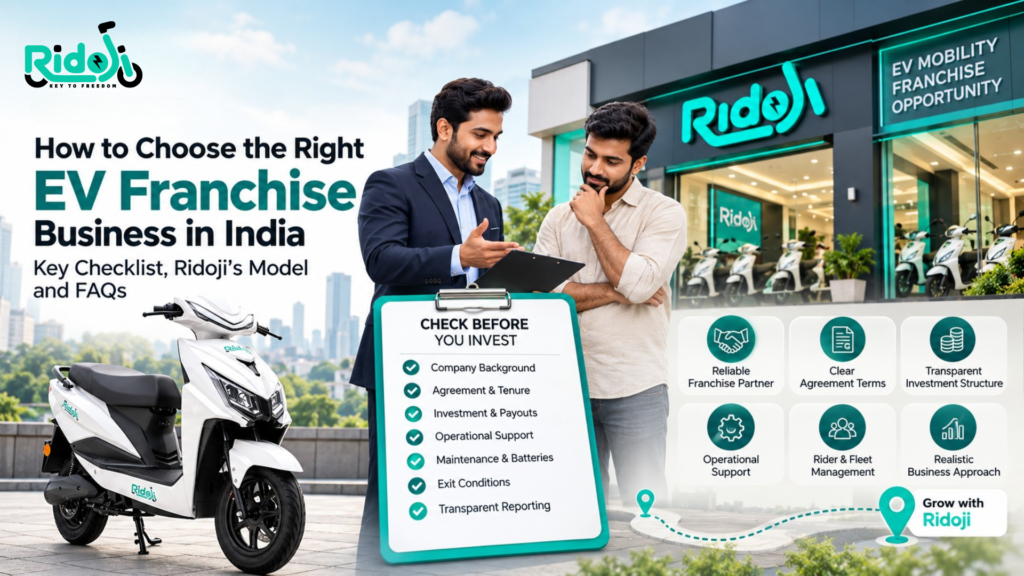
How to Choose the Best EV Franchise Business in India
Choosing the right EV Franchise Business in India requires more than comparing investment amounts and monthly income projections. The real strength of any franchise depends on the company’s credibility, operational experience, customer demand, financial transparency, and contractual responsibilities.
An electric vehicle franchise can appear attractive because it operates in a growing industry. However, industry growth alone does not establish that a particular franchise will be successful.
Whether you are considering an electric scooter dealership, an EV rental franchise, or a company-managed EV fleet business, careful evaluation should come before any financial commitment.
Here are the most important factors to consider.
1. Verify the Company’s Registration and Background
Before investing in an EV franchise, verify the legal identity of the company offering the opportunity.
Start by checking its registered company name, Corporate Identification Number (CIN), registered address, business activities, and available statutory filings.
Company information can be checked through the official Ministry of Corporate Affairs portal.
Also consider reviewing:
- The company’s operating history.
- Its physical office and operational locations.
- The experience of its management team.
- Existing business operations.
- Available customer and franchise references.
- Its vehicle fleet and service infrastructure.
A professional website and promotional brochure can provide useful information, but they should not replace independent verification.
2. Review the Franchise Agreement and Tenure
The franchise agreement is one of the most important documents in the entire investment process.
It defines the legal relationship between the franchise provider and franchise partner.
Before signing, understand:
- Agreement duration.
- Renewal conditions.
- Franchisee and franchisor responsibilities.
- Vehicle ownership.
- Payment obligations.
- Management fees.
- Termination conditions.
- Dispute resolution procedures.
- Exit and asset-transfer provisions.
An EV franchise investor should not depend solely on verbal explanations from a sales representative.
All important financial and operational commitments should be reflected accurately in the signed agreement.
3. Understand the Investment and Payout Structure
An attractive monthly payout figure should not be the only reason to choose a franchise.
Ask the company to explain how the business generates revenue and what financial obligations support the proposed payouts.
For example, in an EV rental franchise, revenue may come from scooters rented to delivery riders or businesses.
However, the investor should understand how rental collections translate into operating income and franchise payouts.
Important questions include:
- What is the total investment amount?
- What is included in the investment?
- Are there additional fees?
- Are payouts contractual or performance-linked?
- When do payouts begin?
- What conditions can affect payment?
- Are operating expenses deducted?
- What happens if revenue falls below expectations?
A transparent franchise model should provide clear written answers.
4. Check Who Manages Daily Operations
The operational structure is particularly important when evaluating a company-managed EV Franchise Business in India.
Some franchise providers require partners to manage employees, business premises, sales, vehicle servicing, and customers.
Others may take responsibility for agreed operational activities.
Before investing, confirm who manages:
- Rider recruitment and onboarding.
- Electric scooter deployment.
- Fleet maintenance.
- Charging coordination.
- Rental collection.
- Staff salaries.
- Premises and utilities.
- Vehicle monitoring.
- Operational reporting.
If a company claims to provide complete operational management, ask for those responsibilities to be documented in the agreement.
5. Evaluate Fleet Deployment and Rider Demand
For an EV rental franchise, vehicle utilization directly influences the underlying business.
A company may own hundreds of scooters, but the more relevant question is how many are deployed and generating rental revenue.
Investors should ask for information about active vehicles, utilization rates, downtime, and customer demand.
They should also understand what happens when a rider returns a scooter or a commercial customer stops using the fleet.
Vehicle redeployment is an important part of maintaining rental operations.
6. Check Maintenance and Battery Responsibilities
Electric scooters used commercially require regular maintenance.
Although EVs have fewer engine-related components than petrol scooters, batteries, tyres, brakes, suspension, electrical systems, and other parts still need inspection and replacement.
Before choosing a franchise partner, understand who pays for:
- Routine servicing.
- Unexpected repairs.
- Battery degradation and replacement.
- Tyre and brake replacement.
- Accident-related damage.
- Insurance deductibles.
- Vehicle recovery and transportation.
These costs should be considered when evaluating projected franchise income.
7. Understand Exit Conditions and Risk Allocation
A responsible investor should understand how to exit a business before entering it.
Review whether the franchise agreement includes a lock-in period, early termination charges, asset buyback conditions, or restrictions on transferring ownership.
Ask what happens if:
- The investor wants to exit early.
- Vehicle utilization decreases.
- The franchise company faces financial difficulties.
- The agreement is not renewed.
- Assets need to be sold or transferred.
- Contractual payouts are delayed.
Clearly documented exit provisions are an important part of financial planning.
8. Ask for Transparent Operational Reporting
A professionally managed EV fleet business should maintain reliable operational records.
Depending on the franchise structure, relevant reports may include vehicle deployment, utilization, maintenance, collections, expenses, and financial distributions.
Investors should determine what information they are contractually entitled to receive and how frequently it will be shared.
Transparency helps investors understand the business rather than relying entirely on advertised projections.
Why a Company-Managed EV Franchise Can Be Attractive
A company-managed franchise may appeal to entrepreneurs who want to participate in commercial EV mobility without personally managing a fleet every day.
Running an electric scooter rental business independently requires operational coordination, maintenance systems, rider support, staff management, and payment collection.
A managed model can allocate specified activities to an experienced operating company.
Potential advantages include:
Reduced direct operational involvement: The franchise partner may not need to personally coordinate every rider, scooter, or service issue.
Access to fleet management processes: An established operator may already have systems for vehicle allocation, monitoring, and maintenance.
Operational support: The company may provide personnel and processes for ongoing fleet operations.
A structured partnership: Responsibilities can be divided between the company and franchise partner through written agreements.
However, company-managed does not mean guaranteed profitability, automatic payouts, or protection from business losses.
The financial outcome still depends on the contractual arrangement and the operating company’s performance and financial capacity.
How Ridoji’s EV Franchise Model Works
Ridoji operates in the electric scooter rental and managed EV fleet ecosystem, serving commercial mobility needs through vehicle deployment, rider coordination, maintenance support, and fleet operations.
Its franchise proposition is designed around participation in this operating ecosystem rather than relying exclusively on traditional electric vehicle showroom sales.
For prospective franchise partners, the distinction lies in the responsibilities assigned to Ridoji and the investor.
Understanding Ridoji’s Company-Managed Approach
Ridoji’s franchise model centres on EV fleet deployment and management.
The company-managed structure is intended to provide operational support in areas such as:
Electric Scooter Deployment
Vehicles are allocated for commercial use according to the company’s operating arrangements and demand.
Rider Coordination
Rider onboarding and usage coordination support the daily functioning of rental fleets.
Maintenance Support
Fleet maintenance processes help keep scooters available for commercial use.
Fleet Monitoring
Vehicle usage and operational performance can be monitored through the company’s management processes.
Daily Operational Management
The operating team coordinates activities required to maintain the fleet business.
The exact scope of these services, associated costs, service standards, and legal obligations must be established in the franchise agreement.
Ridoji Franchise Investment and Plan Selection
Prospective investors should request Ridoji’s latest official franchise brochure before selecting a plan.
Important plan details to verify include:
- Total capital investment.
- Number and specification of electric scooters.
- Franchise premises requirements.
- Vehicle ownership and asset registration.
- Operational responsibilities.
- Monthly income or payout conditions.
- Agreement tenure.
- Maintenance and insurance obligations.
- Lock-in and exit terms.
Ridoji may offer different franchise configurations based on the scale of the fleet and the commercial arrangement.
Investors should compare these configurations using their complete costs and contractual terms rather than only their advertised payout amounts.
What Makes Ridoji Relevant to EV Franchise Investors?
Ridoji’s core business focus is relevant to entrepreneurs looking specifically at electric scooter rentals and commercially managed fleets.
For an investor comparing EV dealerships with EV rental operations, this distinction matters.
A dealership primarily focuses on selling vehicles.
A managed fleet operation focuses on deploying vehicles, supporting users, and maintaining commercial utilization.
Ridoji’s franchise opportunity should therefore be evaluated based on its actual fleet operations, operational support capabilities, financial terms, and contractual commitments.
Prospective partners should request evidence of operational performance and independently assess whether the franchise meets their business objectives.
Who Should Consider a Ridoji EV Franchise?
A managed EV franchise may be relevant to several types of entrepreneurs.
1. Entrepreneurs Entering the EV Industry
Individuals interested in electric mobility but without extensive vehicle rental experience may wish to explore a company-managed arrangement.
They should evaluate the operating company, required capital, and contractual protections carefully.
2. Existing Business Owners
Business owners with available capital may consider diversifying into electric mobility.
However, diversification should reflect business capacity, financial objectives, and acceptable risk rather than expectations of guaranteed payouts.
3. Investors Interested in Commercial Fleet Assets
Some investors prefer opportunities involving physical assets, such as electric scooters deployed for commercial use.
They should verify asset ownership and understand depreciation, maintenance, utilization, and liquidity risks.
4. Entrepreneurs Seeking Reduced Daily Operational Involvement
A managed franchise may appeal to people who cannot operate a fleet business full-time.
However, reduced involvement does not remove the need for financial monitoring, due diligence, and contractual oversight.
Questions to Ask Before Investing in a Ridoji Franchise
Before making a franchise investment decision, request clear written answers to the following questions.
- What is the total investment amount for each franchise plan?
- What number of electric scooters is included?
- Who legally owns and registers the vehicles?
- What is the complete agreement tenure?
- Who pays for office rent, interiors, and staff salaries?
- Who handles charging, servicing, batteries, and repairs?
- How are monthly income or payouts calculated?
- What financial conditions may delay or reduce payments?
- What happens if scooters remain idle?
- What reports will the franchise partner receive?
- Is there a lock-in period?
- What happens when the agreement expires?
- Can the franchise partner exit early?
- What happens to the vehicle assets at the end of the term?
- How are disputes resolved?
These questions are useful not only for Ridoji but for evaluating any EV Franchise Business in India.
Red Flags to Avoid When Choosing an EV Franchise
Not every franchise opportunity is suitable for every investor.
Be cautious if a company:
- Promises unusually high returns without explaining revenue sources.
- Refuses to provide a complete written agreement.
- Cannot demonstrate genuine fleet or business operations.
- Avoids questions about vehicle ownership.
- Does not explain additional expenses.
- Offers unclear exit conditions.
- Makes unrealistic claims about guaranteed income.
- Refuses to disclose significant operational risks.
- Pressures investors to pay immediately.
- Does not provide official payment receipts or documentation.
A trustworthy business proposal should withstand careful questioning and independent evaluation.
Final Checklist Before Starting an EV Franchise Business in India
Before proceeding, confirm that you understand the following:
| Evaluation Area | What to Verify |
| Company credibility | Registration, operations and track record |
| Franchise investment | Total cost and additional charges |
| Revenue model | How business income is generated |
| Franchise payouts | Calculation, timing and conditions |
| Vehicle ownership | Legal title and asset documentation |
| Fleet operations | Who manages riders and vehicles |
| Maintenance | Servicing, batteries and repairs |
| Business expenses | Rent, salaries, utilities and fees |
| Reporting | Access to operational and financial records |
| Contractual terms | Tenure, lock-in, renewal and termination |
| Exit process | Asset handling and capital recovery terms |
| Risks | Market, operational, financial and liquidity risks |
An EV Franchise Business in India should be selected only after the investor understands these elements and is comfortable with the responsibilities and potential financial outcomes.
Final Thoughts: Is an EV Franchise Business Right for You?
Electric mobility is creating business opportunities across dealerships, scooter rentals, charging infrastructure, and managed commercial fleets.
For entrepreneurs, an EV Franchise Business in India can offer a route into this ecosystem through an established operating structure.
However, choosing a franchise is a serious business decision.
The best option is not necessarily the one advertising the highest monthly income. It is the one whose business model, operating responsibilities, investment requirements, contract terms, and risks you understand.
A company-managed EV franchise may be relevant for investors who prefer structured operational support and reduced day-to-day involvement.
Ridoji’s managed EV fleet approach provides one model to evaluate within India’s commercial electric mobility sector.
Before deciding, examine the company’s operations, request its current franchise brochure, review the financial assumptions, and carefully read the written agreement.
A successful franchise decision starts with research, transparency, and realistic expectations.
Explore EV Franchise Opportunities with Ridoji
Interested in starting an EV franchise business through a company-managed fleet model?
Explore Ridoji’s franchise offering and learn more about available plans, electric scooter fleet deployment, operational support, investment requirements, and partnership conditions.
Website: https://www.ridoji.com/
Contact: +91 9991119652 Speak with the Ridoji team to request the latest franchise brochure and review the terms before making an investment decision.