

Introduction: Is EV Fleet Investment a Good Business Opportunity?
As India’s EV industry is emerging, more and more business opportunities are also growing for entrepreneurs, investors, and businessmen. One such opportunity is EV Fleet Investment, where investors can gain exposure to the EV industry without operating an entire electric vehicle dealership. With increasing demand for last-mile delivery, food delivery, and instant courier services, the need for electric vehicles is also rising. This increasing adoption of electric two-wheelers, rising interest in sustainability, and demand for affordable vehicles are supporting EV fleet investment.
The growing demand for commercial electric vehicles is making the EV fleet business in India an emerging opportunity for entrepreneurs and investors.
For entrepreneurs looking to enter the electric mobility sector, EV fleet investment offers an opportunity to participate in the growing commercial EV market. It allows investors to explore income-generating opportunities through electric vehicle rentals, leasing, and fleet operations.
However, starting an EV fleet business is much more than just investing money; one has to look at many other factors as well. Investors must understand the cost of the vehicle, the correct location, fleet size, business model, revenue generation, and operating costs. So, before we dive in, let’s understand what an EV Fleet investment is.
EV Fleet Investment At A Glance
EV fleet investment is where individuals or organisations invest in a range of electric vehicles in order to make money by renting or leasing them out. Rather than buying an EV for personal use, investors buy electric vehicles that can then be used by delivery workers, commercial use, and other transport-related businesses.
An EV Fleet can consist of:
Electric scooters
Electric two-wheelers
Electric three-wheelers
Electric cars and taxis
Electric commercial vehicles (for example, vans)
Electric trucks and buses
Within India, electric two-wheelers are especially focused on food, retail, and fast commerce delivery, as well as last-mile delivery services. Electric vehicle fleet investment allows investors to participate in commercial mobility by deploying vehicles for different business requirements.
Understanding how EV fleet investment works is important before committing your money. From selecting the right electric vehicles to identifying commercial users, every step plays a role in building a sustainable EV fleet business.
How Does an EV Fleet Investment Work?
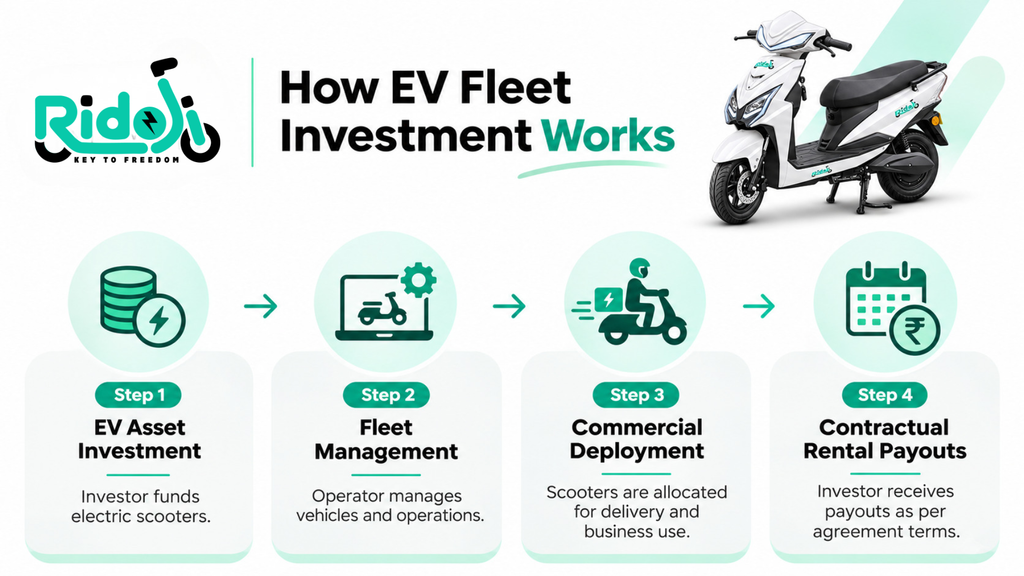
The ultimate goal of an EV fleet investment is to generate recurring income by renting out electric vehicles and giving them on lease. You simply purchase or finance the electric vehicles, which are then used by delivery riders, businesses, fleet operators, and commercial operations. According to the type of business model, the investor may manage everything on his own by being the independent fleet owner or can opt for an EV fleet management company that can manage things like rider onboarding, vehicle tracking, fleet operations, and maintenance. The revenue, which is then earned from rentals, leasing, and commercial contracts, is shared or paid to the investor according to the terms and conditions.
Hence, an EV Fleet Investment works on vehicle utilisation, operating expenses, contractual terms, and market demands, so you need not to worry about other hassles like daily operations.
The EV fleet investment model can be suitable for individuals who want to explore the electric mobility business without necessarily establishing a traditional vehicle dealership. However, understanding the investment structure and operational responsibilities is essential. The structure of electric vehicle fleet investment can vary depending on vehicle ownership, fleet operations, and the revenue-sharing arrangement.
As discussed above, an EV Fleet investment depends on many factors as well. So, whether you are a first-time investor or a businessman, it is necessary to take into account these things:
1. Understand EV Market Demand in India
First things first, before investing in the EV fleet industry, you must understand the potential growth of Electric vehicles in the market and their current market demand.
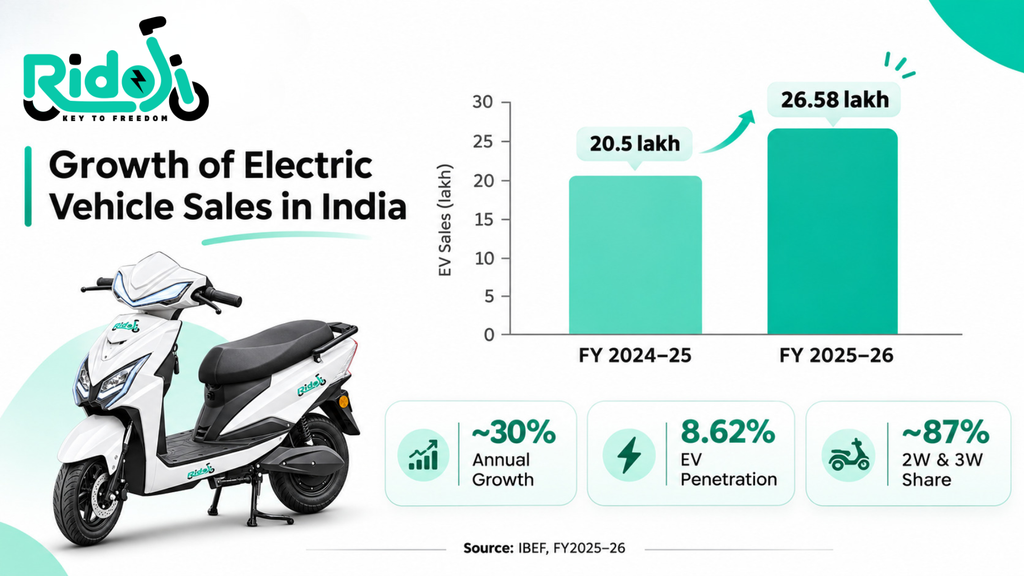
Well, India’s EV market has grown considerably in 2026, especially in the two-wheeler and three-wheeler sector. These vehicles are now used for personal transportation, commercial deliveries, logistics, and passenger mobility. According to the India Brand Equity Foundation (IBEF), India recorded approximately 26.58 lakh EV sales in FY2026, representing nearly 30% year-on-year growth and 8.62% penetration of total automotive sales. Electric two-wheelers and three-wheelers accounted for nearly 87% of total EV volumes.
These market developments are creating favourable conditions for the EV fleet business in India, particularly in the last-mile delivery segment.
This significant growth is creating opportunities for commercial EV fleet operations. Some of the major factors can include:
1. Last-mile delivery
The rising growth of e-commerce, food delivery, grocery delivery, and courier businesses is increasing the need for more and more vehicles daily. In this scenario, an affordable vehicle seems to be a practical option. That’s why people opt for electric vehicles, as they are best for shorter distances and cheaper in comparison to petrol vehicles. This increasing requirement for affordable commercial transportation is supporting the growth of the EV rental business in India.
2. Sustainability
Nowadays, more and more businesses are focusing on becoming sustainable. Hence, to reduce pollution and promote a cleaner atmosphere, electric vehicles are becoming a strong choice for those businesses.
3. Increasing Fuel Costs
As electric vehicles do not run on petrol, they reduce the high costs of petrol and engine oil. They prove to be a great alternative to petrol-based vehicles, hence saving a significant amount of money.
4. Urban-Mobility Requirements
For shorter distances, considering electric vehicles is a better option. Electric scooters are suitable for short-distance travel and regular commercial operations.
Understanding these factors is necessary for investors, as the profitability of a fleet depends on whether these vehicles can be deployed consistently or not. Instead of just investing on the basis of the popularity of the electric vehicle, you must first consider the actual commercial demand in your target location. These market developments are creating favourable conditions for the EV fleet business in India, particularly in the last-mile delivery segment.
2. Choose the Right Vehicles for Your EV Fleet
Choosing the right type of electric vehicle is one of the crucial steps in your EV fleet management. The type of vehicle that you choose directly influences its operational performance, maintenance, expenses, and commercial applications. Just because electric cars are very famous doesn’t mean that they will be suitable for your business as well. Different businesses need different electric vehicles to operate.
Selecting suitable vehicles according to business requirements is essential for building a sustainable EV fleet business in India.
Some of the common electric vehicles include:
| Vehicle type | Commercial applications | Key consideration |
|---|---|---|
| Electric two-wheelers | Food delivery, grocery delivery, courier services | Range and battery durability |
| Electric three-wheelers | Goods transportation and passenger mobility | Load capacity |
| Electric cars | Corporate transportation and taxi services | Acquisition cost |
| Electric vans | E-commerce and logistics | Cargo capacity and charging |
| Electric trucks | Large-scale goods transportation | Infrastructure and capital requirements |
However, before purchasing any vehicle, you must evaluate these factors first:
- Cost of the vehicle.
- Battery capacity
- Battery warranty
- Replacement and repair costs
- Vehicle durability
- Availability of spare parts and servicing
- After-sales support
- Company reputation
If you are a first-time investor and are thinking of investing, then an electric two-wheeler can be a practical option for you. It provides multiple last-mile mobility requirements.
But the final decision should depend on the type of business that you want and the expected vehicle utilization.
For a successful EV fleet investment, choosing vehicles based on their commercial applications is more important than simply selecting popular EV models. Investors should prioritise vehicle performance, durability, battery efficiency, and long-term operating costs.
3. Calculate EV Fleet Investment Costs
Purchasing a vehicle alone is not enough; it is necessary to know about the whole investment, including the additional business expenses. Having knowledge of initial capital requirements and recurring operational costs is important to run a successful EV fleet investment. Your initial investment may include:
| Initial investment costs | Recurring operational costs |
|---|---|
| Electric vehicle purchase | Electricity consumption |
| Vehicle registration | Regular servicing |
| Initial insurance | Insurance renewal |
| Charging infrastructure | Battery replacement provision |
| GPS tracking setup | Fleet management charges |
| Initial working capital | Tyre replacement and repairs |
These are the initial investments; apart from these, also keep in mind the recurring costs that include battery replacements, electricity consumption, insurance renewals, tyre changing costs, servicing, and fleet management.
Understand the total cost of ownership (TCO)
Understanding the actual costs of the vehicle throughout its operational period reveals the total cost of ownership. For instance, an electric vehicle has a higher purchase price initially than some conventional petrol scooter; however, its operating costs can be lower in comparison to the petrol scooter as electricity usually costs less than fuel charges.
But wait, the actual savings still depend on electricity tariffs, vehicle efficiency, daily kilometres travelled, battery health, and maintenance requirements.
And that’s why it is advised to maintain an investment checklist before purchasing any vehicle.
- How much total investment is required for a fleet?
- What are the monthly expenses?
- How much revenue can be generated from a single vehicle?
- What happens if the vehicles can not be utilised?
A practical financial assessment will help you avoid unexpected expenses and support better investment planning.
Evaluating long-term expenses is an important part of planning electric vehicle fleet investment and estimating its financial viability.
4. Understand EV Fleet Management Responsibilities
When starting fleet management, it is necessary to know the type of business model that you are taking, as fleet management comes with a lot of responsibilities. Managing that EV fleet efficiently is what makes an EV business successful. An electric vehicle fleet requires a lot of things to take care of, like regular monitoring, rider onboarding, and commercial deployment.
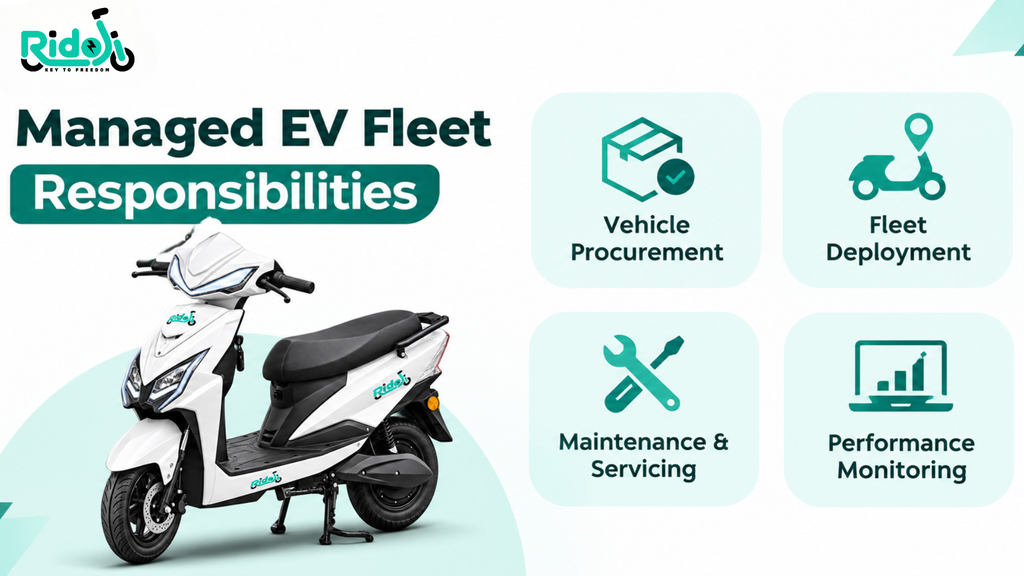
If someone opts for a self-managed fleet, then he will be responsible for:
- Finding commercial customers
- Finding suitable riders
- Monitoring vehicle utilisation
- Coordinating maintenance and vehicle repair services
- Tracking the vehicles
- Riders salary management
- Fleet branding and marketing
- Collecting rental payments
- Maintaining vehicle records
These activities require time, operational knowledge, and a reliable management system. And that’s why managed EV fleet investment is preferred the most. Proper operational planning helps make electric vehicle fleet investment more organised and easier to monitor.
Benefits of Managed EV Fleet Investment
Many investors do not want the hassle of doing everything on their own, like managing daily fleet operations, and this is where professional managed EV fleet management services come into the picture. In the managed fleet investment business model, investors put their money in a pre-existing company that provides the whole setup of EVs. You do not have to worry about anything; everything will be managed by the company.
For instance, Ridoji operates in the commercial EV Fleet management space. Its model connects electric vehicle ownership with commercial delivery operations and fleet management support.
However, before opting for this model, investors must know which responsibilities will be handled by the company and what the company’s reputation is.
| Operational responsibility | Self-managed EV fleet | Managed EV fleet |
|---|---|---|
| Vehicle funding | Investor | Investor |
| Commercial deployment | Investor | Fleet management company |
| Rider onboarding | Investor | Fleet management company |
| Vehicle maintenance | Investor | As per agreement |
| Insurance management | Investor | As per agreement |
| GPS tracking | Investor | Fleet management company |
| Rental collection | Investor | Fleet management company |
| Daily operations | Investor | Fleet management company |
| Revenue structure | Actual rental revenue | Contractual payment structure |
| Investor involvement | High | Relatively low |
Responsibilities may vary depending on the fleet management agreement.
5. Understand EV Fleet Revenue and Returns
Before you start an EV Fleet Investment model, it is necessary to know how your electric vehicles will generate income. Well, there are several ways to generate money, such as:
| Revenue model | Target customers | Revenue structure |
|---|---|---|
| Daily EV rental | Individual delivery riders | Daily rental charges |
| Monthly EV rental | Regular commercial riders | Monthly rental charges |
| B2B fleet leasing | Logistics and quick commerce companies | Contractual leasing fees |
| Usage-based deployment | Commercial fleet operators | Utilisation-based payments |
| Managed EV fleet investment | Individual asset investors | Agreement-based payouts |
How Can You Evaluate ROI?
Return on investment (ROI) helps you understand the relationship between your investment and the returns generated.
A basic ROI formula is:
ROI=NetProfit/ TotalInvestment*100
However, investors should not evaluate an EV fleet opportunity based only on advertised monthly income or projected ROI.
You should also check these things:
- What’s the duration of the agreement?
- Is the rental income fixed or dependent on the vehicle utilisation?
- Who is responsible for the maintenance?
- What happens if the vehicle is damaged?
- Are there any management or service charges?
Understanding the Risks of EV Fleet Investment
Like any commercial business, EV fleet investment involves certain financial and operational risks. Understanding these risks beforehand can help investors evaluate the long-term viability of their investment and make better-informed decisions.
| Potential risk | Possible impact | What investors should check |
|---|---|---|
| Battery degradation | Reduced vehicle performance | Battery warranty and replacement policy |
| Vehicle downtime | Reduced rental revenue | Maintenance and servicing support |
| Accidental damage | Unexpected repair costs | Insurance coverage |
| Low rental demand | Reduced fleet utilisation | Commercial demand in the target location |
| Vehicle theft | Potential financial loss | GPS tracking and insurance |
| Payment delays or defaults | Disruption in cash flow | Fleet operator’s financial stability |
| Vehicle depreciation | Lower resale value | Asset valuation and ownership terms |
| Early agreement termination | Financial uncertainty | Exit and termination clauses |
Investors should carefully review the fleet management agreement to understand how financial and operational responsibilities are allocated between the investor and the fleet operator.
6. Check EV Government Policies and Subsidies
Government policies play a crucial role in India’s mobility ecosystem. Before making an EV fleet investment, investors must know the government policies and any other legal terms and conditions that are applicable.
One of the major initiatives is the PM E-DRIVE Scheme, introduced by the Ministry of Heavy Industries to accelerate to EV adoption, increase charging infrastructure and to support the EV industry more and more. As per the August 2026 government notification, the scheme has an enhanced outlay of ₹11,900 crore and has been extended until 31 March 2028.
However, investors must know that these schemes are subject to specific vehicles, eligible categories, registration requirements, and applicable deadlines. Not every vehicle you purchase comes under the schemes of government.
Important Legal and Regulatory Considerations
Before deploying your fleet, one must check:
- The terms and conditions of the agreement.
- Registration requirements
- Rental and leasing agreements
- Taxation and GST applicability
- Driver and rider documentation
- Local charging and parking permission.
If you are thinking of entering a managed fleet model, then it is necessary to review all the rules, regulations, and agreements beforehand. Understanding these terms and policies may help avoid any further confusion and misunderstandings.
7. Choose the Right EV Fleet Investment Partner
If you do not want the hassle of doing everything alone and is thinking to opt for a managed EV fleet model, then choosing a right partner is the very crucial step. A fleet management partner can simply help you manage your electric vehicles, rider onboarding, tracking, fleet management, daily operations, and other stuff.
Whilst different EV investment organisations may have different products and business models, it is important to carry out sufficient background research.
Apart from managed EV fleet investment, entrepreneurs can also explore other business opportunities within the electric mobility sector, such as an EV franchise business. While EV fleet investment primarily focuses on investing in electric vehicle assets for commercial deployment, an EV franchise involves establishing a broader business setup under an established brand. Understanding the differences between these business models can help investors choose an opportunity that aligns with their capital, business objectives, and operational preferences.
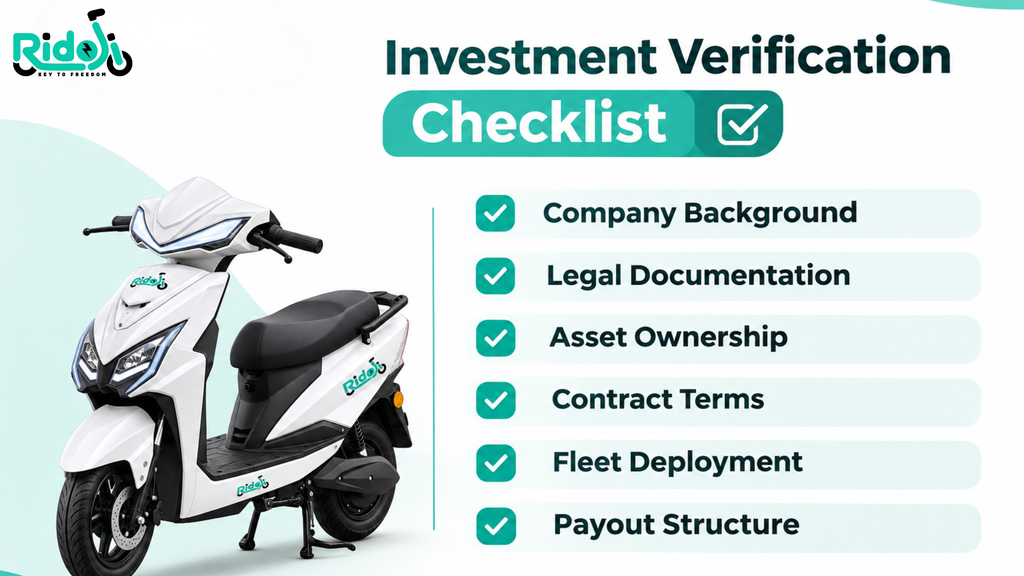
Areas to investigate when assessing EV investment companies include:
- Company background – knowledge of the companies’ expertise in both electric and business fleet provision.
- Ownership – whether the EVs are owned by the company or by you.
- Usage – what and how the EVs are used.
- Management – who is responsible for servicing, repairing, and location (GPS) data provision plus business partnership management.
- Monetary arrangements – including fee and rental rates, and any associated charges.
- Contract – including the contract term, re-contracting and termination procedures.
- Buyback provisions – if promotion is made of a buyback facility, then investigate the criteria, value assessment and contractual requirements that apply.
How Ridoji Simplifies EV Fleet Investment
Ridoji offers a professionally managed EV fleet investment model that allows individuals to participate in India’s commercial electric mobility sector without independently managing daily fleet operations.
Under this model, investors purchase electric scooters that are deployed for commercial rental purposes. Ridoji manages vehicle deployment, rider onboarding, fleet monitoring, servicing, maintenance, and other operational activities according to the agreement.
This business model can be suitable for individuals who want to explore electric vehicle fleet investment while reducing their involvement in day-to-day fleet management.
Before proceeding, investors should review the available investment plans, vehicle costs, rental payout structure, agreement duration, ownership rights, and associated risks.
Explore Ridoji’s EV fleet investment plans to understand the business model, available options, and applicable terms.
Conclusion: Is EV Fleet Investment Right for You?
India is currently witnessing developments in the electric space that extend well beyond manufacturing and showrooms. Business EV fleets are becoming significant within the nation’s transport and last-mile supply provision sectors. Understanding the market potential, financial requirements, and operational structure can help investors make informed electric vehicle fleet investment decisions.
As more people adopt electric vehicles, there continues to be a rising requirement for transport solutions for supply provision, together with heightened consciousness around environmentally friendly transport. Thus, there is potential to benefit from investment in EV fleet provision.
Nevertheless, success will rely on a number of elements such as vehicle type, initial capital, running costs and fleet usage as well as monetary and management processes.
Investors seeking a more formal investment option may wish to utilise professionally managed EV fleet provision rather than personally run a rental business. With increasing commercial EV adoption, the EV fleet business in India offers an opportunity worth exploring for people interested in electric mobility.
Thoroughly analysing a company’s business model, appreciating related risks and ensuring contractual provisions are understood, together with identifying a competent fleet management organisation, are all important considerations. Entrepreneurs exploring the EV rental business in India should carefully evaluate local demand, vehicle costs, and fleet management requirements before starting.
If you are looking to become involved in India’s expanding electric industry, it is favourable timing to investigate EV fleet investment possibilities and recognise how business EV ownership might fit within your business strategy.
Frequently Asked Questions (FAQs)
What is EV fleet investment?
EV fleet investment involves funding electric vehicles that are deployed for commercial purposes to generate revenue through rentals, leasing, or managed fleet agreements.
Is EV fleet investment profitable in India?
Profitability depends on factors such as initial investment costs, vehicle utilisation, rental demand, operating expenses, and contractual payment terms.
How much money is required to start EV fleet investment?
The investment amount depends on the number and type of electric vehicles, the selected business model, and associated operational expenses.
Can I start an EV fleet investment with two electric scooters?
Yes, some managed EV fleet platforms allow investors to start with a small number of electric scooters, depending on their available plans.
What are the risks of EV fleet investment?
Common risks include vehicle depreciation, battery degradation, low rental demand, vehicle downtime, accidental damage, and payment defaults.
Who manages electric vehicles in managed EV fleet investment?
A professional fleet management company generally handles commercial deployment, rider onboarding, vehicle tracking, and other operational responsibilities according to the agreement.