
Introduction
People researching passive income opportunities in India increasingly encounter managed electric vehicle fleets. In this model, participants fund vehicle assets while an operator handles agreed commercial activities. The key question is how much work the participant must still do and how payments are determined.
Electric scooters can support rentals and last-mile transport, but buying a scooter alone does not create passive income. Deployment, rider coordination, maintenance, collections, and reporting require an operating business.
This guide explains when fleet participation can involve less day-to-day work, how it differs from operating your own rental business, and what to check before choosing a provider. It focuses on EV fleets rather than ranking every investment or income option available in India.
For industry background, see the IBEF electric vehicle industry overview.
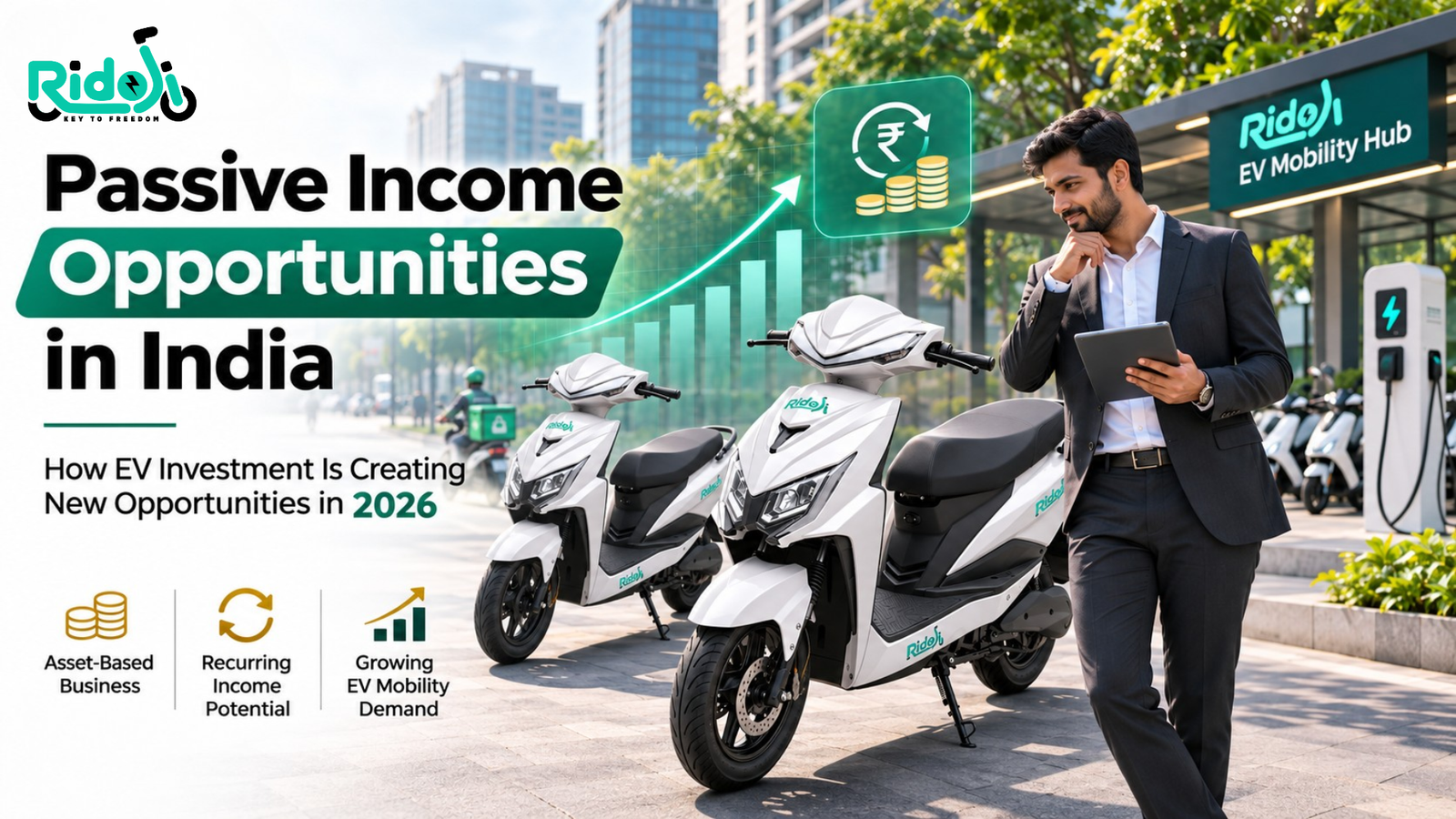
The growing demand for alternative income sources has made passive income opportunities in India an increasingly relevant topic. From traditional rental income to emerging asset-based business models, individuals are exploring different ways to diversify their income.
One such emerging sector is electric mobility. With the increasing use of electric vehicles across transportation, delivery, and commercial operations, EV investment is becoming an area worth exploring.
Today, people are not satisfied with only one income; everyone wants some other source of income as well. And hence, people are exploring more and more passive income opportunities in India. Quick commerce services and small businesses are flourishing rapidly, and so is the demand for new vehicles. Consequently, the use of conventional vehicles is expensive, and the pollution is unimaginable. That’s why more and more people are shifting towards electric mobility.
Among the emerging trends, electric vehicles are gaining attention not only as a passive income opportunity but also as potential business assets.
This has opened up new doors around electric scooter rentals, commercial EV fleets, and managed electric vehicle operations.
The electric vehicle industry in India is expanding, creating new opportunities for businesses involved in electric mobility, commercial rentals, and fleet management.
For people looking for passive income opportunities in India, EV investment is a business model worth investing. Apart from conventional investment options like real estate, people can explore opportunities focusing on physical assets and the growing electric mobility ecosystem.
Let’s understand how EV investment works, why the sector is attracting attention, and how Ridoji fits into this evolving landscape.
Key Takeaways
- EV investment is emerging as an asset-based business opportunity in India.
- Electric scooters can be utilised for commercial rentals and delivery operations.
- EV fleet management plays an important role in generating business revenue.
- Electric mobility offers different models to explore when researching passive income opportunities in India.
- Vehicle ownership, maintenance, utilisation, and revenue arrangements should be evaluated before investing.
When Is EV Fleet Investment Passive?
“Passive” describes the participant’s level of day-to-day involvement. A managed arrangement can reduce operational work if the provider actually takes responsibility for deployment, rider coordination, servicing and collections. The underlying business still requires active management.
| Activity | Operating your own fleet | Participating in a managed fleet |
|---|---|---|
| Finding riders and deploying scooters | You organise the process or employ staff. | The operator handles this if included in the agreement. |
| Maintenance, tracking and collections | You manage schedules, suppliers and payment collection. | The operator manages agreed activities; confirm all charges and exclusions. |
| Oversight and documentation | You maintain business and asset records. | You still review ownership documents, reports, payments and the operator’s performance. |
| Financial exposure | You bear the business risks allocated to you. | Delegating work does not remove asset, operational or counterparty risk. |
Before proceeding, ask for written responsibilities and a sample reporting format. Confirm who handles exceptional events such as accidents, theft, battery failure, and extended downtime.
Why Are EVs Becoming a Passive Income Investment Opportunity in India?
According to the Global EV Outlook 2026, electric mobility continues to evolve across international markets, including India.
As more and more businesses are developing in India, the need for the electric mobility industry is also rising.
Electric scooters are particularly helpful in urban mobility, daily commuting, and last-mile delivery operations. Their commercial applications have created a heap of opportunities for businesses involved in quick commerce, vehicle rentals, and fleet operations.
There are many factors that are contributing to the rising interest in EV-related business opportunities:
- Rising demand for electric mobility: More consumers and businesses are exploring electric vehicles for transportation requirements.
- Last-mile delivery requirements: Delivery businesses need accessible and efficient transportation options for everyday operations.
- Commercial vehicle utilisation: Electric scooters can be used for different purposes like delivery and rental services.
- Emerging business models: EV rentals and managed fleet operations are creating additional opportunities within the mobility ecosystem.
- Focus on sustainable transportation: Electric mobility is becoming an important part of conversations around cleaner transportation.
- Emerging quick commerce platforms: As quick commerce businesses like Blinkit, Flipkart Minutes, and Big Basket are growing day by day, the need for electric vehicles is also growing.
These developments make EV investment an interesting area to research for individuals looking to explore new business opportunities in India.
For individuals researching passive income opportunities in India, these developments also highlight the growing relevance of commercial electric mobility and asset-based business models.
What Is EV Fleet Investment?
Investing in an electric vehicle fleet entails putting finances into electric vehicles that are used for business transportation and rental purposes. In a fleet management model, electric scooters are used for businesses such as delivery services and transportation. The vehicles may generate revenue for the business depending on the operating model chosen and market demands.
For instance, the delivery partners could use electric scooters for their daily operations. Companies that operate such fleets may be able to earn revenue from rentals or any other agreed arrangements that can be established in the market.
The growing electric two-wheeler market highlights the increasing relevance of electric scooters in transportation and commercial mobility.
However, investing in an electric vehicle fleet is not only about purchasing the vehicles for business needs. It also requires Intelligence and management of the fleet, maintenance, insurance, customer acquisition,n and actual use of the fleet.
How Does EV Fleet Investment Compare with Other Passive Income Opportunities in India?
EV fleet investment is an asset-based business model in which electric vehicles are utilised for commercial purposes. Unlike some conventional income sources, this model involves physical vehicle assets and their commercial deployment.
For people exploring Ridoji’s managed fleet programme in India, understanding the difference between traditional investments and EV-related business models can help in evaluating their options.
| Investment model | Income source |
| Real estate | Property rentals |
| Fixed deposits | Interest earnings |
| Mutual funds | Market-linked returns |
| EV fleet investment | Commercial vehicle operations |
| Electric scooter rentals | Vehicle rental revenue |
Each model involves different levels of risk, management, and financial commitment.
Compare Effort, Payments, and Access to Your Money
These categories are not interchangeable. This qualitative comparison explains the questions to ask; it does not recommend a product or forecast returns. Specific terms vary by provider and arrangement.
| Model | Management effort | Payment basis | Liquidity, expenses and principal risks |
|---|---|---|---|
| Rental property | Tenant, repair and property administration, directly or through a manager. | Rent under a tenancy agreement. | Sale may take time. Vacancy, repairs, transaction costs and tenant non-payment affect outcomes. |
| Fixed deposit | Usually limited ongoing administration. | Interest and payment frequency under the deposit terms. | Check maturity, premature withdrawal, penalties and institution-specific protection and risk. |
| Mutual fund | Portfolio selection and periodic review. | Market performance; distributions are not assured. Withdrawals can involve selling units. | Liquidity, exit loads, expenses and risks depend on the scheme. A withdrawal may include your own capital. |
| Managed EV fleet | Operator handles contracted activities; participant retains oversight. | Fixed contractual amount or another defined formula, depending on the agreement. | Check early exit, fees, downtime, battery costs, asset value and operator payment risk. |
| Self-operated scooter rentals | Active deployment, servicing, rider and collection management. | Rental collections less applicable costs. | Vehicle resale and business exit may take time; utilisation, loss, repairs and collection failures affect cash flow. |
How Can Electric Scooters Become Income-Generating Assets?
The usage of electric scooters is not solely for personal transportation. They can also be effectively used from a business perspective due to their built-out operation.
The general process includes the following steps:
1. Scooters are acquired
The e-scooters are rented or bought for commercial purposes.
2. Fleet management
The scooters are rented out for suitable commercial purposes, such as last-mile delivery.
3. Management of operations
The business involves maintaining the fleet, tracking how the scooters are being used, contacting clients, etc.
4. Making money
With the help of a certain business model, e-scooters can bring money to the owner through renting out or making some agreements.
5. Continuation of asset management
Regular servicing and checking of the scooters enable maintaining the efficient operation of the fleet.
What Makes Electric Scooters Relevant to Passive Income Opportunities in India?
Electric scooters have applications across different commercial activities, particularly delivery services, rentals, and local transportation.
Their repeated commercial utilisation can create revenue opportunities for businesses managing vehicle fleets. This is why electric scooter-based business models are increasingly relevant when discussing passive income opportunities in India.
Why Consider EV Investment as a Passive Income Opportunity?
One of the reasons people are interested in investing in EVs is because of their association with asset-based business models. Unlike normal business operations based solely on selling products, an electric scooter fleet can be put to use repeatedly. The same approach seems to be especially attractive to those looking for passive income opportunities in India. There are several points to consider.
1. Asset-Based Business Model
The idea of electric scooters as physical assets provides an opportunity to earn regular revenue from the use of scooters under certain operating conditions.
2. Emergence of Electric Mobility Ecosystem
The emergence of electric mobility gives opportunities for the development of vehicle rental or delivery services.
3. Commercial Potential
Electric scooters can be interesting for different segments of customers: delivery partners, logistics services, or people looking to rent a vehicle.
4. Fleet Management Solution
Some models applied to EVs mean that you do not need to deal with your fleet on your own, and you can hire managers to help you with it, because fleet management can be in the hands of professionals. But details of all responsibilities should be checked with the provider of the service.
5. The Chance to Investigate a New Sector
Investing in EV provides an opportunity to enter a growing transportation industry that is evolving its commercial practices. It is also significant to note that investing in EV fleets is not always a passive and risk-free option. Those who invest should have a good understanding of how and in what way they are involved in the process, how they will be paid, who owns the assets, who is responsible for servicing, and other pertinent contractual aspects.
Quick Revision: Benefits of EV Investment
For people researching passive income opportunities in India, EV investment introduces an alternative asset-based business model.
The key areas to understand include:
- Commercial usage of electric scooters.
- Vehicle rental and fleet operations.
- Potential revenue from commercial agreements.
- Professional fleet management.
- Ownership and maintenance responsibilities.
EV Fleet Management: An Important Part of the Business Model
Investing in electric vehicles is just one aspect of running a successful electric vehicle fleet operation. However, efficient fleet management is critical too.
Thus, fleet management consists of:
- Putting the vehicles to use and taking care of them.
- Scheduling periodic service and maintenance.
- Keeping track of vehicle and battery performance.
- Coordinating rentals and customers.
- Controlling operating costs.
- Handling insurance and other paperwork.
Effective fleet management leads to maximized utilization of the vehicles and better functioning of the company.
For those planning to invest in electric cars, knowing about the management of the above-mentioned operations should be one of the steps prior to the selection of a partner for business.
Why Is Fleet Management Important for Passive Income Opportunities in India?
Fleet management directly affects how effectively electric vehicles are utilised in commercial operations.
Vehicle downtime, maintenance expenses, customer coordination, and operational efficiency can all influence business performance.
Therefore, individuals exploring passive income opportunities in India through EV fleets should understand the role of fleet management before selecting an investment partner.
How Ridoji’s Managed EV Fleet Programme Works
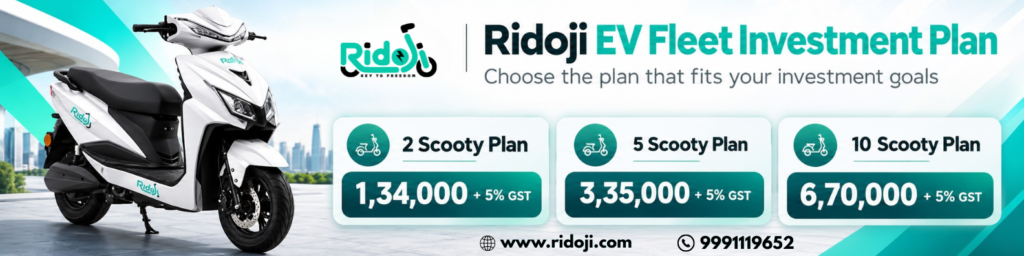
Ridoji provides managed electric scooter fleet operations. Participants fund scooters, while Ridoji manages deployment, rider operations, maintenance, tracking, and rental-payment administration. Ridoji is a fleet management provider, rather than a vehicle manufacturer or delivery company.
The programme is described as a four-year arrangement with fixed monthly payouts under the applicable agreement. The contractual payment amount and conditions should be read separately from the fleet’s gross rental collections. A fixed contractual payment does not remove the risk of delayed payment or non-performance.
What Does Ridoji Actually Do?
| Area | Programme explanation | What to confirm before signing |
|---|---|---|
| Funding and ownership | Participants fund electric scooters for commercial fleet use. | Purchaser, legal owner, invoice, registration where applicable, vehicle identification and ownership evidence. |
| Deployment and operations | Ridoji manages scooter deployment and rider operations. | Deployment timeline, location, reporting, low-utilisation and replacement arrangements. |
| Maintenance and tracking | Ridoji manages maintenance and vehicle tracking. | Who pays for servicing, insurance, charging, accidents, battery replacement and excluded costs. |
| Tenure and payments | The programme is described as having a four-year term and fixed monthly payouts. | Start date, due date, conditions, deductions, downtime treatment and remedies for delayed payment. |
| Exit and end of term | These outcomes must be set out in the agreement. | Early exit, transfer, settlement, vehicle return or disposal, residual value and whether any capital repayment is promised. |
See the Ridoji fleet programme details and request the agreement and supporting documents. Do not assume that funding an asset alone establishes its legal ownership, insurance coverage, or exit value.
Understand the Money Flow
The operating business collects revenue from the commercial use of vehicles and pays applicable costs. A participant’s payment is then governed by the specific agreement. In a fixed-payment arrangement, do not substitute a generic revenue-sharing formula for the contractual obligation.
Separate gross rental collections, operating costs, contractual payouts, and net economic gain. Also establish whether a payment includes any repayment of capital. For more detail, read the guide to EV monthly payout structures.
Things to Consider Before Investing in an EV Fleet
EV investments make a good opportunity for investors, but research should be done.
The following aspects should be considered in an EV investment venture:
- Investment structure: the place for the investment and what assets it is made of.
- As to ownership: the owner of electric scooters should be identified.
- Revenue mechanism: the method of earning profit should be settled.
- Maintenance duties: one should know who is responsible for maintenance, repairs, and battery charges.
- Vehicle usage: need to clarify how the vehicles operate and how downtime is managed.
- Terms of the contract: payment terms and what kind of responsibilities are stated in the agreement.
What Should Investors Evaluate Before Exploring Passive Income Opportunities in India?
Before participating in any EV-related investment model, it is important to understand the business structure and its financial implications.
Investors should evaluate the following:
| Factor | What to understand |
| Investment structure | Where the money is allocated |
| Asset ownership | Who legally owns the vehicles |
| Revenue generation | How the business earns money |
| Maintenance | Who handles servicing and repairs |
| Vehicle utilisation | How vehicles are commercially deployed |
| Contract terms | Payment, tenure, and exit conditions |
| Risk | Operational and financial uncertainties |
These considerations are important for anyone evaluating passive income opportunities in India through electric mobility.
Final Thoughts
The electric mobility sector is opening up new possibilities for organisations and individuals across India. Electric vehicles are becoming important in many sectors of the transportation industry, from electric scooter rentals to commercial vehicle fleets.
For those exploring passive income methods, investing in an EV fleet is an innovative business opportunity.
However, success with EV investments is determined by many factors, including vehicle usage, efficiency, demand, and management.
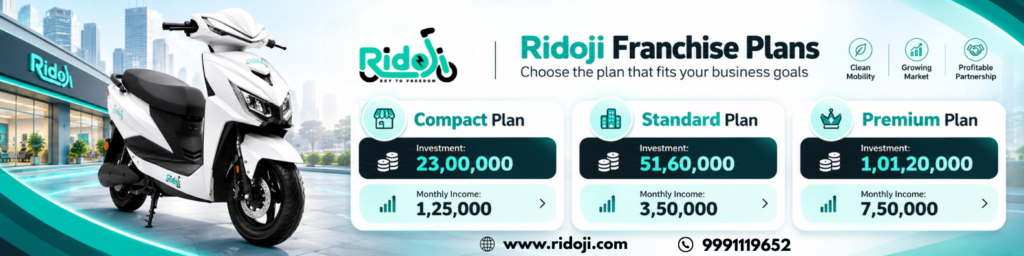
If you are keen on understanding how electric mobility can become part of your investment journey, consider getting in touch with Ridoji.
Look into Ridoji’s investment opportunities in EVs and see how electric scooter fleets can create new opportunities in India’s growing electric mobility industry.
Frequently Asked Questions (FAQs)
2. How can electric scooters generate passive income?
Electric scooters can be deployed for commercial activities such as last-mile delivery, rentals, and transportation. Businesses may generate revenue through these operations, depending on vehicle utilisation and rental agreements.
3. Is EV fleet investment a good option among passive income opportunities in India?
EV fleet investment is an emerging business model worth researching. Its suitability depends on investment costs, vehicle ownership, market demand, operational efficiency, and the revenue-generation arrangement.
4. What is the role of fleet management in EV investment?
Fleet management involves vehicle deployment, maintenance, performance monitoring, customer coordination, and operational cost management. Efficient fleet management can support better vehicle utilisation and business performance.
5. Can EV investment provide regular income?
EV businesses may generate revenue through vehicle rentals, commercial transportation, and delivery operations. Whether investors receive regular payments depends on the investment agreement and the financial performance of the underlying business.
6. What should I check before exploring passive income opportunities in India through EV investment?
Investors should evaluate the investment structure, vehicle ownership, revenue model, maintenance responsibilities, operational arrangements, contractual terms, and financial risks before participating.
7. How does Ridoji relate to passive income opportunities in India?
Ridoji focuses on electric mobility, particularly electric scooters and fleet management. Individuals interested in EV-related business opportunities can explore its model to understand how electric vehicles may be utilised for commercial purposes.