
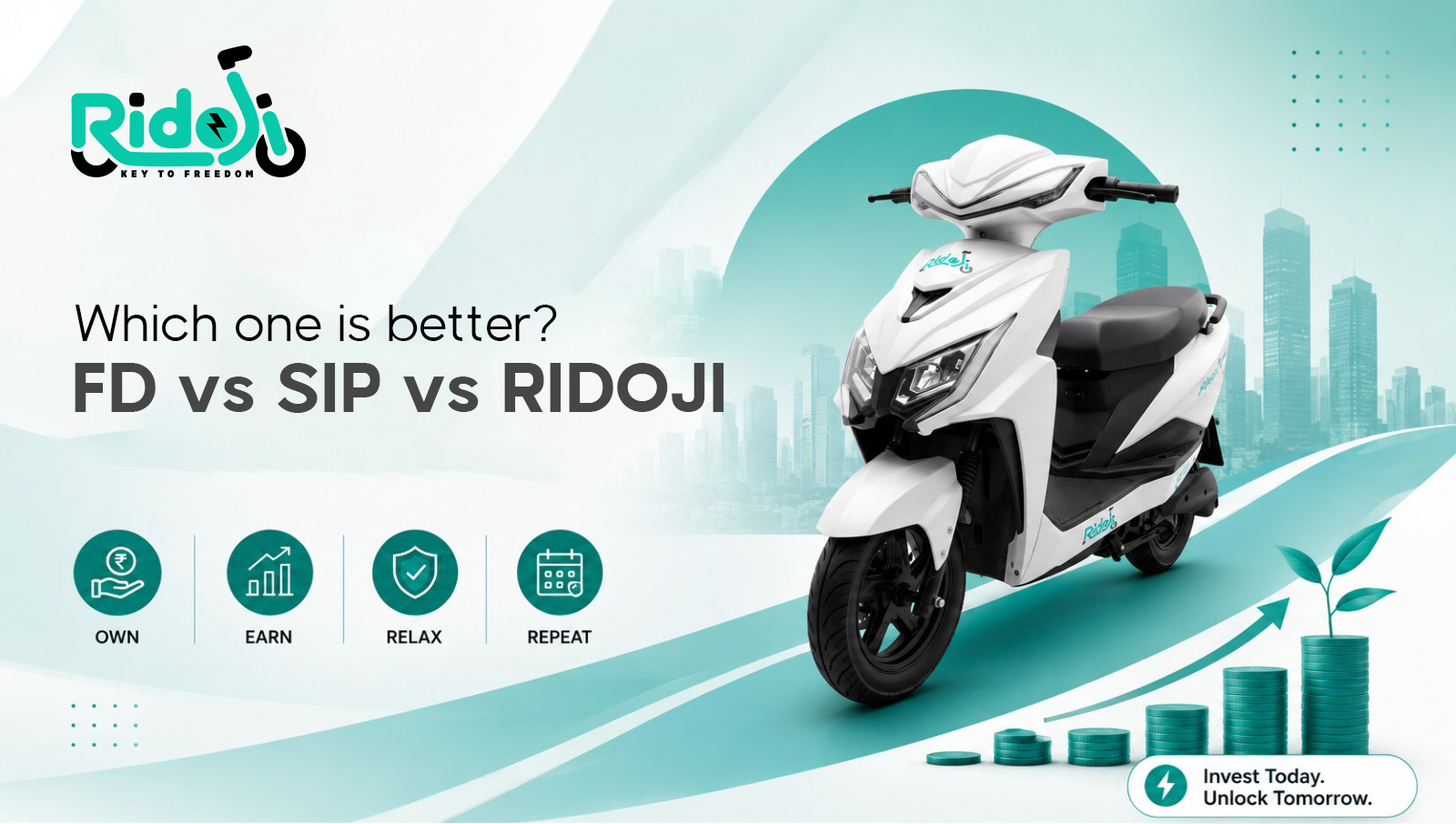
FD vs SIP vs EV Investment is an important comparison for Indian investors exploring different ways to build wealth and generate recurring income. Fixed Deposits (FDs) offer predictable interest, while Systematic Investment Plans (SIPs) provide a disciplined way to invest in mutual funds. Managed EV fleet programs introduce another approach involving commercial electric vehicle assets and contractual rental payouts.
This shift has led to the rise of asset-backed investments, where investors own productive assets capable of generating recurring income. Among these emerging opportunities, Ridoji’s Investment Plan has gained attention as a unique EV fleet management program that allows individuals to own electric vehicles and earn passive income through commercial deployment.
Unlike conventional investments that depend entirely on market appreciation or fixed interest rates, Ridoji’s Investment Plan focuses on converting physical assets into income-generating assets.
In this article, we explore how Ridoji’s Investment Plan works, compare it with Fixed Deposits and SIPs, and understand why many investors are exploring this innovative approach to passive income.
Understanding Traditional Investments
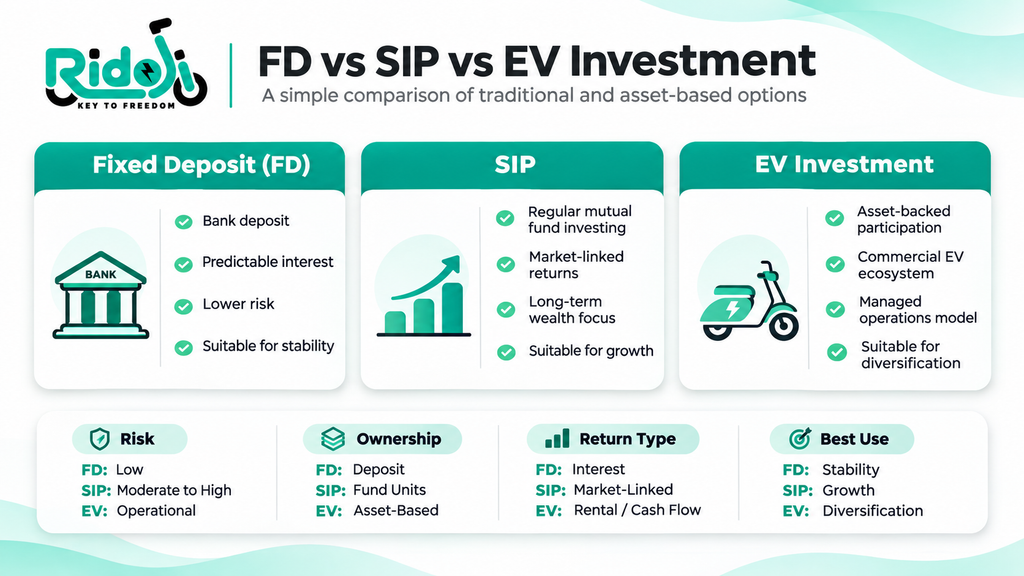
Understanding FD vs SIP begins with examining how these two approaches work. Fixed deposits generally focus on predictable interest payments, whereas SIPs allow regular investments in mutual fund schemes whose performance depends on underlying market conditions.
Fixed Deposits (FD)
Fixed Deposits are one of the most popular investment choices in India. Investors deposit money with a bank for a fixed period and receive interest at predetermined rates.
Advantages of FDs
- Capital preservation
- Predictable returns
- Low risk
- Easy accessibility
Bank fixed deposits are generally considered relatively low-risk savings instruments. In India, eligible deposits with insured banks are covered by the Deposit Insurance and Credit Guarantee Corporation (DICGC) up to ₹5 lakh per depositor per bank, including principal and interest, subject to applicable conditions. This protection is different from the risks associated with mutual funds or privately operated EV fleet programs.
Source: DICGC Deposit Insurance Guide
Limitations of FDs
- Returns may barely beat inflation.
- Limited wealth creation potential.
- No ownership of productive assets.
- Interest income is taxable.
While FDs are suitable for conservative investors, they may not always provide sufficient long-term growth or monthly cash flow.
In an FD vs SIP comparison, fixed deposits are generally preferred by individuals seeking predictable interest payments, while SIPs provide a disciplined approach to investing in mutual funds. The right choice depends on investment goals, risk tolerance, and liquidity requirements.
Systematic Investment Plans (SIP)
A Systematic Investment Plan (SIP) is a method of investing a fixed amount regularly in a mutual fund scheme. SIPs encourage disciplined investing, while returns depend on the underlying investments and market conditions. They do not promise a fixed rate of return, and liquidity depends on the selected mutual fund scheme.
Advantages of SIPs
- Wealth creation through compounding.
- Flexibility and liquidity.
- Professional fund management.
- Diversification across sectors.
Limitations of SIPs
- Market fluctuations can impact returns.
- Short-term volatility.
- No guaranteed income.
- Performance depends on market conditions.
SIPs are ideal for long-term capital appreciation but may not provide consistent monthly cash flow.
When evaluating FD vs SIP, understanding the differences in risk and financial stability is essential. Fixed Deposits generally provide predetermined interest rates, while Systematic Investment Plans allow investors to invest regularly in mutual funds with market-linked performance. The FD vs SIP comparison becomes particularly important for individuals deciding between predictable interest income and potential long-term capital appreciation. Both approaches have distinct advantages depending on financial objectives, investment duration, and risk tolerance.
What is Ridoji’s Investment Plan?
Ridoji’s Investment Plan is a 4-year EV Fleet Management Program designed to transform electric vehicles into income-generating assets.
Under the program, investors own electric scooters while Ridoji handles commercial deployment and fleet operations. The vehicles are utilized in India’s rapidly expanding delivery and mobility ecosystem, allowing owners to participate in the growth of the EV sector without managing day-to-day operations.
The model is designed to simplify EV asset ownership and provide a structured passive income opportunity.
When evaluating FD vs SIP alongside managed EV fleet programs, investors should consider more than potential payouts. Asset ownership, liquidity, financial risks, agreement duration, and operational responsibilities are also important factors.
1. FD vs SIP: Comparing Traditional Investment Options
The FD vs SIP comparison is important for investors evaluating traditional investment options in India. When analysing FD vs SIP, individuals often compare interest rates, investment risks, liquidity, and long-term financial goals. Understanding FD vs SIP also helps investors recognise how fixed deposits differ from regular mutual fund investments. While the FD vs SIP decision depends on individual financial priorities, both approaches remain relevant for investors exploring different ways to manage their savings and investments.
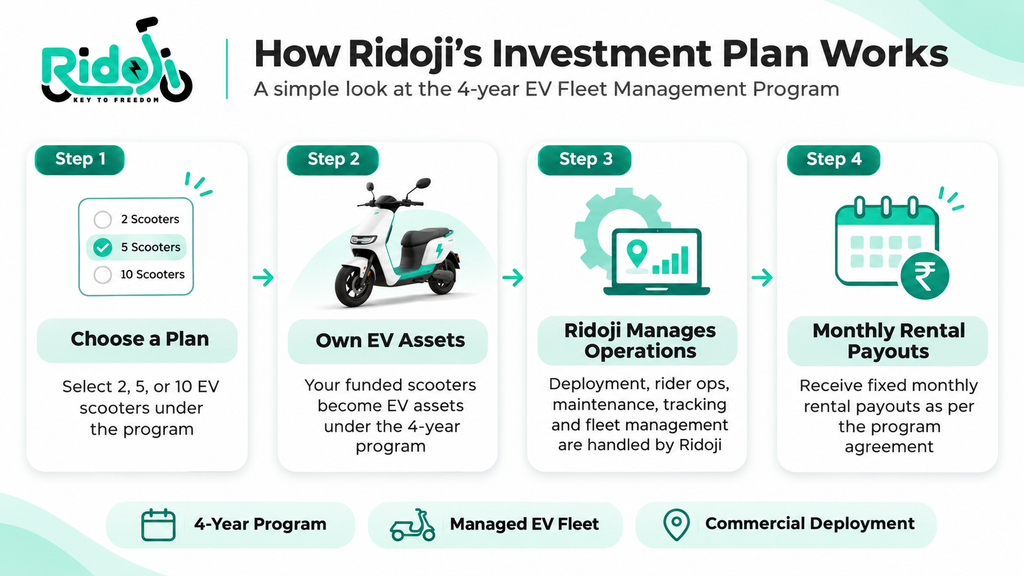
How Ridoji’s Investment Plan Works
Step 1: Own an EV Asset
Investors purchase electric scooters that become productive assets.
Step 2: Fleet Enrollment
The vehicles are enrolled into Ridoji’s managed fleet program.
Step 3: Operational Management
Ridoji oversees deployment, fleet coordination, maintenance support, and operational management.
Step 4: Income Generation
Commercial utilization enables the assets to generate recurring income over the duration of the program.
This model enables investors to participate in the expanding EV and delivery ecosystem while avoiding the complexities of fleet management.
What Should Investors Check Before Joining a Managed EV Fleet Program?
Before joining a managed EV fleet program, it is important to understand the financial and operational terms of the arrangement.
Key questions include:
- What is the total vehicle funding requirement, including applicable taxes?
- Who holds legal ownership of the electric scooters?
- What is the agreement duration?
- How are monthly rental payouts calculated and paid?
- Who is responsible for insurance, maintenance, and battery replacement?
- What happens if an electric scooter remains undeployed?
- What happens to the vehicle at the end of the agreement?
- Are there early exit, transfer, or termination provisions?
Ridoji offers a four-year EV Fleet Management Program in which the company manages vehicle deployment and associated fleet operations. Prospective participants should review the latest official program agreement for the specific commercial terms.
Why Asset-Based Investing Is Becoming Popular
Traditional investments are primarily financial instruments. Asset-based investing focuses on owning productive assets that create value and generate income.
Examples include:
- Rental real estate
- Commercial equipment
- Warehousing assets
- Logistics infrastructure
- EV fleet assets
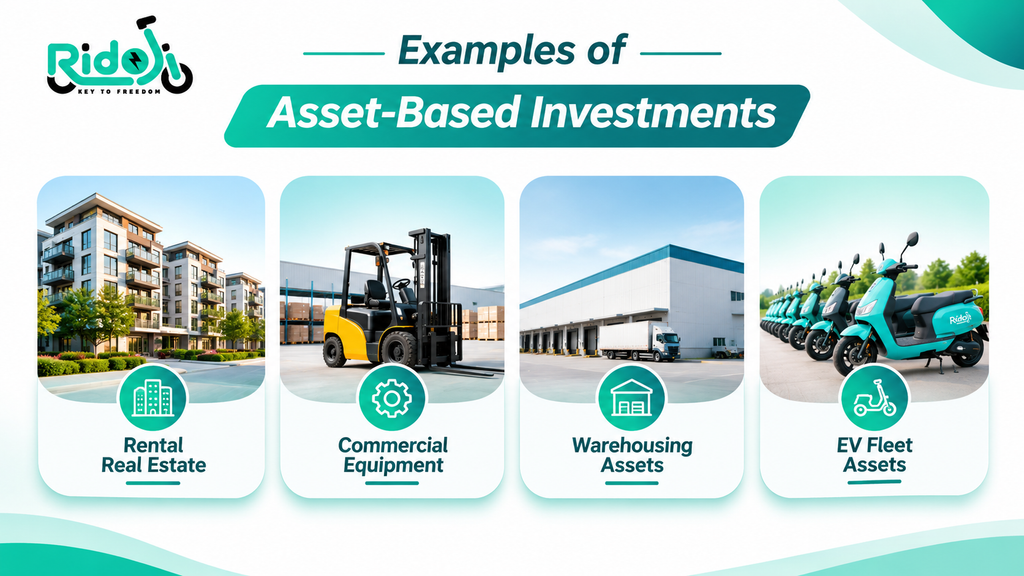
The increasing growth of e-commerce, quick commerce, and last-mile delivery has created demand for commercial mobility solutions, making EV fleet assets an emerging investment category.
The FD vs SIP comparison often focuses on predictable interest income versus market-linked investment growth. However, India’s expanding electric mobility ecosystem has introduced opportunities involving commercial EV assets. Unlike conventional FD vs SIP options, managed EV fleet programs involve electric scooters deployed for commercial use, with contractual rental payment arrangements. These programs have different risk profiles, including vehicle utilization, maintenance requirements, depreciation, and operator performance, making careful evaluation essential before participating.
5. FD vs SIP vs EV Investment: Key Differences Explained
1. Participation in a Growing Industry
FDs provide fixed interest, and SIPs provide exposure to financial markets. Ridoji’s Investment Plan allows investors to participate in India’s fast-growing EV and delivery ecosystem.
With increasing adoption of electric mobility and rapid expansion of last-mile logistics, EV assets are becoming commercially significant.
2. Productive Asset Ownership
In an FD, investors only deposit money.
In SIPs, investors hold units of mutual funds.
With Ridoji’s Investment Plan, investors own physical assets that are deployed commercially.
Asset ownership creates a different investment experience compared with purely financial instruments.
3. Passive Income Potential
Unlike the conventional FD vs SIP comparison, managed EV fleet programs focus on contractual rental payments generated through commercial vehicle arrangements. These programs involve different risks, including operator performance, asset depreciation and payment obligations. Many investors seek investments that provide regular income instead of waiting years for appreciation.
Ridoji’s Investment Plan focuses on transforming EV assets into income-generating assets through managed operations. This makes it appealing for individuals seeking alternative passive income opportunities.
FD vs SIP vs EV Investment: Exploring Monthly Cash Flow
The FD vs SIP comparison becomes more relevant when investors explore opportunities for recurring cash flow. Fixed Deposits may offer periodic interest payments, while mutual fund investments made through SIPs may support systematic withdrawals depending on the scheme and available investment value. Managed EV fleet programs introduce a different model involving commercial vehicle assets and contractual rental payouts. When comparing FD vs SIP with EV investment, investors should carefully evaluate payment terms, liquidity, maintenance responsibilities, and associated financial risks.
4. Hands-Free Operations
Managing commercial vehicles independently can be challenging.
Ridoji simplifies the process by managing operations, deployment, and fleet coordination, allowing owners to remain passive participants.
This creates convenience and reduces operational complexity.
5. Diversification Beyond Traditional Assets
Financial experts often recommend diversification across different asset classes.
Investors commonly allocate funds to:
- Fixed Deposits
- Mutual Funds
- Gold
- Real Estate
- Equities
Asset-backed EV investments introduce an additional category that can complement traditional portfolios.
Why India’s EV Ecosystem Creates New Opportunities
India’s mobility landscape is undergoing a transformation.
Several factors are driving this shift:
Growth of Quick Commerce
Platforms delivering groceries and essentials require efficient transportation solutions.
Expansion of Last-Mile Delivery
Millions of deliveries take place daily, increasing demand for commercial vehicles.
Rising Fuel Costs
Electric mobility offers lower operating costs compared with conventional vehicles.
Government Push for EV Adoption
Policy support and infrastructure development continue to accelerate EV adoption.
These trends are creating long-term opportunities in commercial EV utilization.
Who Might Consider an EV Fleet Investment?
Salaried Professionals
Individuals seeking additional income streams.
Business Owners
Entrepreneurs looking to diversify their investments.
Retired Individuals
People interested in passive income opportunities.
Existing Investors
Those who already invest in FD, SIP, gold, or real estate and want portfolio diversification.
First-Time Asset Investors
People interested in owning productive assets without operational responsibilities.
A detailed FD vs SIP vs EV Investment comparison helps investors understand how these approaches differ in terms of ownership, liquidity, income mechanisms, and risk exposure. Each option should be evaluated according to its actual financial and contractual characteristics.
FD vs SIP vs EV Investment: Comparison Table
| Feature | FD | SIP | Ridoji’s Investment Plan |
|---|---|---|---|
| Asset Ownership | No | No | Yes |
| Market Dependency | Low | High | Operational |
| Income Focus | Interest | Growth | Cash Flow |
| Wealth Creation | Moderate | Long-Term | Asset-Based |
| Inflation Protection | Limited | Better | Diversification Opportunity |
| Operational Involvement | None | None | Managed by Ridoji |
| Exposure to EV Industry | No | Indirect | Direct |
Each investment category serves different objectives, and investors should choose according to their risk appetite and financial goals.
Risks and Important Considerations Before Choosing an Investment
Every financial arrangement carries a different combination of risks, costs, and liquidity conditions.
Bank fixed deposits offer relatively predictable interest payments, but inflation, taxation, premature withdrawal conditions, and deposit insurance limits should be considered.
Mutual fund investments made through SIPs are exposed to the risks of their underlying securities. Returns are not fixed, and the value of investments may fluctuate.
Managed EV fleet programs involve a different set of considerations, including vehicle utilization, maintenance costs, battery performance, asset depreciation, operator financial strength, and contractual payment obligations.
Before participating in an EV fleet program, individuals should review who legally owns the vehicle, how rental payments are funded, what happens if vehicles remain undeployed, whether payments can be delayed, and how the asset or agreement is handled at the end of its term.
Industry growth alone should not be treated as evidence of assured investment performance.
The Importance of Diversification
Understanding FD vs SIP is only one part of investment planning. Individuals may also evaluate other asset categories to diversify their exposure, provided they carefully consider liquidity, associated costs, and the risks of each arrangement. There is no single investment that fits everyone. Fixed Deposits provide safety. SIPs provide long-term growth. Asset-backed investments provide participation in real-world economic activity.
A balanced portfolio often combines multiple asset classes instead of depending on one option.
Diversification helps manage risk and creates multiple avenues for wealth creation.
The FD vs SIP comparison also highlights why investment decisions should reflect individual financial goals, liquidity needs, and risk tolerance. Alternative asset-based programs may offer additional exposure, but they carry distinct contractual and operational risks.
Choosing between FD vs SIP requires understanding the balance between financial stability, market exposure, and long-term objectives. Fixed Deposits may suit individuals prioritizing predictable interest payments, while SIPs can support disciplined mutual fund investing over time. Beyond the FD vs SIP comparison, investors may explore asset-based opportunities such as managed electric vehicle fleets to diversify their exposure. However, financial decisions should consider liquidity, taxation, contractual terms, and potential risks rather than focusing only on expected monthly payouts.
A meaningful FD vs SIP comparison should consider more than potential returns. Investment objectives, tax treatment, liquidity, and time horizon can influence which approach is suitable for different individuals. Beyond the traditional FD vs SIP discussion, asset-based opportunities such as managed electric scooter fleets may offer additional exposure to commercial mobility operations. However, investors should review contractual obligations, asset depreciation, and operator-related risks before making financial decisions.
Final Thoughts
The FD vs SIP vs EV Investment comparison demonstrates that different financial arrangements serve different objectives. Fixed deposits can offer relatively predictable interest, SIPs provide a disciplined mutual fund investment method, and managed EV fleet programs introduce asset-based rental arrangements. Understanding the associated risks, costs, and contractual terms can help individuals make better-informed financial decisions.
Ridoji’s Investment Plan is not just about owning an EV—it is about participating in the future of mobility through professionally managed, income-generating assets.
Frequently Asked Questions (FAQs)
1. What is the main difference between FD, SIP and EV investment?
An FD is a bank deposit, a SIP is a regular investment method commonly used for mutual funds, and an EV fleet program involves commercial vehicle assets and contractual operating arrangements.
2. Is an EV fleet investment safer than a fixed deposit?
These arrangements carry different risks. Eligible bank deposits have defined deposit-insurance protection, while EV fleet programs involve asset, operator, and contractual risks.
3. Can mutual fund SIPs provide monthly income?
Mutual fund investments may support periodic withdrawals through a systematic withdrawal plan, but withdrawals and investment returns are not guaranteed.
4. How does Ridoji’s EV fleet program work?
Participants fund EV assets under program terms, while Ridoji manages fleet operations, vehicle deployment, and related activities. Rental payment terms are governed by the agreement.
5. What are the risks of a managed EV fleet program?
Risks may include low vehicle utilization, battery deterioration, depreciation, delayed payments and operator financial performance.