

The electric vehicle industry has made remarkable progress in recent years, but one challenge continues to influence almost every EV purchase decision: driving range.
Although modern electric cars and two-wheelers can comfortably handle daily travel, many buyers still worry about limited range, charging time and battery replacement costs. Battery manufacturers and research institutions are therefore working to store more energy in smaller, lighter and more efficient battery packs.
A new development in anode-free battery technology may represent an important step in that direction.
According to a recent electric and hybrid vehicle technology report published by Tech Briefs, researchers have developed an anode-free lithium-metal battery capable of reaching approximately 1,270 watt-hours per litre of volumetric energy density. The report suggests that this is nearly twice the volumetric energy density associated with many conventional electric vehicle batteries, creating the possibility of significantly longer EV driving ranges.
However, does this mean electric vehicles will soon travel twice as far on a single charge?
The answer is promising, but more complicated than the headline suggests.
What Is an Anode-Free Battery?
Most electric vehicles currently use lithium-ion batteries. A conventional lithium-ion cell generally includes a cathode, electrolyte, separator and an anode made from materials such as graphite or a graphite-silicon mixture.
The anode stores lithium ions when the battery is charged. It is therefore an essential part of the traditional battery structure, but it also occupies space and adds weight.
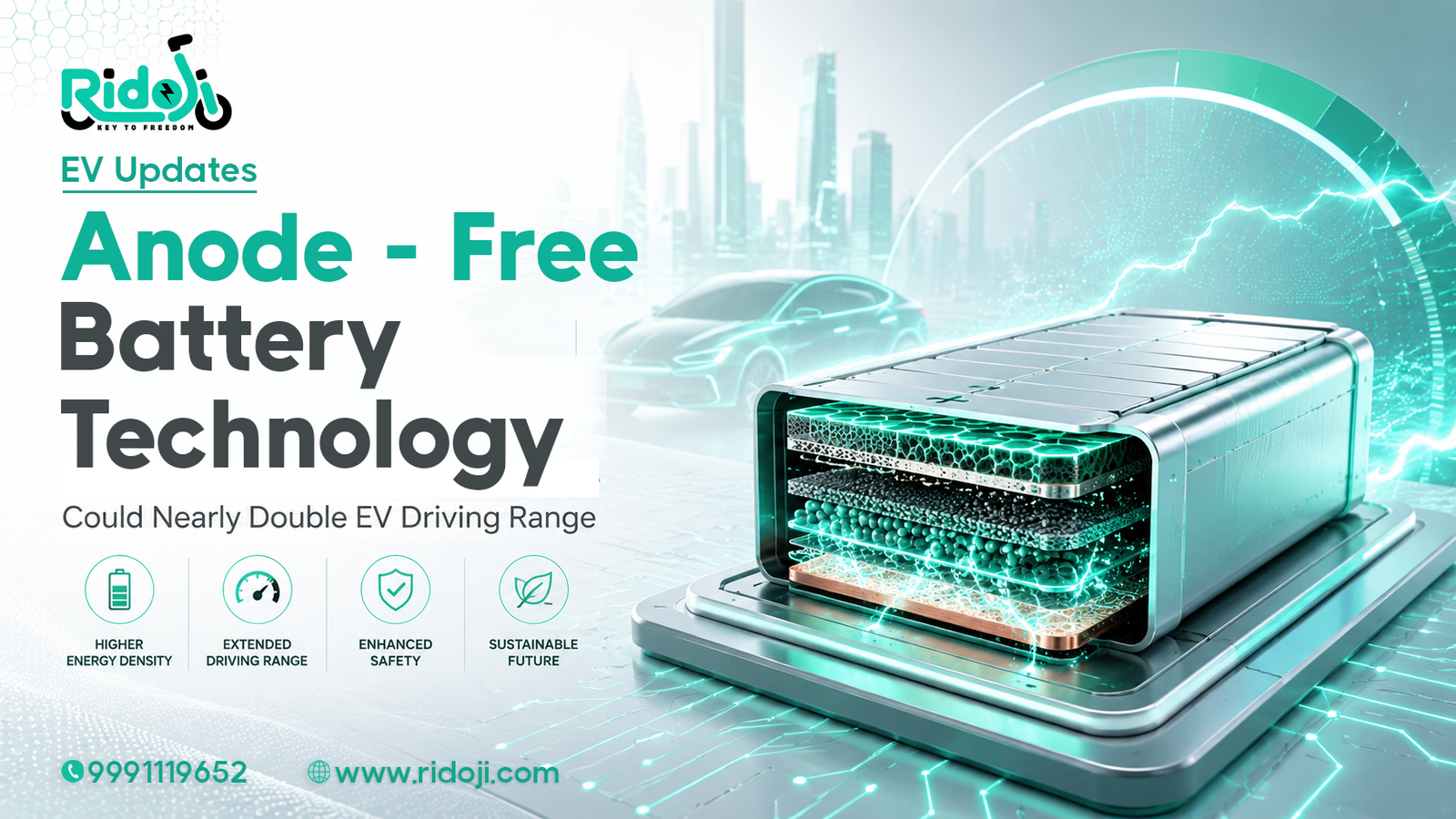
An anode-free lithium-metal battery is manufactured without a conventional active anode material. Instead, the negative side of the battery initially contains a thin current collector, usually made from copper.
When the battery is charged for the first time, lithium ions move from the cathode through the electrolyte and deposit as metallic lithium on the copper current collector. This deposited lithium temporarily forms the battery’s anode.
During discharge, the lithium moves back toward the cathode.
Removing the traditional graphite anode allows battery designers to use more of the cell’s available space for energy storage. In theory, this can improve both the battery’s volumetric and gravimetric energy density.
In simple terms, an anode-free battery may store more energy without requiring a proportionally larger or heavier battery pack.
How the New Anode-Free Battery Works
The biggest challenge with anode-free batteries is controlling how lithium metal forms and disappears during charging and discharging.
Lithium does not always deposit evenly on the current collector. It may develop irregular structures, including needle-like formations commonly known as dendrites. These structures can reduce battery performance and, in extreme conditions, penetrate the battery separator and cause an internal short circuit.
The researchers behind the reported breakthrough addressed this problem by combining two carefully designed elements: a reversible host and a specialised electrolyte.
A reversible host for lithium deposition
The battery uses a polymer-based framework containing uniformly distributed silver nanoparticles.
Silver helps attract lithium and encourages it to deposit more evenly. Instead of lithium randomly accumulating on the copper surface, the silver particles act as controlled starting points for lithium formation.
The polymer host also provides space for the physical changes that occur as lithium is deposited during charging and removed during discharge.
This structure is intended to reduce uneven lithium growth, minimise inactive lithium formation and improve the battery’s cycling stability.
A specially designed electrolyte
The researchers also developed an electrolyte intended to create a stable protective layer between the lithium metal and the electrolyte.
This interface, known as the solid-electrolyte interphase or SEI, plays a vital role in battery performance. It should allow lithium ions to pass through while limiting unwanted chemical reactions.
A stable SEI can reduce electrolyte decomposition, improve charging efficiency and help prevent the continuous loss of active lithium.
By combining the silver-containing host with the specially designed electrolyte, the research team was able to achieve more controlled lithium deposition than would normally occur in an anode-free cell.
Why 1,270 Wh/L Is Important
Battery energy density measures how much energy can be stored relative to the battery’s weight or volume.
Gravimetric energy density is expressed in watt-hours per kilogram, while volumetric energy density is measured in watt-hours per litre.
Volumetric energy density is especially important for electric vehicles because the space available for a battery pack is limited. A battery that stores more energy in the same physical space could potentially provide a longer driving range without requiring a larger vehicle.
The reported anode-free pouch cell achieved approximately 1,270 Wh/L. Tech Briefs compares this with roughly 650 Wh/L for existing lithium-ion battery technology, leading to the conclusion that the new design could potentially support nearly twice the energy within a similar cell volume.
This could allow vehicle manufacturers to choose between two major benefits.
They could retain the existing battery size and offer a much longer driving range, or they could reduce the size and weight of the battery while maintaining a similar range.
For electric scooters and motorcycles, the second option may be particularly valuable. Smaller batteries could reduce vehicle weight, create more storage space and make removable battery packs easier to carry.
Could This Battery Really Double EV Range?
Theoretically, a battery with nearly twice the volumetric energy density could significantly increase the amount of energy stored inside an electric vehicle.
However, doubling cell-level energy density does not automatically double the vehicle’s real-world range.
An EV battery pack contains much more than electrochemical cells. It also requires:
- Cooling and temperature-management systems
- Protective structural components
- Electrical wiring and connectors
- Battery-management electronics
- Safety barriers
- Cell holders and modules
- Unused capacity reserved for battery protection
The complete battery pack therefore has a lower energy density than an individual cell.
Vehicle range is also affected by aerodynamics, vehicle weight, tyre resistance, motor efficiency, weather conditions, road gradient, speed and driving behaviour.
Consequently, the new technology could support a major range improvement, but the actual increase would depend on how the cells are integrated into a commercial battery pack and vehicle.
The phrase “double EV driving range” should currently be viewed as a potential outcome based on energy-density comparisons—not as a result already demonstrated in a production electric vehicle.
The Biggest Challenge: Battery Cycle Life
The reported battery retained approximately 81.9% of its capacity after 100 charging cycles.
That is an encouraging laboratory result for anode-free lithium-metal technology, but it is not yet sufficient for most commercial electric vehicles.
A vehicle battery may be expected to complete hundreds or even thousands of charging cycles during its useful life. The US Department of Energy’s Battery500 programme, for example, has set objectives that include developing high-energy lithium-metal pouch cells and demonstrating up to 1,000 deep charge-discharge cycles.
Cycle life is especially important for commercial fleets and delivery vehicles.
A privately owned vehicle may use only a portion of its battery each day. A delivery scooter, however, could complete close to a full cycle every working day. At that level of utilisation, 100 cycles may represent only a few months of operation.
For fleet applications, a battery must deliver not only a high range but also predictable long-term performance, manageable degradation and a competitive total cost of ownership.
Why Anode-Free Batteries Degrade
Anode-free batteries begin with a limited amount of lithium stored in the cathode. Unlike some lithium-metal battery designs, they do not contain a thick reserve of extra lithium at the anode.
Every time the battery charges and discharges, a small amount of lithium can be lost through unwanted reactions.
Lithium may become trapped in inactive structures, react with the electrolyte or become electrically disconnected from the current collector. The protective SEI layer can also break and reform, consuming additional lithium and electrolyte.
These losses may appear small during an individual cycle, but they accumulate over time.
This is why lithium plating and stripping must occur at extremely high efficiency for anode-free batteries to achieve commercially useful lifespans. The Battery500 programme has highlighted the importance of achieving Coulombic efficiency above 99.9% while addressing lithium-metal degradation under realistic cell conditions.
Potential Benefits for Electric Vehicles
If researchers successfully improve cycle life, safety and manufacturing consistency, anode-free batteries could offer several major advantages.
Longer driving range
More energy could be fitted into the same battery space, helping electric vehicles travel farther between charges.
Lower vehicle weight
Manufacturers could offer the same driving range using a smaller battery. A lighter vehicle may improve acceleration, handling and energy efficiency.
More compact electric two-wheelers
Electric scooters could gain more under-seat storage or use smaller removable batteries without sacrificing range.
Reduced dependence on graphite
Conventional lithium-ion batteries require significant quantities of graphite for their anodes. Anode-free designs could reduce demand for processed graphite and simplify parts of the battery supply chain.
Potential manufacturing advantages
Because the cell does not require a conventional coated graphite anode, certain material-processing and electrode-production stages may be reduced or redesigned.
However, these benefits will depend on whether the new polymer host, silver nanoparticles and electrolyte can be manufactured reliably and affordably at scale.
Safety and Commercialisation Questions
Lithium metal is highly reactive, which means safety will remain one of the most important areas of development.
Before an anode-free battery can be installed in a production EV, it must undergo extensive testing, including:
- High-temperature operation
- Low-temperature charging
- Fast-charging tests
- Overcharging and deep discharge
- Nail penetration
- Vibration and road shock
- Crush and collision simulations
- Internal short-circuit testing
- Thermal propagation testing
- Multi-year calendar ageing
The technology must also perform consistently across thousands or millions of cells. A successful laboratory pouch cell is an important achievement, but automotive-scale manufacturing requires extremely high quality control and low defect rates.
Cost is another unanswered question. Removing graphite could reduce some costs, but the new design uses silver nanoparticles, a specialised host and a carefully engineered electrolyte. Researchers and manufacturers will need to demonstrate that these materials can be produced economically.
What This Means for India’s EV Market
Anode-free battery technology could eventually have significant implications for India, where electric two-wheelers, three-wheelers and last-mile delivery fleets represent a major part of the EV transition.
A lighter and more energy-dense battery could help improve electric scooter range without making the vehicle heavier. It could also reduce the charging frequency required by riders and delivery partners.
However, Indian operating conditions create additional challenges.
EV batteries may experience high summer temperatures, heavy daily usage, frequent charging and varying road conditions. Commercial viability will therefore depend on heat resistance, cycle life, serviceability and battery replacement economics—not only maximum energy density.
For a managed EV fleet, the most important metric is not simply how far a vehicle can travel on one charge. It is how reliably the battery can deliver energy over its complete operational life.
Is Anode-Free Technology the Future of EV Batteries?
Anode-free lithium-metal batteries are among the most promising next-generation energy-storage technologies.
The reported 1,270 Wh/L result demonstrates that researchers are making meaningful progress toward batteries that are smaller, lighter and more energy dense than today’s conventional lithium-ion cells.
At the same time, the technology remains at an early stage.
A battery that retains around 82% capacity after 100 cycles is not yet ready to replace the proven batteries used in everyday electric vehicles. Researchers must substantially improve cycle life, validate safety, demonstrate fast charging and prove that the design can be mass-produced at an affordable cost.
The breakthrough should therefore be viewed as an important scientific milestone rather than an immediately available commercial product.
Conclusion
Anode-free battery technology could transform the future of electric mobility by storing more energy within a smaller space.
For electric cars, this may eventually mean longer driving ranges and lighter battery packs. For electric scooters and commercial EV fleets, it could provide compact batteries, reduced vehicle weight and greater operational flexibility.
However, energy density is only one part of a successful EV battery.
Cycle life, safety, thermal performance, charging speed, manufacturing quality and cost will ultimately determine whether this technology moves from the laboratory into millions of vehicles.
The latest research shows that nearly double the cell-level energy density may be technically possible. The next challenge is proving that the battery can deliver that performance safely, affordably and repeatedly throughout the life of an electric vehicle.