

Why Investors Are Looking Beyond Traditional Options
Introduction: The Search for Better Investment Opportunities
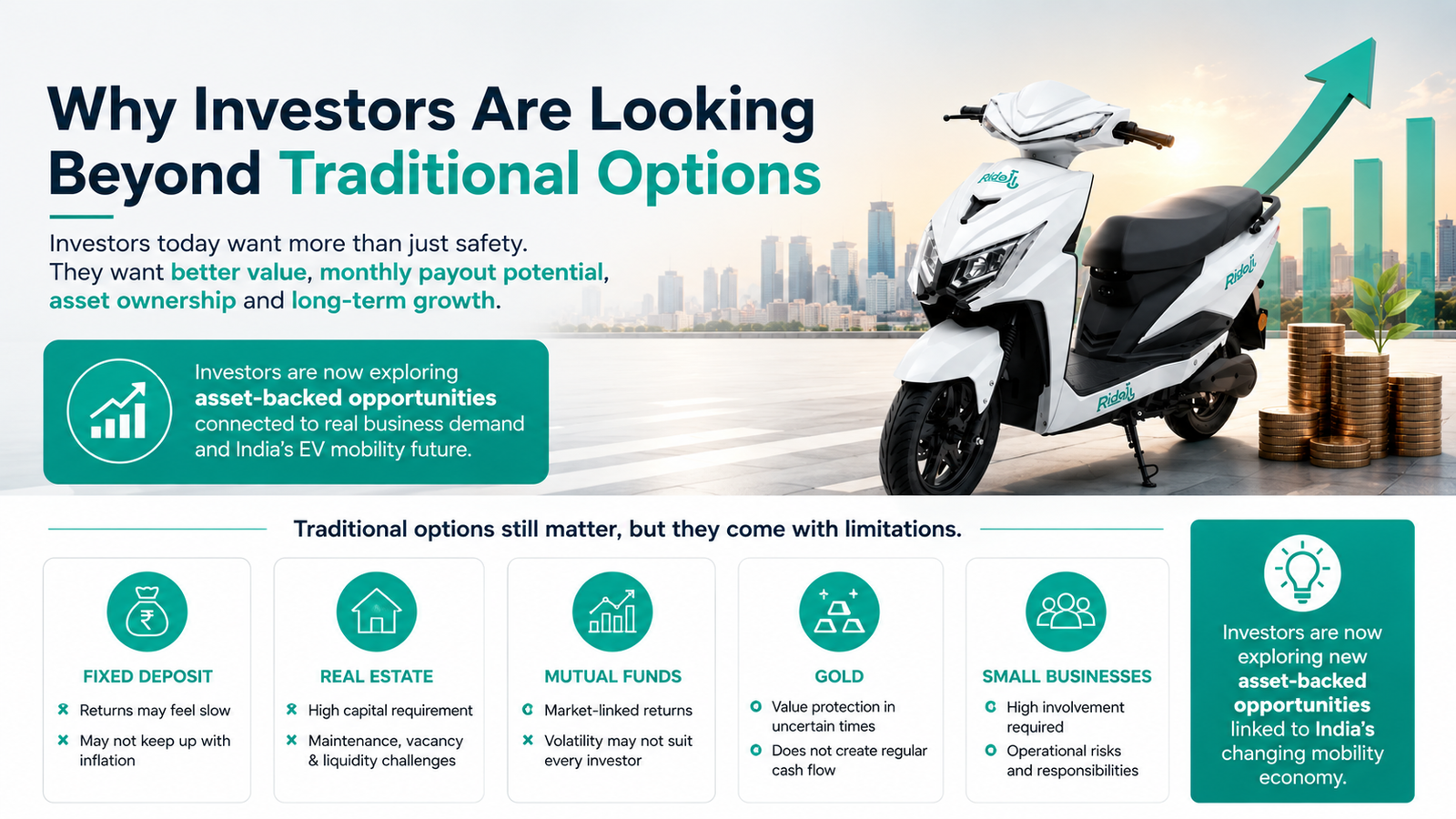
For many Indian investors, the investment journey usually begins with familiar options: fixed deposits, real estate, gold, mutual funds, insurance plans, or small businesses.These options have been trusted for years. Fixed deposits offer simplicity. Real estate gives the comfort of owning a physical asset. Gold is seen as a traditional safety net. Mutual funds help investors participate in market-linked growth.But investor expectations are changing.Today, many people are not only asking, “Where should I invest?” They are asking:
Where can I invest for better value, monthly payout potential, asset ownership, and long-term growth?
This is why investors are now exploring newer asset-backed opportunities beyond traditional choices. One such opportunity gaining attention is EV fleet investment.
EV fleet investment is different because it connects a physical electric vehicle asset with real-world commercial mobility demand. Electric scooters and electric vehicles are no longer only personal transport options. They are increasingly being used in delivery, rider rental, logistics, urban mobility, and business fleet operations.
This creates a new investment conversation.
Instead of simply buying a financial product or property, investors can participate in a managed EV fleet model where electric scooters are commercially deployed and professionally managed.
Why FD and Real Estate Still Matter
Before comparing EV fleet investment with traditional options, it is important to be fair.
Fixed deposits and real estate still matter.
FDs are popular because they are simple, familiar, and easy to understand. An investor deposits money, earns interest, and receives returns based on the bank’s terms. For conservative investors, this simplicity is valuable.
Real estate is also deeply trusted in India. It gives investors a physical asset, long-term appreciation potential, and rental income possibilities. Many people still consider property ownership one of the strongest forms of wealth creation.
So the point is not that FD or real estate are bad.
The point is that investor needs are becoming more diverse.
Some investors want higher monthly payout potential. Some want lower entry barriers than real estate. Some want exposure to fast-growing sectors. Some want physical asset-backed opportunities without personally managing a business.
That is where alternatives like managed EV fleet investment become relevant.
The Limitations Investors Are Noticing
Every investment option has advantages and limitations.
Fixed deposits are stable, but returns may feel slow for investors who want stronger growth or better monthly income potential.
Real estate can generate rental income, but it usually requires high capital. It also comes with maintenance costs, tenant issues, property tax, legal documentation, vacancy risk, and lower liquidity.
Mutual funds can create long-term wealth, but they are linked to market performance. Stock market volatility may not suit every investor.
Gold may protect value during uncertainty, but it does not usually create regular monthly cash flow.
Small businesses can generate strong income, but they need time, daily involvement, employees, operations, and risk management.
This is why many investors are asking a new question:
Is there an investment option that is asset-backed, linked to a growing sector, and professionally managed?
EV fleet investment attempts to answer this question.
Why Alternative Asset-Backed Opportunities Are Growing
Alternative asset-backed opportunities are becoming popular because investors are looking for models connected to real business demand.
Instead of depending only on interest rates, property appreciation, or market movement, investors are exploring assets that can be used in active commercial ecosystems.
Examples include:
- Renewable energy assets
- Commercial equipment leasing
- Logistics assets
- Mobility assets
- EV fleets
- Managed business assets
EV fleet investment fits into this trend because it combines three things:
- A physical electric vehicle asset
- Commercial deployment potential
- Professional fleet management
The electric scooter is not only owned. It is deployed, used, maintained, tracked, and managed within a commercial mobility system.
That is what makes the model different from simply buying a scooter or investing in a normal financial product.
Why EV Fleet Investment Is Gaining Attention
What Is EV Fleet Investment?
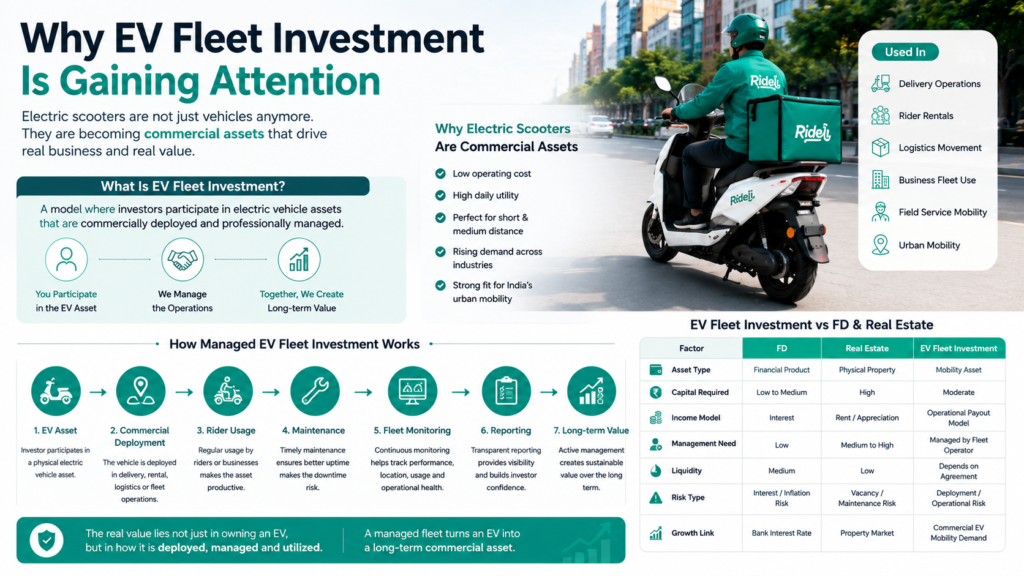
EV fleet investment is a model where investors participate in electric vehicle assets that are deployed for commercial mobility and managed by a fleet management company.
In simple words:
The investor participates in the EV asset. The fleet company manages the operations.
The vehicle may be used for:
- Delivery operations
- Rider rentals
- Logistics movement
- Business fleet use
- Field service movement
- Urban mobility operations
A managed EV fleet model may include vehicle deployment, rider coordination, maintenance support, fleet monitoring, reporting, documentation coordination, and day-to-day operational management.
This is what makes it different from informal vehicle renting.
In an informal rental model, the investor may have to find riders, collect payments, handle repairs, solve breakdown issues, track the vehicle, and manage disputes.
In a managed fleet model, these responsibilities are handled through a structured system.
Why Electric Scooters Are Becoming Commercial Assets
Electric scooters are gaining importance because they fit the daily needs of Indian cities.
They are compact, practical, affordable to operate, and suitable for short-distance and medium-distance movement. This makes them useful for delivery riders, logistics partners, rental platforms, local businesses, and field teams.
Electric scooters can be used in:
- Food delivery
- Grocery delivery
- E-commerce logistics
- Courier services
- Rider rental models
- Hyperlocal business movement
- Urban service operations
For a personal user, an electric scooter is a mobility product.
For a business, it is an operational tool.
For an investor, it can become a commercial mobility asset when deployed through a managed fleet system.
This is the key reason EV fleet investment is gaining attention.
The value does not come from the vehicle sitting idle.
The value comes from structured deployment and managed utilization.
For readers who want to understand the broader EV ecosystem, electric mobility in India resources by e-AMRIT provide useful information on adoption, charging, and EV benefits.
How Managed EV Fleet Investment Works
A managed EV fleet investment model works through a value chain:
EV asset → commercial deployment → rider usage → maintenance → fleet monitoring → reporting → long-term value
Each step matters.
1. EV Asset
The investor participates in a physical electric vehicle asset, usually an electric scooter or fleet unit.
2. Commercial Deployment
The vehicle is deployed into a business use case such as delivery, rider rental, logistics, or fleet mobility.
3. Rider Usage
The vehicle becomes productive when it is used regularly by riders or commercial users.
4. Maintenance Support
Regular maintenance helps protect the asset, reduce sudden breakdowns, and improve vehicle uptime.
5. Fleet Monitoring
Monitoring helps track usage, performance, location, and operational issues.
6. Reporting
Reporting gives investors better visibility into how the asset is being managed.
7. Long-Term Value
The vehicle creates value when it remains active, maintained, monitored, and commercially useful over time.
This is why managed EV fleet investment should not be seen as only vehicle ownership. It is an operationally managed asset model.
Government initiatives such as the PM E-DRIVE scheme are also supporting India’s electric mobility transition through demand incentives and charging infrastructure support.
EV Fleet Investment vs FD and Real Estate
| Factor | Fixed Deposit | Real Estate | EV Fleet Investment |
| Asset Type | Financial product | Physical property | Mobility asset |
| Capital Required | Low to medium | High | Moderate, depending on plan |
| Income Model | Interest-based | Rent/appreciation | Operational payout model |
| Management Need | Low | Medium to high | Managed by fleet operator |
| Liquidity | Medium | Low | Depends on agreement |
| Risk Type | Interest/inflation risk | Vacancy/maintenance risk | Deployment/operational risk |
| Growth Link | Bank interest rate | Property market | Commercial EV mobility demand |
| Investor Involvement | Low | Medium | Lower if professionally managed |
This comparison shows that EV fleet investment is not a replacement for FD or real estate. It is a different category.
FDs may suit conservative investors.
Real estate may suit investors with high capital and long-term property goals.
EV fleet investment may suit investors who want exposure to India’s electric mobility sector through an asset-backed, professionally managed model.
Why Fleet Management Matters More Than the Vehicle
Many people assume the scooter is the investment.
In reality, the scooter is only the starting point.
The real value depends on how that scooter is deployed, used, maintained, tracked, and managed.
A scooter that remains idle creates limited value.
A scooter used without maintenance may face downtime.
A scooter without rider coordination may become difficult to manage.
A scooter without reporting lacks transparency.
A scooter inside a managed fleet system has better structure.
This is why fleet management matters.
Professional EV fleet management helps with:
- Vehicle deployment
- Rider coordination
- Maintenance planning
- Downtime reduction
- Fleet monitoring
- Documentation support
- Operational reporting
- Day-to-day supervision
The asset is important.
But the system behind the asset creates long-term value.
Risks, Ridoji Model and Investor CTA
What Investors Should Check Before Investing
Before investing in any EV fleet investment program, investors should ask practical questions.
They should not focus only on expected returns. They should understand how those returns are created.
Important questions include:
- Who owns the vehicle?
- Who manages the vehicle?
- Where will the vehicle be deployed?
- What is the payout model?
- Is the payout fixed, variable, or performance-linked?
- What is the lock-in period?
- What happens during downtime?
- Who handles maintenance?
- Who handles rider issues?
- What happens if the vehicle is damaged?
- What insurance support is included?
- What reports are shared?
- What is the exit process?
- What risks are mentioned in the agreement?
A serious investment decision should be based on clarity, not only attraction.
Risks Investors Should Understand
EV fleet investment can be attractive, but it is not risk-free.
It is a business-linked asset model, so investors should understand the risks clearly.
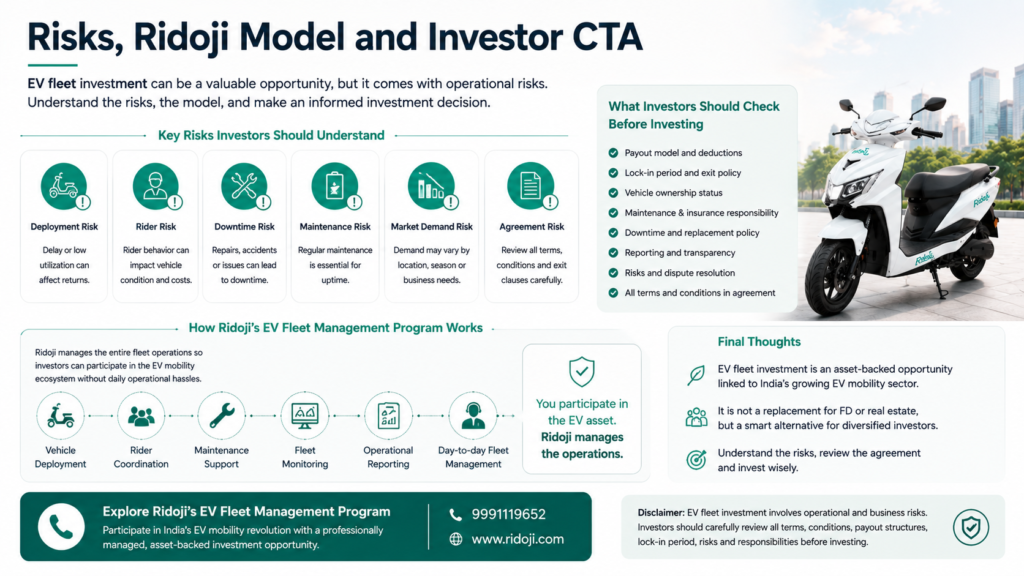
1. Deployment Risk
If the vehicle is not deployed quickly or consistently, payout potential may be affected.
2. Rider Risk
Rider behavior can affect vehicle condition, maintenance cost, and operational consistency.
3. Downtime Risk
The vehicle may remain unavailable due to repairs, service, damage, battery issues, documentation delays, or accidents.
4. Maintenance Risk
Electric vehicles have fewer moving parts than petrol vehicles, but they still require tyre checks, brake maintenance, battery monitoring, inspections, and regular service.
5. Market Demand Risk
Commercial demand can vary by city, location, rider availability, season, business partnerships, and mobility demand.
6. Policy Risk
Government incentives, subsidies, and EV regulations may change over time.
7. Agreement Risk
Investors must carefully review payout terms, lock-in period, exit clauses, damage policy, insurance coverage, service responsibility, and dispute resolution terms.
Understanding these risks does not make the opportunity weak. It makes the investor better prepared.
How Ridoji’s EV Fleet Management Program Fits This Opportunity
Ridoji’s EV Fleet Management Program is designed for investors who want to participate in India’s electric mobility sector without managing daily fleet operations themselves.
The model focuses on professionally managed EV fleet operations where Ridoji handles key responsibilities such as:
- Vehicle deployment
- Rider coordination
- Maintenance support
- Fleet monitoring
- Operational reporting
- Documentation coordination
- Day-to-day fleet management
This makes the model relevant for investors who are looking beyond traditional investment options and want to explore an asset-backed opportunity connected to India’s growing EV ecosystem.
The idea is simple:
You participate in the EV asset. Ridoji manages the fleet operations.
This is what makes managed EV fleets different from simply buying a scooter.
The investor is not only buying a vehicle. The investor is entering a professionally managed mobility ecosystem.
Who Should Consider EV Fleet Investment?
EV fleet investment may be suitable for investors who:
- Want to explore alternative asset-backed opportunities
- Are interested in India’s EV growth story
- Prefer a professionally managed model
- Do not want to manage vehicles personally
- Understand operational risks
- Are comfortable reviewing agreements
- Want exposure to commercial mobility
- Are looking beyond only FD and real estate
It may not be suitable for investors who:
- Want completely risk-free income
- Need instant liquidity
- Do not want any lock-in period
- Expect guaranteed returns
- Do not want to understand agreement terms
- Prefer only traditional financial products
- Are uncomfortable with operational risk
This distinction is important because EV fleet investment is not a bank deposit. It is an operationally linked asset model.
Final Thoughts: Beyond Traditional Investing
FD and real estate will continue to remain important for Indian investors.
But investment behavior is evolving.
Modern investors are exploring new opportunities that combine asset ownership, commercial demand, and professional management. EV fleet investment fits into this shift because electric vehicles are becoming part of India’s delivery, logistics, rental, and urban mobility ecosystem.
The opportunity is not only in owning an electric scooter.
The real opportunity is in managed utilization.
When an EV asset is commercially deployed, maintained, monitored, and professionally managed, it can become part of a long-term mobility value chain.
For investors looking beyond FD and real estate, managed EV fleet investment can be a new category worth understanding.
But the decision should be made carefully.
Do not invest only because the EV sector is growing.
Invest after understanding the agreement, risks, payout model, lock-in period, maintenance process, and fleet management structure.
Smart investing is not only about finding new opportunities.
It is about understanding how those opportunities actually work.
CTA: Explore Ridoji’s EV Fleet Management Program
Looking beyond FD and real estate for an asset-backed opportunity?
Explore Ridoji’s EV Fleet Management Program, where Ridoji manages vehicle deployment, rider coordination, maintenance support, fleet monitoring, reporting, and day-to-day fleet operations.
To understand the program structure, payout model, responsibilities, risks, and agreement terms, connect with Ridoji today.