

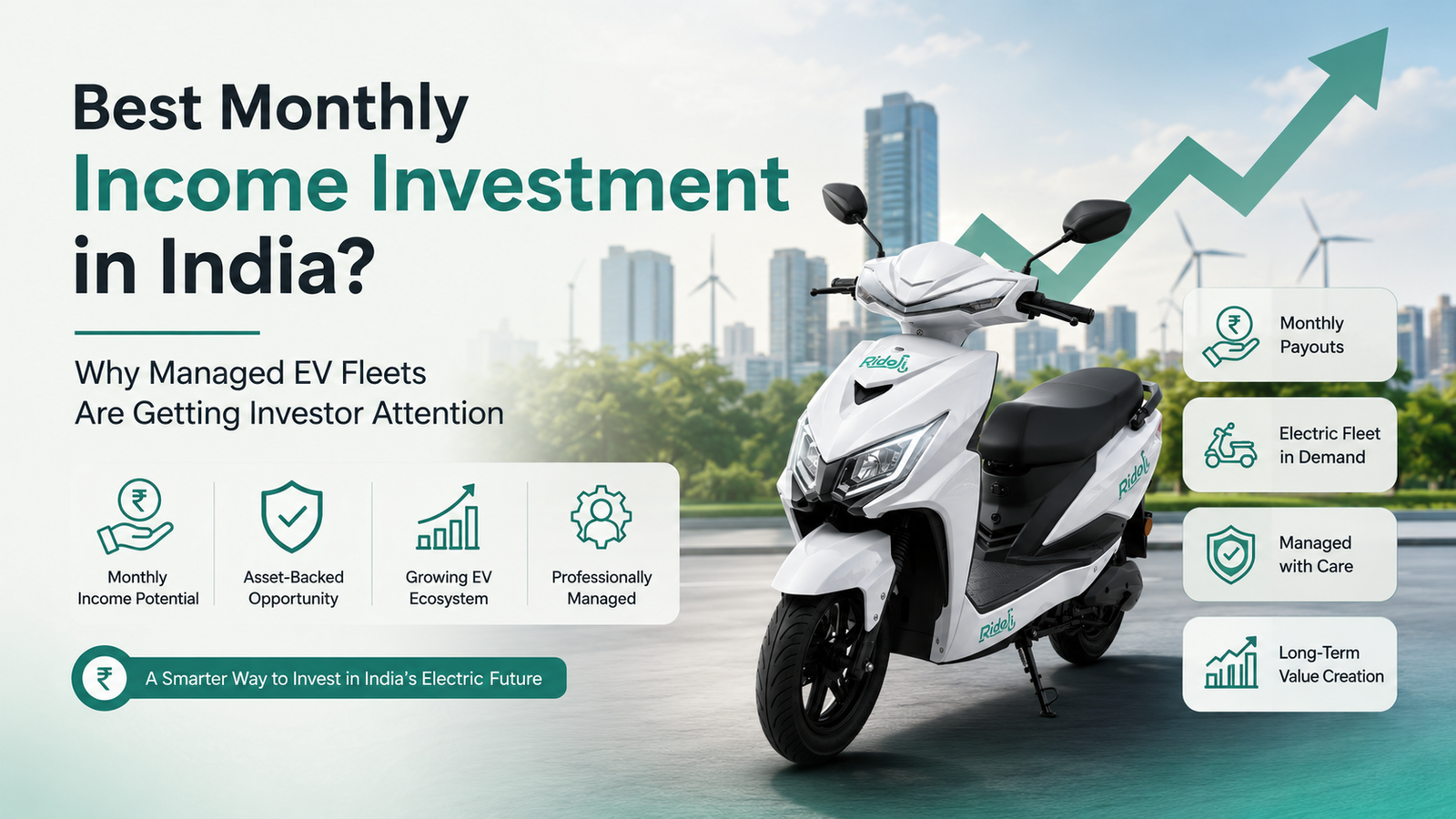
Introduction: Why Investors Are Searching for Monthly Income Options
Most investors in India want one thing from their money: stability with regular cash flow.This is why people often search for the best monthly income investment in India. Some look at fixed deposits. Some explore rental income from real estate. Some consider dividend stocks, mutual funds, small businesses, or alternative asset-backed opportunities.But in the last few years, a new category has started getting investor attention: managed EV fleet investment.
The idea is simple.
Instead of investing only in traditional financial products, investors are exploring physical electric vehicle assets that can be deployed into commercial mobility. These vehicles, especially electric scooters, can be used by delivery riders, rental fleets, logistics partners, field teams, and other urban mobility users.
For investors, this creates a new question:
Can electric scooters become income-generating mobility assets when managed professionally?
The answer depends on execution.
A scooter by itself is only a vehicle. But when it is deployed into a structured fleet system, maintained properly, assigned to commercial use, monitored regularly, and managed by a professional operator, it can become part of a long-term asset-backed monthly payout model.
This is why managed EV fleets are getting investor attention in India.
Why Monthly Income Investments Are Popular in India
Monthly income investment options are popular because they solve a practical financial need.
Many investors do not only want long-term capital appreciation. They also want recurring payouts that can support expenses, supplement salary, diversify income, or create a second income stream.
Common monthly income options in India include:
- Fixed deposits with monthly interest payout
- Post Office Monthly Income Scheme
- Rental income from real estate
- Dividend-paying stocks
- Systematic withdrawal plans
- Small businesses
- Franchise models
- Asset-backed business opportunities
Each option has its own strengths and risks.
Fixed deposits offer stability but may have limited growth potential. Real estate can generate rent, but it requires high capital and maintenance. Mutual funds can create long-term wealth, but market volatility remains. Small businesses can generate income, but they require active involvement.
This is where managed EV fleet investment creates a different conversation.
It is not purely financial like an FD.
It is not market-linked like equity.
It is not as capital-heavy as real estate.
It is not as hands-on as running a business independently.
It sits between physical asset ownership and professionally managed commercial deployment.
Why EV Fleets Are Emerging as a New-Age Investment Option
India’s electric mobility market is growing quickly, especially in the two-wheeler category.
Electric two-wheelers are becoming one of the most important parts of India’s EV transition because they are practical, affordable, and suitable for city movement.
This matters because electric two-wheelers are not just being purchased for personal use. They are increasingly becoming commercial mobility tools.
They are used in:
- Food delivery
- Grocery delivery
- E-commerce logistics
- Rider rental models
- Courier services
- Local business deliveries
- Field sales operations
- Urban fleet mobility
This makes electric scooters interesting from an investment point of view. When a vehicle category has growing adoption and commercial usage, it can become more than a consumer product. It can become a productive asset.
Policy Support Is Strengthening the EV Ecosystem
The EV opportunity is also supported by government policy.
Government schemes and state-level EV policies are helping build awareness, affordability, and infrastructure for electric mobility. Policy support does not remove investment risk, but it strengthens the larger ecosystem.
When EV adoption is supported by demand incentives, charging infrastructure, and market awareness, fleet operators and investors get a more favorable environment to evaluate electric mobility assets.
Why Commercial EV Fleet Demand Is Growing
One of the biggest reasons managed EV fleets are attracting attention is the rise of commercial electric mobility.
Delivery-led businesses are growing across Indian cities. Quick commerce, food delivery, grocery delivery, and hyperlocal logistics depend heavily on two-wheelers. These businesses need vehicles that are affordable to run, easy to deploy, and suitable for daily urban use.
This is where electric scooters fit well.
Compared to petrol scooters, electric scooters can offer:
- Lower running cost
- Lower dependence on fuel prices
- Reduced tailpipe emissions
- Better suitability for short urban routes
- Lower noise
- Fewer moving parts
- Commercial deployment potential
This shows that electric two-wheeler fleets are becoming a serious commercial mobility category, not just a consumer trend.
What Is Managed EV Fleet Investment?
Managed EV fleet investment is a model where an investor participates in electric vehicle ownership or deployment, while a fleet management company handles daily operations.
In simple terms:
The investor participates in the EV asset. The fleet company manages the operations.
The vehicle may be deployed for rider use, delivery operations, rental models, logistics, or other commercial mobility needs.
A professionally managed EV fleet model may include:
- Vehicle deployment
- Rider coordination
- Fleet monitoring
- Maintenance support
- Battery and charging coordination
- Documentation support
- Operational reporting
- Downtime control
- Service management
This is different from simply buying a scooter and renting it informally.
In an informal model, the investor may need to find riders, collect payments, handle service, track the vehicle, manage breakdowns, and resolve disputes.
In a managed model, these responsibilities are handled by a professional fleet operator through a structured process.
That structure is what makes the model attractive for investors looking for monthly payout opportunities.
How Managed EV Fleets Can Create Monthly Income Potential
Monthly income potential in EV fleet investment comes from commercial deployment.
The vehicle must be placed into real use. It must be active, maintained, and managed. The more efficiently it is deployed, the better its value creation potential.
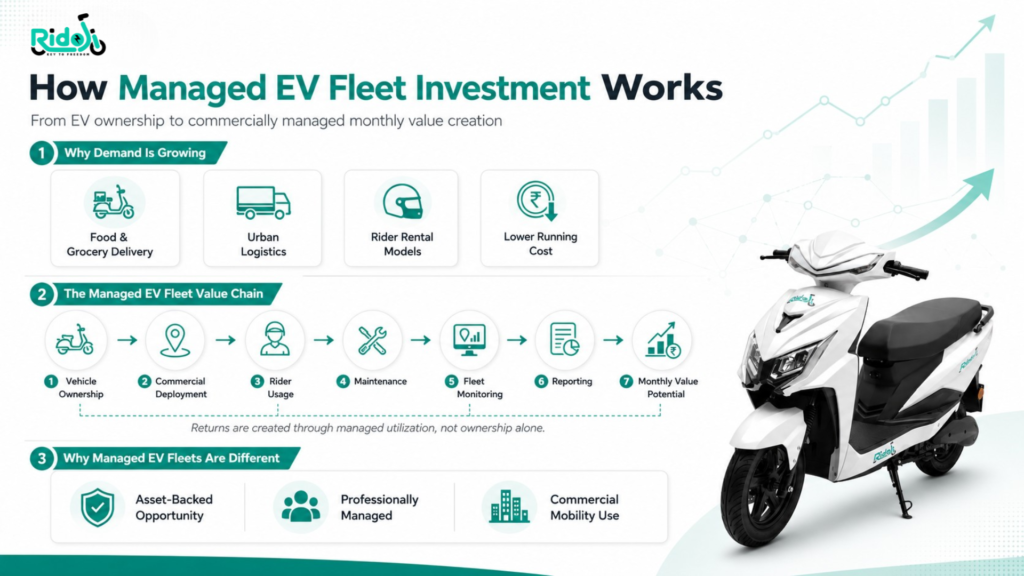
A managed EV fleet usually creates value through this chain:
Vehicle ownership + commercial deployment + rider usage + maintenance + fleet monitoring + reporting = long-term value creation
Each part matters.
1. Vehicle Ownership
The investor participates in a physical EV asset.
2. Commercial Deployment
The vehicle is placed into a use case such as delivery, rental, logistics, or rider mobility.
3. Rider Usage
The vehicle becomes productive when it is used regularly by riders or commercial users.
4. Maintenance
Preventive maintenance helps reduce breakdowns and protect the asset.
5. Fleet Monitoring
Tracking and monitoring help the fleet operator understand usage, location, performance, and issues.
6. Reporting
Reports give investors more clarity about how the asset is being managed.
This is why returns in EV fleet investment are not created by ownership alone. They are created by managed utilization.
EV Fleet Investment vs Traditional Monthly Income Options
| Investment Option | Nature | Income Potential | Key Strength | Key Limitation |
| Fixed Deposit | Financial product | Monthly interest option | Stability | Lower growth potential |
| Real Estate | Physical asset | Rental income | Tangible asset | High capital requirement |
| Mutual Fund SWP | Market-linked | Periodic withdrawals | Long-term flexibility | Market risk |
| Dividend Stocks | Equity-linked | Dividend income | Wealth creation potential | Volatility |
| Small Business | Active business | Business profit | High control | Requires daily work |
| Managed EV Fleet | Mobility asset | Operational payout model | Asset-backed commercial use | Management-dependent risk |
Managed EV fleets should not be seen as a replacement for every traditional investment. They are a separate category.
The biggest advantage is asset-backed commercial deployment.
The biggest risk is operational dependency.
This means the quality of the fleet management company matters deeply.
Why Fleet Management Matters More Than the Vehicle
Many investors focus only on the scooter.
But the scooter is only the beginning.
The real investment performance depends on what happens after the vehicle is purchased.
A scooter that is idle creates limited value.
A scooter that is poorly maintained loses productivity.
A scooter without rider coordination creates operational problems.
A scooter without monitoring lacks transparency.
A scooter inside a managed fleet system has better structure.
This is why fleet management matters more than the vehicle itself.
Professional fleet management helps with:
- Deploying the vehicle in the right use case
- Coordinating riders
- Managing maintenance
- Reducing downtime
- Supporting documentation
- Tracking performance
- Sharing reports
- Handling daily operational issues
The asset is important.
But the system behind the asset is what creates value.
What Investors Should Check Before Choosing a Monthly Income Investment
Before entering any monthly income investment, investors should ask practical questions.
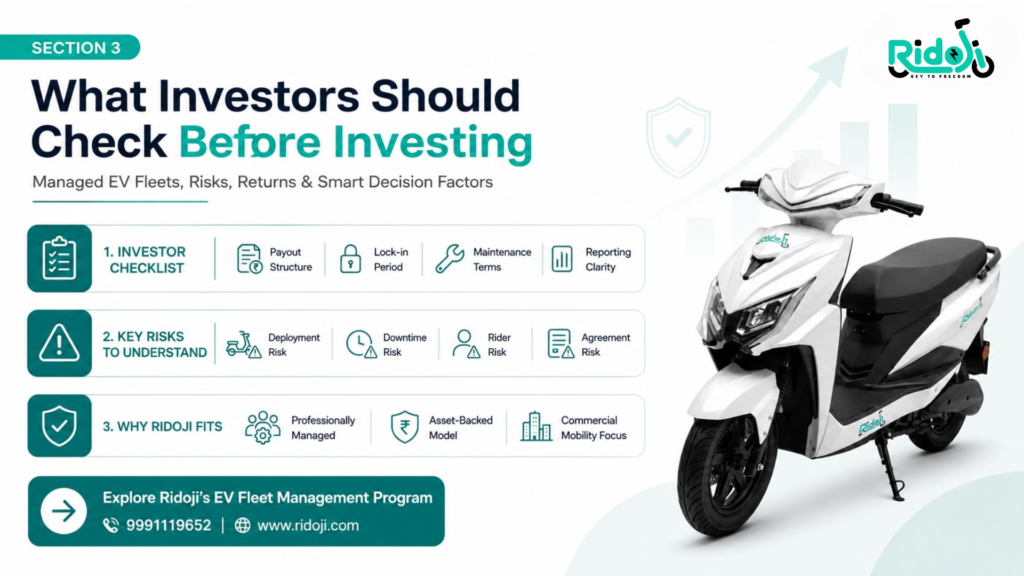
For managed EV fleet investment plan, they should check:
- Who owns the vehicle?
- Who manages the vehicle?
- Where will the vehicle be deployed?
- What is the payout structure?
- Is the payout fixed, variable, or performance-linked?
- What are the maintenance terms?
- What happens during downtime?
- Who handles rider issues?
- What is the lock-in period?
- What is the exit process?
- What reports will be shared?
- What risks are mentioned in the agreement?
A good investment decision is based on clarity, not only attraction.
Investors should avoid making decisions only because a plan sounds profitable. They should understand how the payout is generated, what risks exist, and what responsibilities each party has.
Risks Investors Should Understand
Managed EV fleet investment can be attractive, but it is not risk-free.
Important risks include:
1. Deployment Risk
If the vehicle is not deployed quickly or consistently, payout potential may be affected.
2. Rider Risk
Rider behavior can affect vehicle condition, maintenance cost, and operational consistency.
3. Downtime Risk
The vehicle may be unavailable due to service, damage, documentation, battery issues, or other operational delays.
4. Maintenance Risk
Even though EVs usually have fewer moving parts than petrol vehicles, they still require tyres, brakes, battery monitoring, inspections, and regular service.
5. Market Demand Risk
Commercial demand may vary by location, business cycle, rider availability, and partner network.
6. Policy Risk
Government subsidy rules and EV policies can change over time.
7. Agreement Risk
Investors must carefully review payout terms, lock-in period, exit clauses, damage policy, insurance coverage, and company responsibilities.
Understanding risk does not make the opportunity weak. It makes the investor better prepared.
Why Ridoji’s EV Fleet Management Program Fits This Opportunity
Ridoji’s EV Fleet Management Program is designed for investors who want to participate in India’s electric mobility sector without managing day-to-day fleet operations themselves.
The program focuses on a structured model where Ridoji manages key operational responsibilities such as:
- Vehicle deployment
- Rider coordination
- Maintenance support
- Fleet monitoring
- Operational reporting
- Documentation coordination
- Day-to-day fleet management
This makes the model relevant for investors searching for asset-backed monthly income opportunities but who do not want to personally operate a fleet business.
The idea is simple:
You participate in the EV asset. Ridoji manages the fleet operations.
This is what makes managed EV fleets different from simply buying a scooter.
The investor is not only buying a vehicle. The investor is entering a professionally managed mobility ecosystem.
Who Should Consider Managed EV Fleet Investment?
Managed EV fleet investment may be suitable for people who:
- Want monthly payout-oriented opportunities
- Prefer physical asset-backed models
- Are interested in India’s EV growth story
- Do not want to manage vehicles personally
- Understand operational risks
- Are comfortable reviewing agreements
- Want exposure to commercial mobility
It may not be suitable for people who:
- Want a risk-free investment
- Need instant liquidity
- Do not want any lock-in period
- Expect guaranteed returns
- Do not want to understand operational terms
- Prefer only traditional financial products
This distinction is important.
Managed EV fleet investment is not a bank deposit. It is a business-linked asset model.
Final Thoughts: Is This the Best Monthly Income Investment in India?
There is no single “best” monthly income investment for everyone.
The right investment depends on the investor’s risk appetite, capital, time horizon, liquidity needs, and comfort with different asset classes.
Fixed deposits may suit conservative investors.
Real estate may suit investors with higher capital.
Mutual funds may suit long-term wealth builders.
Small businesses may suit active operators.
Managed EV fleets may suit investors who want asset-backed participation in India’s growing electric mobility sector.
What makes managed EV fleets interesting is the combination of three things:
- A physical electric vehicle asset
- Growing commercial demand for electric two-wheelers
- Professional fleet management
As India’s EV market grows and commercial mobility becomes more electric, managed EV fleets may become an important monthly payout-oriented opportunity for investors.
But investors should always evaluate the model carefully.
Do not invest only because the sector is growing.
Invest after understanding the agreement, risks, payout structure, maintenance process, and fleet management system.
That is how smart investment decisions are made.
Explore Ridoji’s EV Fleet Management Program
Looking for an asset-backed way to participate in India’s growing electric mobility sector?
Explore Ridoji’s EV Fleet Management Program, where Ridoji manages vehicle deployment, rider coordination, maintenance support, fleet monitoring, reporting, and day-to-day operations.
To understand the program structure, payout model, risks, responsibilities, and agreement terms, connect with Ridoji today.
Need further details of proposal , agreement nd payout .Lockin period and Vehicle ownership status after completion of agreement tenure
Thank you for your interest!
We’d be happy to share the complete details regarding the proposal, agreement, payout structure, lock-in period, and vehicle ownership terms after completion of the agreement tenure.
Since these terms are explained in detail based on the selected plan, please connect with our team at 📞 9991119652 or visit http://www.ridoji.com. Our team will guide you through the complete process and share the relevant documentation.