

The electric vehicle industry is no longer a niche market.
Governments are pushing clean mobility policies, automakers are investing billions into electrification, and consumers are slowly shifting toward electric transportation. Everywhere you look, the EV ecosystem is expanding.
But for investors, one question keeps getting harder to answer:
Should you Invest in EV Manufacturers, or is charging infrastructure the smarter long-term opportunity?
At first glance, EV manufacturers seem like the obvious choice. They build the vehicles, dominate headlines, and attract massive valuations. Companies like Tesla, BYD, and Rivian became symbols of the EV revolution.
But there’s another side to the industry that many investors overlook:
charging infrastructure.
Without charging networks, the EV industry cannot scale properly. That makes charging companies potentially just as important as the manufacturers themselves.
The real challenge is this:
Which side of the EV ecosystem has the stronger long-term economics?
The answer is not as simple as most people think.
Why EV Manufacturers Attract Most Investor Attention
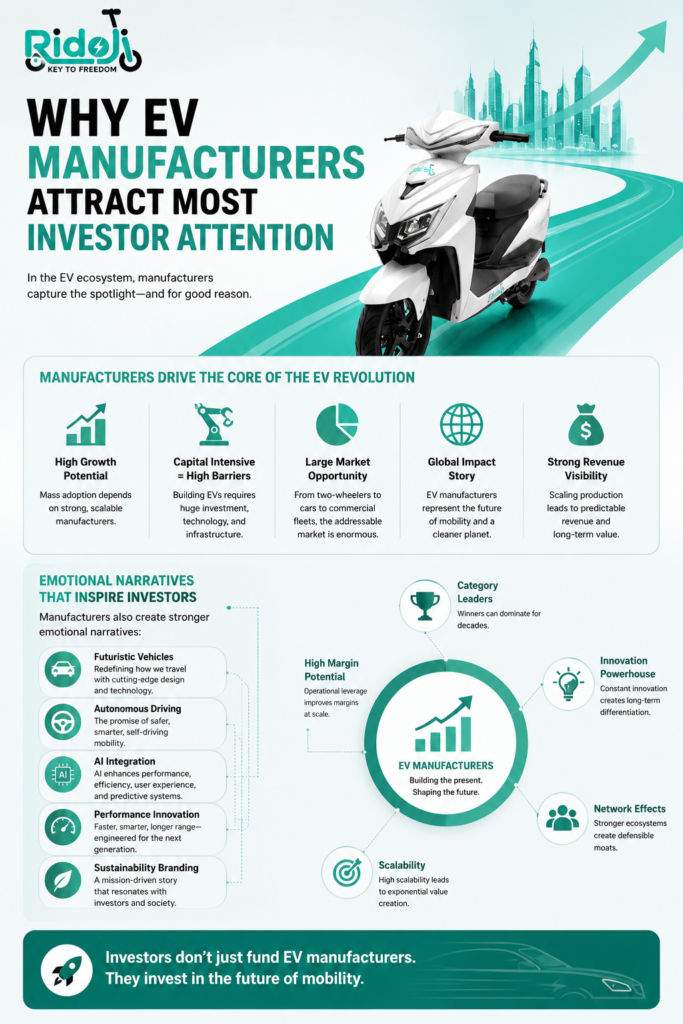
People naturally gravitate toward vehicle manufacturers because they are easier to understand.
Cars, scooters, trucks, and bikes are visible products. Consumers interact with them directly. The brands become cultural symbols.
That’s why investors rush to Invest in EV Manufacturers during periods of market excitement.
Manufacturers also create stronger emotional narratives:
- futuristic vehicles
- autonomous driving
- AI integration
- performance innovation
- sustainability branding
Charging infrastructure companies rarely generate the same excitement.
Nobody dreams about charging stations.
People dream about vehicles.
That emotional difference matters in financial markets because narrative drives attention.
But attention alone does not guarantee better investments.
The Problem With Investing Only in EV Manufacturers
Here’s the issue most retail investors underestimate:
Vehicle manufacturing is an extremely difficult business.
Margins are often thin.
Competition becomes brutal.
Production scaling is expensive.
To successfully Invest in EV Manufacturers, companies must handle:
- supply chain complexity
- battery sourcing
- factory expansion
- labor costs
- software development
- regulatory compliance
- warranty management
Even successful EV companies face enormous pressure.
The market learned this lesson during recent EV price wars. Companies cut prices aggressively to maintain demand, which reduced profitability across the industry.
That’s why many EV startups struggle despite strong products.
Building a prototype is easy compared to manufacturing profitably at scale.
Charging Infrastructure Is Becoming the Backbone of EV Adoption
Now look at the other side of the market.
Charging infrastructure is less glamorous, but it may become one of the most critical pieces of the EV ecosystem.
Think about it logically.
Consumers will not fully adopt electric vehicles unless charging becomes:
- convenient
- fast
- reliable
- affordable
That means charging infrastructure is not optional.
It’s essential.
This creates a powerful long-term investment argument.
As more consumers buy EVs, charging demand naturally increases.
In theory, that gives charging networks recurring usage opportunities similar to fuel stations.
Some investors now believe charging companies could become the “picks and shovels” of the EV revolution.
EV Manufacturers Still Have Huge Advantages
Despite the risks, there are strong reasons why many investors still prefer to Invest in EV Manufacturers.
1. Brand Power
Vehicle companies can build emotional customer loyalty.
Tesla is a perfect example.
People identify with the brand itself, not just the product.
Charging companies rarely develop that kind of emotional connection.
2. Larger Revenue Potential
Manufacturers can monetize:
- vehicle sales
- software subscriptions
- autonomous driving features
- energy products
- financing
- insurance
Charging infrastructure companies usually operate narrower business models.
3. Global Expansion Opportunities
Large EV manufacturers can scale internationally faster than many charging companies because vehicles can enter multiple markets more easily.
This is especially true in emerging markets where charging infrastructure is still developing.
But Charging Infrastructure Has Better Long-Term Stability
This is where things become interesting.
While manufacturers fight aggressive competition, charging infrastructure businesses may eventually benefit from more stable recurring demand.
Think about gas stations.
Most consumers don’t care who owns the fuel station.
They simply need access to energy.
The same could happen with EV charging.
As EV adoption grows, charging networks could generate revenue continuously from vehicle usage rather than one-time vehicle purchases.
That creates a very different business model.
When you Invest in EV Manufacturers, you often depend heavily on:
- vehicle demand cycles
- pricing power
- new model launches
- production efficiency
Charging infrastructure may rely more on long-term usage growth.
The EV Market Could Consolidate Hard
One reason investors should think carefully before they Invest in EV Manufacturers is market consolidation risk.
The EV market currently has too many players.
Every year:
- new startups appear
- legacy automakers launch EV models
- Chinese manufacturers expand globally
- pricing competition intensifies
Eventually, many companies may disappear.
This is normal in growing industries.
The smartphone market consolidated.
The airline industry consolidated.
Ride-sharing consolidated.
The EV industry may follow the same path.
That means many smaller manufacturers may never survive long enough to become profitable.
Charging infrastructure companies face competition too, but infrastructure markets often consolidate differently than manufacturing sectors.
China Is Changing the Entire Industry
One of the biggest factors investors must consider is China’s dominance.
Chinese companies control large portions of:
- battery production
- raw material processing
- low-cost manufacturing
- EV supply chains
This creates enormous pressure on global manufacturers.
If Chinese EV exports continue growing aggressively, many Western companies could struggle to compete on pricing.
That makes it riskier to blindly Invest in EV Manufacturers without analyzing their cost structure carefully.
Meanwhile, charging infrastructure businesses may be somewhat less vulnerable to foreign vehicle competition because charging networks are often localized.
Charging Infrastructure Has Its Own Problems
Charging companies are not perfect investments either.
Many charging operators still struggle with profitability because:
- expansion costs are high
- utilization rates remain inconsistent
- maintenance costs add up
- hardware upgrades are expensive
Some charging companies expanded too aggressively before achieving stable economics.
This matters because investors sometimes assume infrastructure automatically equals stability.
That assumption can be dangerous.
The EV charging market is still early, fragmented, and highly competitive.
Companies need significant capital to scale effectively.
Consumer Behavior Matters More Than People Think
One overlooked factor in this debate is human behavior.
Most consumers buy vehicles emotionally.
They choose based on:
- design
- performance
- brand perception
- status
- affordability
That emotional attachment benefits manufacturers.
People rarely become loyal to charging networks unless:
- pricing is competitive
- charging reliability is excellent
- locations are convenient
This gives manufacturers stronger branding opportunities.
When investors Invest in EV Manufacturers, they are often investing in consumer psychology as much as industrial production.
Software Could Change Everything
Software integration may become one of the biggest differentiators in the EV market.
The most successful EV manufacturers increasingly behave like technology companies.
Tesla demonstrated this clearly through:
- over-the-air updates
- software-driven features
- AI integration
- connected ecosystems
If software becomes central to mobility, the strongest manufacturers could gain enormous advantages.
That strengthens the argument to Invest in EV Manufacturers with strong technology ecosystems.
Charging companies may eventually integrate software too, but manufacturers currently control more of the customer experience.
Which Side Has Better Margins?
This is one of the hardest questions in the EV ecosystem.
Historically, automotive manufacturing has lower margins than software businesses. But top EV companies briefly achieved unusually high profitability because the market was still early.
Now margins are shrinking again due to competition.
Charging infrastructure margins remain uncertain because the industry is still developing.
Some analysts believe charging networks may eventually resemble utility businesses:
- stable
- recurring
- lower growth
- moderate profitability
Meanwhile, successful manufacturers could still generate much larger upside — but with significantly higher volatility.
The EV Scooter and Two-Wheeler Opportunity
One area investors should not ignore is electric two-wheelers.
In markets like India and Southeast Asia, scooters and bikes dominate transportation far more than cars.
This creates a massive opportunity.
Investors who only Invest in EV Manufacturers focused on cars may miss the scale potential in electric scooters and lightweight mobility.
At the same time, EV scooter adoption depends heavily on:
- affordable charging access
- battery swapping
- urban infrastructure
That means charging ecosystems may become especially important in two-wheeler markets.
The future winner may not just sell vehicles.
It may control the entire mobility ecosystem.
What Smart Investors Are Actually Doing
Most sophisticated investors are not choosing only one side.
They are diversifying across the EV ecosystem.
That includes:
- EV manufacturers
- battery companies
- charging infrastructure
- semiconductor suppliers
- energy storage businesses
- software platforms
Why?
Because predicting the exact winners is extremely difficult.
Some manufacturers will dominate.
Others will collapse.
Some charging companies may become critical infrastructure providers.
Others may fail before utilization improves.
The EV market is still evolving rapidly.
So, Where Should Investors Focus?
If you prefer:
- higher growth potential
- stronger branding
- technology upside
- global scalability
then it may make sense to Invest in EV Manufacturers.
But you must accept:
- higher volatility
- intense competition
- margin pressure
- consolidation risk
On the other hand, if you prefer:
- infrastructure exposure
- recurring usage potential
- ecosystem stability
- long-term adoption trends
then charging infrastructure may offer attractive opportunities.
Neither path is risk-free.
Final Thoughts
The EV revolution is not just about vehicles anymore.
It’s about ecosystems.
Manufacturers may capture headlines, but charging infrastructure could become just as important over the next decade. One side creates the products. The other enables the entire industry to function.
The smartest investors understand that both sectors are deeply connected.
Still, blindly chasing hype is dangerous.
If you Invest in EV Manufacturers, focus on companies with:
- strong balance sheets
- scalable production
- software capabilities
- supply chain control
If you focus on charging infrastructure, look for:
- expanding utilization
- strategic locations
- strong partnerships
- realistic profitability timelines
The EV market will likely create enormous winners by 2030.
But it will also eliminate many weak players along the way.
That’s the reality of every major technological shift.