
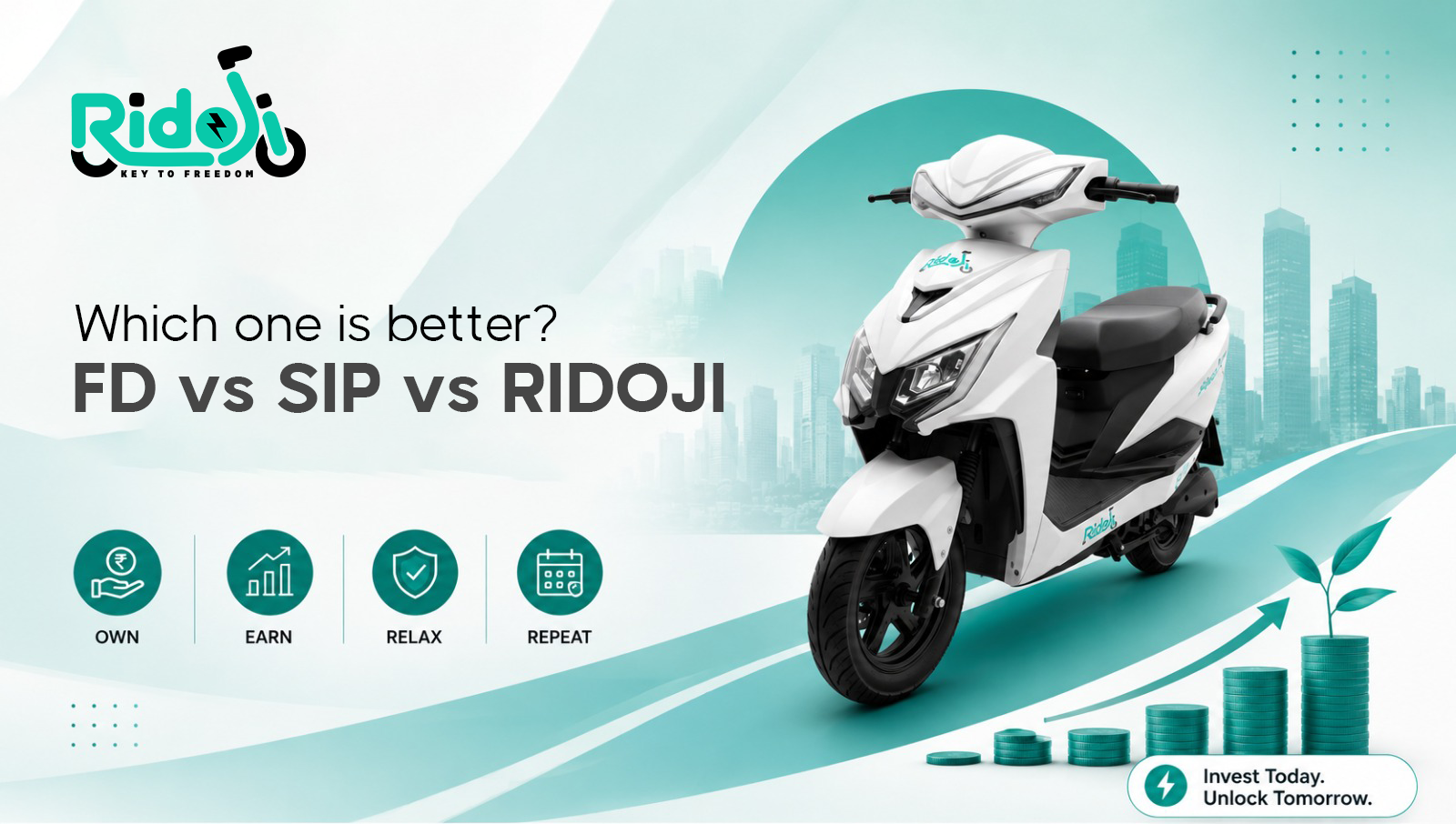
For decades, Indians have relied on traditional investment options like Fixed Deposits (FDs) and Systematic Investment Plans (SIPs) to build wealth and secure their future. While both investment avenues have their own advantages, modern investors are increasingly looking for opportunities that combine predictable cash flow, asset ownership, and participation in high-growth industries.
This shift has led to the rise of asset-backed investments, where investors own productive assets capable of generating recurring income. Among these emerging opportunities, Ridoji’s Investment Plan has gained attention as a unique EV fleet management program that allows individuals to own electric vehicles and earn passive income through commercial deployment.
Unlike conventional investments that depend entirely on market appreciation or fixed interest rates, Ridoji’s Investment Plan focuses on converting physical assets into income-generating assets.
In this article, we explore how Ridoji’s Investment Plan works, compare it with Fixed Deposits and SIPs, and understand why many investors are exploring this innovative approach to passive income.
Understanding Traditional Investments
Fixed Deposits (FD)
Fixed Deposits are one of the most popular investment choices in India. Investors deposit money with a bank for a fixed period and receive interest at predetermined rates.
Advantages of FDs
- Capital preservation
- Predictable returns
- Low risk
- Easy accessibility
Limitations of FDs
- Returns may barely beat inflation.
- Limited wealth creation potential.
- No ownership of productive assets.
- Interest income is taxable.
While FDs are suitable for conservative investors, they may not always provide sufficient long-term growth or monthly cash flow.
Systematic Investment Plans (SIP)
SIPs allow investors to invest regularly in mutual funds and benefit from market growth over time.
Advantages of SIPs
- Wealth creation through compounding.
- Flexibility and liquidity.
- Professional fund management.
- Diversification across sectors.
Limitations of SIPs
- Market fluctuations can impact returns.
- Short-term volatility.
- No guaranteed income.
- Performance depends on market conditions.
SIPs are ideal for long-term capital appreciation but may not provide consistent monthly cash flow.
What is Ridoji’s Investment Plan?
Ridoji’s Investment Plan is a 4-year EV Fleet Management Program designed to transform electric vehicles into income-generating assets.
Under the program, investors own electric scooters while Ridoji handles commercial deployment and fleet operations. The vehicles are utilized in India’s rapidly expanding delivery and mobility ecosystem, allowing owners to participate in the growth of the EV sector without managing day-to-day operations.
The model is designed to simplify EV asset ownership and provide a structured passive income opportunity.
How Ridoji’s Investment Plan Works
Step 1: Own an EV Asset
Investors purchase electric scooters that become productive assets.
Step 2: Fleet Enrollment
The vehicles are enrolled into Ridoji’s managed fleet program.
Step 3: Operational Management
Ridoji oversees deployment, fleet coordination, maintenance support, and operational management.
Step 4: Income Generation
Commercial utilization enables the assets to generate recurring income over the duration of the program.
This model enables investors to participate in the expanding EV and delivery ecosystem while avoiding the complexities of fleet management.
Why Asset-Based Investing Is Becoming Popular
Traditional investments are primarily financial instruments. Asset-based investing focuses on owning productive assets that create value and generate income.
Examples include:
- Rental real estate
- Commercial equipment
- Warehousing assets
- Logistics infrastructure
- EV fleet assets
The increasing growth of e-commerce, quick commerce, and last-mile delivery has created demand for commercial mobility solutions, making EV fleet assets an emerging investment category.
Why Ridoji’s Investment Plan Is Different from FD and SIP
1. Participation in a Growing Industry
FDs provide fixed interest, and SIPs provide exposure to financial markets. Ridoji’s Investment Plan allows investors to participate in India’s fast-growing EV and delivery ecosystem.
With increasing adoption of electric mobility and rapid expansion of last-mile logistics, EV assets are becoming commercially significant.
2. Productive Asset Ownership
In an FD, investors only deposit money.
In SIPs, investors hold units of mutual funds.
With Ridoji’s Investment Plan, investors own physical assets that are deployed commercially.
Asset ownership creates a different investment experience compared with purely financial instruments.
3. Passive Income Potential
Many investors seek investments that provide regular income instead of waiting years for appreciation.
Ridoji’s Investment Plan focuses on transforming EV assets into income-generating assets through managed operations.
This makes it appealing for individuals seeking alternative passive income opportunities.
4. Hands-Free Operations
Managing commercial vehicles independently can be challenging.
Ridoji simplifies the process by managing operations, deployment, and fleet coordination, allowing owners to remain passive participants.
This creates convenience and reduces operational complexity.
5. Diversification Beyond Traditional Assets
Financial experts often recommend diversification across different asset classes.
Investors commonly allocate funds to:
- Fixed Deposits
- Mutual Funds
- Gold
- Real Estate
- Equities
Asset-backed EV investments introduce an additional category that can complement traditional portfolios.
Why India’s EV Ecosystem Creates New Opportunities
India’s mobility landscape is undergoing a transformation.
Several factors are driving this shift:
Growth of Quick Commerce
Platforms delivering groceries and essentials require efficient transportation solutions.
Expansion of Last-Mile Delivery
Millions of deliveries take place daily, increasing demand for commercial vehicles.
Rising Fuel Costs
Electric mobility offers lower operating costs compared with conventional vehicles.
Government Push for EV Adoption
Policy support and infrastructure development continue to accelerate EV adoption.
These trends are creating long-term opportunities in commercial EV utilization.
Who Can Benefit from Ridoji’s Investment Plan?
Salaried Professionals
Individuals seeking additional income streams.
Business Owners
Entrepreneurs looking to diversify their investments.
Retired Individuals
People interested in passive income opportunities.
Existing Investors
Those who already invest in FD, SIP, gold, or real estate and want portfolio diversification.
First-Time Asset Investors
People interested in owning productive assets without operational responsibilities.
FD vs SIP vs Ridoji’s Investment Plan
| Feature | FD | SIP | Ridoji’s Investment Plan |
|---|---|---|---|
| Asset Ownership | No | No | Yes |
| Market Dependency | Low | High | Operational |
| Income Focus | Interest | Growth | Cash Flow |
| Wealth Creation | Moderate | Long-Term | Asset-Based |
| Inflation Protection | Limited | Better | Diversification Opportunity |
| Operational Involvement | None | None | Managed by Ridoji |
| Exposure to EV Industry | No | Indirect | Direct |
Each investment category serves different objectives, and investors should choose according to their risk appetite and financial goals.
The Importance of Diversification
There is no single investment that fits everyone.
Fixed Deposits provide safety.
SIPs provide long-term growth.
Asset-backed investments provide participation in real-world economic activity.
A balanced portfolio often combines multiple asset classes instead of depending on one option.
Diversification helps manage risk and creates multiple avenues for wealth creation.
Final Thoughts
As India’s EV ecosystem and delivery economy continue to expand, new forms of asset ownership are emerging.
Ridoji’s Investment Plan represents an innovative approach that combines EV asset ownership with professional fleet management, allowing investors to participate in one of the country’s fastest-growing sectors.
While Fixed Deposits and SIPs remain valuable components of financial planning, many investors are exploring asset-backed opportunities to diversify their portfolios and create additional income streams.
Ultimately, the right investment strategy depends on individual goals, risk tolerance, and long-term objectives. Understanding the differences between traditional investments and emerging asset classes can help investors make informed decisions and build a more resilient financial future.
Ridoji’s Investment Plan is not just about owning an EV—it is about participating in the future of mobility through professionally managed, income-generating assets.