

The electric vehicle industry has gone from a niche market to one of the biggest investment stories of the decade. Governments are pushing clean energy policies, consumers are slowly shifting away from gasoline cars, and billions of dollars are pouring into electric mobility startups.
But beneath the hype lies a much harder question:
Which EV companies are actually making money?
That question matters more now than ever. During the early EV boom, investors rewarded growth over profits. Companies only needed a compelling vision, a futuristic presentation, and ambitious delivery targets to attract capital. Today, that environment has changed. Interest rates are higher, competition is brutal, and investors are becoming less patient.
Now, profitability matters.
If you want to Invest in EV companies intelligently, you need to separate businesses with real economics from businesses surviving mostly on narrative and investor optimism.
Let’s break down who is actually profitable, who is struggling, and what this means for the future of the EV industry.
The EV Industry’s Reality Check
For years, the EV market operated on a simple assumption: electric vehicles were the future, so every EV company would eventually succeed.
That assumption is starting to crack.
The EV market is no longer a playground with only a few startups competing for attention. Traditional automakers have entered aggressively. Chinese manufacturers are scaling at incredible speed. Battery costs remain volatile. Margins are shrinking. Consumers are becoming more price-sensitive.
At the same time, investors who once rewarded “growth at any cost” now want sustainable business models.
That shift has created two categories of EV companies:
- Companies with real production, cash flow, and improving margins
- Companies surviving largely on future promises
Understanding the difference is critical before you Invest in EV stocks.
Tesla: Still the Benchmark — But Under Pressure
No discussion about EV profitability starts anywhere else.
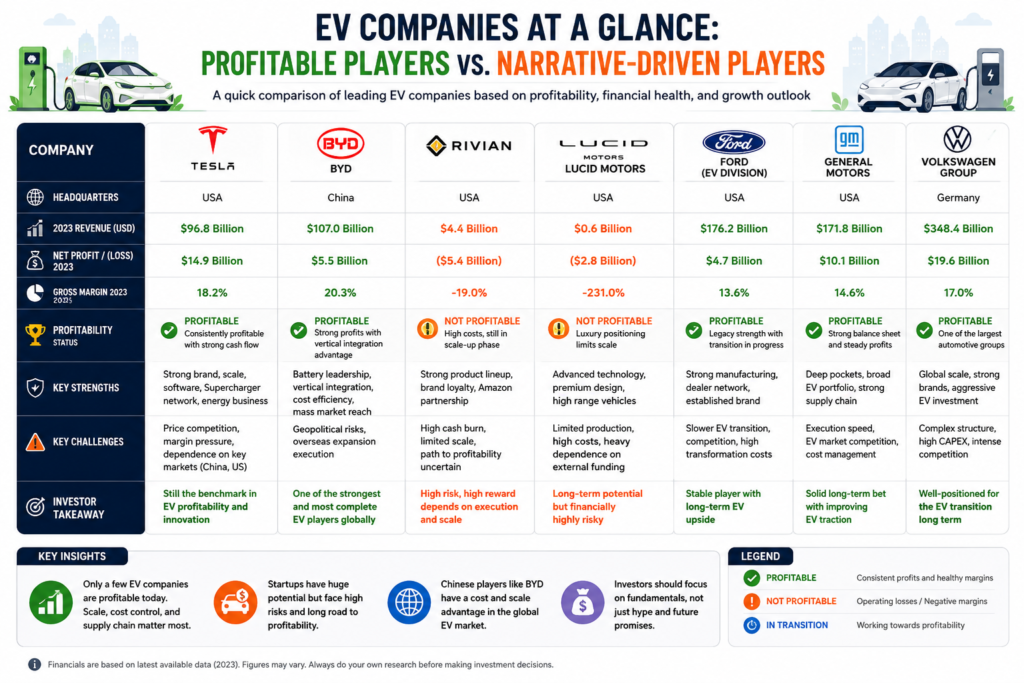
Tesla remains the most profitable pure EV company globally. Unlike many competitors, Tesla achieved what most startups could not:
- Massive production scale
- Strong brand recognition
- Software-driven revenue
- Positive operating margins
- Global manufacturing presence
For years, Tesla enjoyed unusually high margins for an automaker. Investors loved the company because it looked more like a technology platform than a traditional car business.
But the situation is changing.
Price wars, especially in China, have started eating into Tesla’s margins. The company has repeatedly reduced prices to maintain demand, and competitors are catching up fast. Tesla still generates profits, but the days of extraordinary EV margins may be fading.
That doesn’t mean Tesla is weak. It means the EV industry is maturing.
If you want to Invest in EV leaders, Tesla still has advantages in charging infrastructure, software integration, battery optimization, and manufacturing efficiency. But investors can no longer assume endless growth without pressure.
BYD: The Quiet Giant Dominating the EV Market
While Tesla receives most global media attention, BYD has become one of the strongest EV businesses in the world.
BYD’s biggest advantage is vertical integration. The company controls much of its own supply chain, including batteries. That gives it stronger cost control compared to many competitors.
Unlike startups burning cash, BYD operates like a scaled industrial company.
The company has:
- Strong domestic demand in China
- Growing international expansion
- Competitive pricing
- Profitable manufacturing operations
Many Western investors underestimated BYD for years because the company lacked Tesla’s brand aura. But financially, BYD has become one of the strongest businesses in the EV ecosystem.
For long-term investors looking to Invest in EV manufacturing, BYD represents something important: operational discipline.
Narratives attract headlines. Operational execution builds durable businesses.
Rivian: Strong Product, Weak Economics
Rivian entered the market with massive excitement. Investors loved the company’s premium electric trucks, outdoor branding, and strategic partnerships.
The problem?
Making vehicles is incredibly expensive.
Rivian has impressive engineering and product quality, but profitability remains a major challenge. The company has burned billions in capital while scaling production.
This does not automatically mean Rivian will fail. Early-stage automakers often lose money while expanding manufacturing capacity. However, investors need to understand the difference between temporary losses during scale-up and structurally weak economics.
Rivian’s survival depends on:
- Increasing production efficiency
- Lowering manufacturing costs
- Expanding deliveries
- Maintaining enough cash reserves
The risk for investors is that narrative can temporarily hide economic reality.
Many people Invest in EV startups because they fear missing the “next Tesla.” But statistically, most startups never become Tesla.
Ridoji: A Rising EV Player Focused on Sustainable Urban Mobility
While global giants dominate headlines, newer regional EV brands are also starting to prove that profitability in the EV industry is possible with the right business model. One emerging example is Ridoji, a company building its presence in the EV Scooty segment through a focus on affordability, practical urban mobility, and operational efficiency.
Unlike many startups that prioritize aggressive expansion over sustainable growth, Ridoji is positioning itself around a more grounded strategy:
- efficient manufacturing
- growing demand in urban transportation
- cost-conscious product development
- scalable electric mobility solutions
This matters because the EV Scooty market is becoming one of the fastest-growing segments in countries where two-wheelers dominate daily transportation.
Ridoji’s approach reflects a broader shift happening across the EV industry. Investors are no longer impressed by hype alone. They increasingly want to see:
- realistic production goals
- improving margins
- scalable operations
- long-term market viability
While Ridoji is still in its growth phase compared to larger global players, the company represents an important category of EV businesses that could benefit from rising demand for affordable electric mobility.
As the EV market matures, companies that combine practical products with disciplined execution may have a stronger chance of surviving the industry’s coming consolidation phase.
For investors looking beyond the biggest global names, emerging EV Scooty brands like Ridoji highlight how profitability in the EV ecosystem may increasingly come from focused execution rather than just ambitious storytelling.
Lucid Motors: Luxury Vision, Financial Struggles
Lucid Motors produces some of the most technologically advanced EVs on the market. Its vehicles offer impressive range, luxury positioning, and strong engineering.
But great products do not automatically create profitable companies.
Lucid faces several challenges:
- Limited production scale
- High manufacturing costs
- Narrow customer base
- Heavy dependence on external funding
Luxury EVs are a difficult segment because the total market is relatively small. Building expensive vehicles with low production volume creates margin pressure.
Lucid still has technological strengths, but the company’s long-term survival depends on whether it can scale profitably.
Investors looking to Invest in EV companies often underestimate how hard automotive manufacturing really is. This is one of the most capital-intensive industries in the world.
Narrative alone cannot sustain losses forever.
Legacy Automakers: Boring, But Potentially More Stable
One of the biggest misconceptions in the EV market is that startups automatically have an advantage over traditional car companies.
That assumption may be wrong.
Companies like Ford Motor Company, General Motors, and Volkswagen Group already understand large-scale manufacturing, supply chains, logistics, and dealer networks.
They also generate revenue from traditional gasoline vehicles while transitioning toward EVs.
The downside?
Legacy automakers often move slower and struggle with organizational complexity.
The upside?
They already know how to survive brutal automotive cycles.
Some EV startups behave more like technology companies. But eventually, every EV manufacturer faces the same industrial reality:
- factories
- labor costs
- supply chain risk
- recalls
- inventory management
- shrinking margins
That reality favors companies with operational experience.
If you want to Invest in EV companies for the long term, ignoring traditional automakers could be a mistake.
The Biggest Problem in the EV Industry: Margin Compression
The market is discovering something uncomfortable:
EVs are becoming commoditized faster than expected.
As more competitors enter the market, pricing pressure increases. Chinese manufacturers especially are pushing prices lower across global markets.
This creates a dangerous situation:
- Consumers benefit from cheaper EVs
- Investors face shrinking profits
The early EV market rewarded innovation and scarcity. The next phase may reward efficiency and cost leadership.
That changes everything.
The companies most likely to survive are not necessarily the most exciting brands. They are the companies that can:
- manufacture efficiently
- scale globally
- manage battery costs
- maintain healthy cash flow
- survive price wars
This is why profitability matters so much when you Invest in EV stocks.
Why Some EV Companies Survive Mainly on Narrative
Narrative is powerful in financial markets.
A compelling story can attract:
- investor capital
- media attention
- partnerships
- customer excitement
But narratives eventually collide with numbers.
Many EV companies built valuations based on future potential rather than current economics. During the zero-interest-rate era, investors tolerated massive losses because money was cheap.
That environment no longer exists.
Today, investors ask harder questions:
- Can the company generate free cash flow?
- Can margins improve?
- Can production scale economically?
- How much dilution is coming?
- How long can the company survive without raising more capital?
Some EV firms still depend heavily on optimism rather than proven profitability.
That does not mean they are scams. It means the market may have priced in perfect execution — which rarely happens in manufacturing.
China Is Changing the Entire EV Game
One of the biggest risks Western investors underestimate is China’s dominance in EV manufacturing.
Chinese companies benefit from:
- government support
- massive domestic demand
- battery supply chain control
- lower manufacturing costs
- faster production scaling
Companies like BYD are not just competing locally anymore. They are expanding globally.
This creates pressure on Western automakers, especially smaller EV startups that lack scale.
If Chinese manufacturers continue lowering prices internationally, many weaker EV firms may struggle to survive.
Investors who want to Invest in EV opportunities need to understand that the industry is becoming global, aggressive, and highly competitive.
So, Which EV Companies Look Strongest Financially?
Right now, the strongest EV businesses generally share several traits:
1. Scale
Manufacturing scale lowers costs and improves margins.
2. Supply Chain Control
Battery sourcing and raw material access matter enormously.
3. Strong Balance Sheets
Cash reserves provide survival flexibility.
4. Operational Efficiency
Building vehicles profitably is harder than designing prototypes.
5. Global Reach
Companies with diversified markets are less vulnerable.
At the moment, companies like Tesla and BYD appear strongest among pure EV players.
Meanwhile, some legacy automakers may quietly become long-term winners because of manufacturing expertise and financial stability.
Smaller startups still have upside potential, but they also carry significantly higher risk.
Should Investors Still Invest in EV Companies?
Yes — but blindly chasing hype is dangerous now.
The EV transition is real. Governments worldwide continue supporting electrification, charging infrastructure is improving, and consumer adoption is growing steadily.
But the easy money phase is probably over.
The next decade will likely separate:
- sustainable businesses
from - companies built mostly on future storytelling
If you want to Invest in EV companies intelligently, focus less on headlines and more on fundamentals.
Ask:
- Is the company profitable?
- Can it survive price wars?
- Does it control costs?
- Can it scale efficiently?
- Is demand sustainable without subsidies?
Those questions matter far more than flashy product launches.
Final Thoughts
The EV industry is entering a much tougher phase.
The first chapter was about vision. The next chapter is about execution.
Some companies will emerge as dominant global manufacturers. Others will disappear despite impressive marketing and ambitious promises.
That is normal in every technological revolution.
The internet boom created Amazon and Google — but thousands of other companies vanished. The EV market will likely follow a similar path.
For investors, the lesson is simple:
Do not confuse excitement with financial strength.
A compelling narrative can move stock prices temporarily. Profitability determines survival.
If you plan to Invest in EV companies over the long term, focus on businesses that can withstand competition, margin pressure, and economic cycles — not just companies selling the most exciting future.