

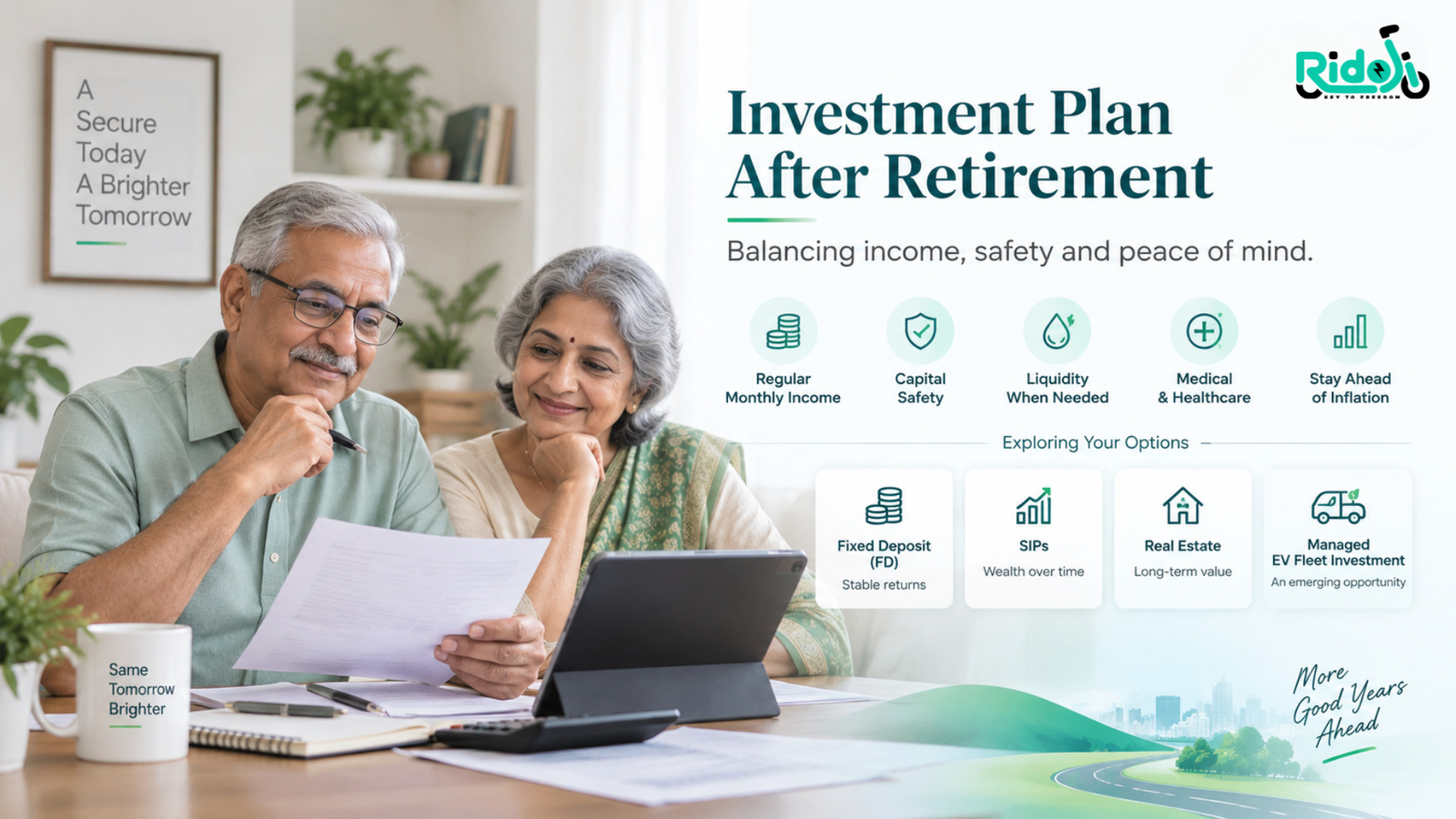
Why Retirement Money Needs a Smarter Investment Plan
Investment Plan After Retirement is one of the most important financial decisions for people who have completed their working years and now want their savings to support their lifestyle, family responsibilities, medical needs, and future goals.
For many retirees, the biggest question is simple:
“I have money after retirement, but where should I invest it?”
This question is common because retirement changes the way people think about money. During working years, a regular salary creates confidence. But after retirement, the focus shifts from earning active income to protecting savings, generating regular cash flow, and avoiding unnecessary risk.
A good Investment Plan After Retirement should not be based only on high returns. It should be based on balance.
Retirement money usually has to serve multiple purposes:
It should help manage monthly household expenses.
It should support medical and emergency needs.
It should protect the original capital as much as possible.
It should fight inflation over the long term.
It should create some form of regular income or payout.
It should not create daily stress for the investor.
This is why retirees should avoid making emotional or rushed investment decisions. After retirement, money becomes more than savings. It becomes security.
Why Traditional Thinking May Not Be Enough
For years, many retired people in India have depended mainly on fixed deposits, property rental income, gold, pension products, or family-supported income. These options still have value, but today’s financial environment is different.
Inflation is higher in everyday life. Medical expenses are rising. Property maintenance is becoming expensive. Rental income is not always consistent. Bank interest may not always be enough for long-term comfort.
That is why many people are now exploring multiple options instead of depending on only one source.
A practical Investment Plan After Retirement should look at three things:
Safety: How protected is the capital?
Liquidity: Can money be accessed when needed?
Income potential: Can the investment create regular cash flow?
No single option is perfect for everyone. A retiree may need a mix of safe products, liquid funds, and income-generating opportunities.
What Retirees Usually Look For
Most people after retirement are not looking for risky experiments. They usually want clarity, simplicity, and confidence.
They want to know:
Where can I invest money after retirement?
Which option can give a monthly income?
How much risk is involved?
Will my money remain secure?
Can I exit if needed?
Who will manage the process?
Is the return stable or market-linked?
Is the investment suitable for my age and goals?
These are the right questions.
Retirement investment is not about chasing the highest number. It is about choosing a structure that matches your needs.
Why Monthly Income Matters After Retirement
Monthly income after retirement gives emotional comfort. It helps retirees manage regular expenses without selling assets again and again.
This is why many retirees prefer options that can create regular payouts, such as fixed deposits, pension products, rental income, bonds, annuities, or managed asset-backed models.
The National Pension System, for example, is designed to create a retirement corpus and regular income after retirement through annuity-based structures, depending on contributions, investment growth, and the portion used to purchase an annuity.
But every option has its own conditions. Some offer stability but lower growth. Some offer market-linked growth but higher volatility. Some offer income but require management. Some are asset-backed but need professional operations.
That is why comparison is important. A strong Investment Plan After Retirement should not ask, “Which investment gives the highest return?” It should ask, “Which investment gives the right balance of income, control, risk, and peace of mind?”
The main goal of an Investment Plan After Retirement is to create balance between monthly income, capital safety, liquidity, and long-term comfort.
A retiree should never choose an Investment Plan After Retirement only because it promises attractive returns.
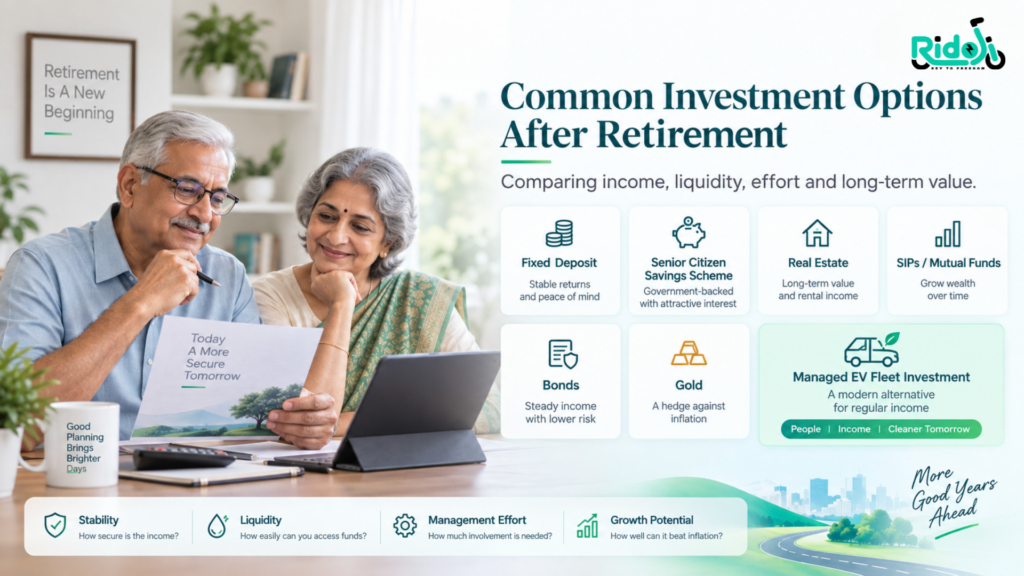
Common Investment Options After Retirement
Before choosing any Investment Plan After Retirement, it is important to understand the available options. Each investment has a different purpose.
Some protect money.
Some create income.
Some offer growth.
Some are linked to assets.
Some require active management.
A good Investment Plan After Retirement should not focus only on returns. It should balance income, capital safety, liquidity, healthcare needs, inflation protection, and risk comfort.
Every Investment Plan After Retirement has its own benefits, limitations, risks, liquidity rules, and income structure.
Before selecting any Investment Plan After Retirement, it is important to compare traditional options with newer asset-backed opportunities.
People comparing savings and bond-related options can also review official updates from the Reserve Bank of India.
Let’s compare the most common options.
1. Fixed Deposits After Retirement
Fixed deposits are one of the most popular retirement investment options in India. They are simple, familiar, and easy to understand.
Many retirees prefer FDs because they provide predictable interest, bank-level accessibility, and a sense of safety. Senior citizens may also get slightly higher interest rates in many banks.
FDs are useful for conservative investors who want stability and low complexity.
However, fixed deposits may not always beat inflation. If living costs rise faster than FD returns, the real purchasing power of money can decrease over time.
Best for: Capital protection and predictable interest
Limitation: Lower growth potential and inflation pressure
2. Senior Citizen Savings Scheme
The Senior Citizen Savings Scheme is a government-backed savings option designed for eligible senior citizens and certain retired employees. It is commonly used by retirees looking for structured income and government-supported safety. Eligibility and rules are defined under the scheme, and banks advise customers to refer to official government or RBI sources for the latest instructions and modifications.
This option can be useful for retirees who want a regulated savings product.
Best for: Senior citizens seeking structured savings
Limitation: Investment limits, tenure rules, and eligibility conditions apply
3. Real Estate Rental Income
Real estate has traditionally been a preferred retirement asset in India. Many people believe property is stable because it is physical and long-term.
Rental income can support monthly expenses, especially if the property is in a good location. However, real estate is not always passive.
It may involve tenant management, repairs, legal paperwork, vacancy periods, property tax, brokerage, and maintenance costs.
Also, selling real estate quickly may not always be easy.
Best for: Long-term asset ownership and rental income
Limitation: Low liquidity and management responsibility
4. SIPs and Mutual Funds After Retirement
Systematic Investment Plans and mutual funds can help with long-term wealth creation. However, they are market-linked, so returns are not fixed.
For retirees, mutual funds may be useful only when selected carefully according to risk tolerance, time horizon, and income needs.
A retiree who needs immediate monthly income may not be comfortable with high market volatility. But someone with surplus funds and a long horizon may use mutual funds for growth.
Best for: Long-term growth potential
Limitation: Market risk and return uncertainty
5. Bonds and RBI Savings Bonds
Bonds can be another option for retirement planning. Some bonds provide periodic interest and may suit investors who want more structure than equity markets.
RBI Floating Rate Savings Bonds are taxable bonds, and RBI has enabled subscription through the Retail Direct Portal, making them accessible to individual investors.
However, retirees should understand interest rate structure, tax impact, lock-in period, liquidity, and payout frequency before investing.
Best for: Structured interest income
Limitation: Taxation, lock-in, and rate conditions
6. Gold After Retirement
Gold is often seen as a store of value. Many Indian families hold gold for emotional, cultural, and financial reasons.
Gold can protect against uncertainty, but it does not naturally create monthly income unless sold, pledged, or used through financial gold products.
So, gold may be part of a retirement portfolio, but it may not be ideal as the main monthly income source.
Best for: Diversification and long-term store of value
Limitation: No regular income by itself
7. Managed EV Fleet Investment
Managed EV fleet investment is a newer alternative asset-backed option where investors participate in electric scooter fleet assets that are commercially deployed and professionally managed.
This type of model is different from traditional financial products because it is linked to real vehicle usage, commercial deployment, rider operations, maintenance support, and fleet monitoring.
India’s electric mobility ecosystem is also receiving policy support. The PM E-DRIVE scheme was approved with an outlay of ₹10,900 crore over two years to support electric mobility in India.
For retirees who are exploring alternatives beyond FD and real estate, managed EV fleet investment may be worth understanding. It can offer an asset-backed structure and potential periodic payouts, but it must be evaluated carefully.
India’s electric mobility ecosystem is also supported by government initiatives such as the PM E-DRIVE scheme.
Best for: People exploring asset-backed, managed, mobility-linked opportunities
Limitation: Operational risk, agreement terms, deployment quality, and management quality matter
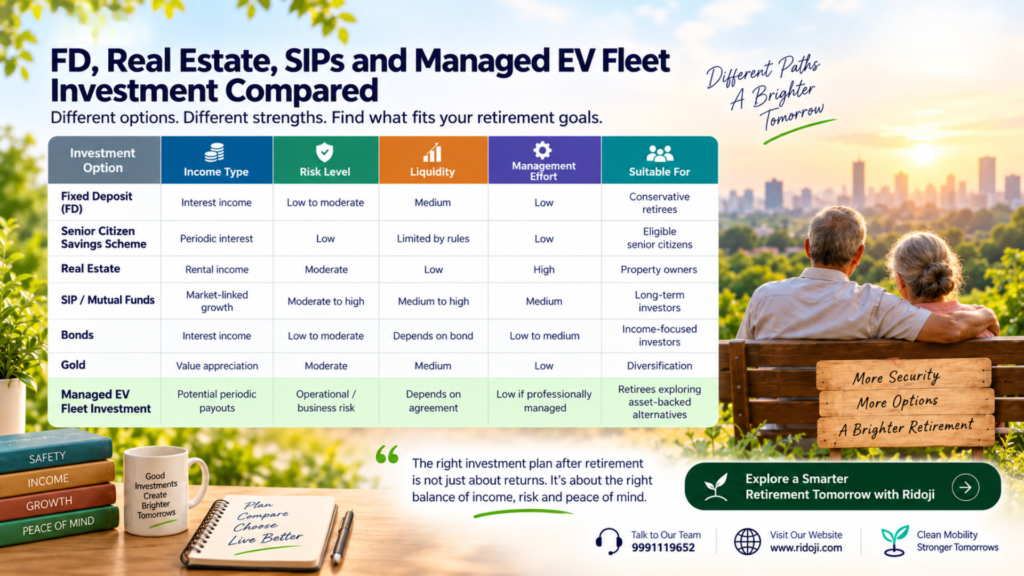
FD, Real Estate, SIPs and Managed EV Fleet Investment Compared
A good Investment Plan After Retirement should compare options based on income, risk, liquidity, involvement, and long-term suitability.
| Option | Income Type | Risk Level | Liquidity | Management Effort | Suitable For |
| Fixed Deposit | Interest income | Low to moderate | Medium | Low | Conservative retirees |
| Senior Citizen Savings Scheme | Periodic interest | Low | Limited by rules | Low | Eligible senior citizens |
| Real Estate | Rental income | Moderate | Low | High | Property owners |
| SIP/Mutual Fund | Market-linked growth | Moderate to high | Medium to high | Medium | Long-term investors |
| Bonds | Interest income | Low to moderate | Depends on bond | Low to medium | Income-focused investors |
| Gold | Value appreciation | Moderate | Medium | Low | Diversification |
| Managed EV Fleet Investment | Potential periodic payouts | Operational/business risk | Depends on agreement | Low if professionally managed | Retirees exploring asset-backed alternatives |
Before choosing any Investment Plan After Retirement, retirees should compare common options like fixed deposits, senior citizen savings schemes, SIPs, real estate, bonds, gold, and asset-backed alternatives.
Why Managed EV Fleet Investment Is Getting Attention
Managed EV fleet investment is gaining attention because it connects investment with a growing real-world sector: electric mobility and last-mile delivery.
Electric scooters are increasingly used for food delivery, grocery delivery, courier services, pharmacy delivery, quick commerce, and local logistics.
In a managed EV fleet model, the investor does not have to operate the scooter personally. The fleet management company handles deployment, riders, maintenance, monitoring, and operational reporting.
This makes the model easier for retirees to understand compared to running a business directly.
The basic structure is:
The investor participates in the EV fleet asset
The vehicle is deployed for commercial use
A rider uses a vehicle for delivery operations
The fleet team manages maintenance and daily operations
The investor receives payouts as per the agreement terms
This is why it can fit into a broader Investment Plan After Retirement, especially for people who want to explore something beyond traditional options.
Why Ridoji Fits This Conversation
Ridoji operates in the managed EV fleet ecosystem. The company works around electric scooter deployment, rider coordination, maintenance support, fleet monitoring, reporting, and daily operations.
For a retiree, this matters because the biggest challenge with any asset-backed model is management.
Owning an asset is one thing. Making that asset useful, active, and commercially deployed is another.
Ridoji’s EV Fleet Management Program helps bridge this gap by managing the operational side of EV scooter deployment.
This does not mean every retiree should invest without research. It means retirees who are already exploring alternative monthly payout opportunities can evaluate Ridoji as one option in their comparison.
What Retirees Should Check Before Choosing Any Plan
Before choosing an Investment Plan After Retirement, always check:
What is the minimum investment amount?
Is the payout fixed, variable, or performance-linked?
What is the lock-in period?
What are the risks?
Who manages the asset or investment?
What happens if the asset is idle?
What happens if maintenance is needed?
Is there a written agreement?
Are payout terms clearly mentioned?
Is exit allowed?
Are there tax implications?
Is the company transparent with reporting?
For Ridoji specifically, the investor should review the agreement, payout structure, fleet deployment process, maintenance responsibility, lock-in period, and operational terms before making a decision.
Managed EV fleet investment can be considered as part of an Investment Plan After Retirement only after understanding the agreement, payout structure, lock-in period, and operational risks.
Final Thoughts
Choosing an Investment Plan After Retirement is not only about finding a place to park money. It is about building a structure that supports peace of mind, regular cash flow, and long-term financial confidence.
FDs, senior citizen schemes, bonds, real estate, SIPs, gold, and managed EV fleet investment all have a place. The right choice depends on your age, expenses, risk comfort, family needs, liquidity requirement, and income expectations.
For retirees who want simple and traditional options, FDs and senior citizen schemes may remain useful.
For those who want long-term growth, SIPs and mutual funds may play a role.
For those who prefer physical assets, real estate may still matter.
And for those exploring new asset-backed opportunities, managed EV fleet investment can be a modern option worth studying.
Ridoji gives retirees and investors a way to participate in India’s growing EV fleet ecosystem through a managed operational model.
Before investing, compare carefully, ask questions, read documents, and choose what matches your retirement goals.
The right Investment Plan After Retirement depends on the investor’s age, family needs, monthly expenses, risk appetite, liquidity requirement, and income expectations.
The right Investment Plan After Retirement should give retirees confidence, clarity, and peace of mind instead of confusion or pressure.
Call to Action
Looking for a managed EV fleet opportunity after retirement?
Explore Ridoji’s EV Fleet Management Program and understand how electric scooter fleets are deployed, managed, maintained, and monitored for long-term value creation.
Website: www.ridoji.com
Contact: 9991119652