Introduction: A New Shift in North India’s Delivery Market
North India is becoming one of the most important regions for electric mobility, especially for electric delivery fleets.
Cities like Delhi, Noida, Gurugram, Ghaziabad, Faridabad, Lucknow, Jaipur, Chandigarh, and other fast-growing urban markets are seeing strong demand for delivery-based businesses. Food delivery, grocery delivery, quick commerce, courier services, pharmacy delivery, and e-commerce logistics all depend heavily on two-wheelers for daily movement.
This creates a practical opportunity for electric scooters and managed EV fleets.
For businesses, delivery is no longer just a backend operation. It directly affects customer satisfaction, delivery speed, cost control, rider productivity, and brand image. As fuel prices, maintenance costs, and urban pollution concerns continue to influence business decisions, many companies are now exploring electric scooters for commercial delivery operations.
This is where electric delivery fleets are becoming important.
A petrol-based delivery fleet may be familiar, but it comes with recurring fuel expenses, servicing needs, emissions, and cost fluctuations. An electric scooter fleet can offer a cleaner and more cost-efficient alternative when managed properly.
But the real shift is not only about replacing petrol scooters with EVs.
The real shift is about moving toward professionally managed delivery fleets that are deployed, maintained, monitored, and supported through a structured system.
Why North India Has Strong EV Fleet Potential
North India has several conditions that make it suitable for EV delivery fleet growth.
First, the region has dense urban markets. Delhi NCR alone has multiple high-demand delivery zones across Delhi, Noida, Gurugram, Faridabad, and Ghaziabad. These areas are filled with restaurants, cloud kitchens, grocery stores, courier hubs, pharmacies, residential societies, corporate parks, and high-frequency delivery routes.
Second, two-wheelers are already deeply connected to daily mobility. Delivery riders use two-wheelers because they are fast, flexible, and practical for congested roads.
Third, businesses are under pressure to control operating costs. For many delivery-led businesses, petrol expenses and maintenance costs directly affect margins.
Fourth, policy support and charging infrastructure are improving. Government initiatives such as PM E-DRIVE are supporting EV adoption and charging infrastructure across India. The official PM India release says the PM E-DRIVE scheme has an outlay of ₹10,900 crore over two years and is designed to support EV adoption and charging infrastructure development.
Together, these factors make North India a strong market for electric delivery fleets.
India’s EV Growth Is Supporting the Shift
The shift toward electric delivery fleets is also supported by wider EV market growth.
India’s electric two-wheeler market has been growing rapidly. Autocar Professional reported that electric two-wheeler registrations rose 65% year-on-year to 180,569 units in August 2026, based on Vahan data compiled by Nuvama Institutional Equities.
This matters because electric two-wheelers are the backbone of many delivery operations. When more electric two-wheelers are sold and registered, businesses get more confidence in the category. More vehicles on the road can also support better service networks, stronger rider familiarity, and wider acceptance of EVs for commercial use.
North India is also seeing strong EV adoption at the state level. Uttar Pradesh recorded 42,007 EV registrations in August 2026, giving it a 14.1% share of national EV sales, according to Financial Express coverage. The report also said India registered 297,820 EVs in August 2026, with the top 10 states accounting for 72% of registrations.
For Ridoji, this is especially relevant because Noida, Delhi NCR, and surrounding regions are part of the larger North India delivery and mobility ecosystem.
Why Delivery Fleets Are a Natural Fit for EVs
Delivery fleets are one of the strongest use cases for electric scooters.
Most last-mile deliveries happen within short and medium-distance routes. Riders travel repeatedly within city zones, commercial clusters, residential societies, and local markets. These patterns are well-suited for electric two-wheelers because EV scooters are designed for urban movement and frequent daily use.
Electric delivery fleets can support businesses by offering:
- Lower running cost compared to petrol vehicles
- Better suitability for short urban routes
- Reduced dependence on fuel price changes
- Cleaner last-mile delivery operations
- Quieter movement in residential areas
- Better alignment with sustainability goals
- Stronger brand image for eco-conscious customers
However, businesses must understand that electric delivery fleets need proper planning. Charging, maintenance, rider allocation, downtime management, and monitoring all matter.
This is why EV fleet management becomes important.
An electric scooter can reduce cost only when it is available, charged, maintained, and deployed effectively.
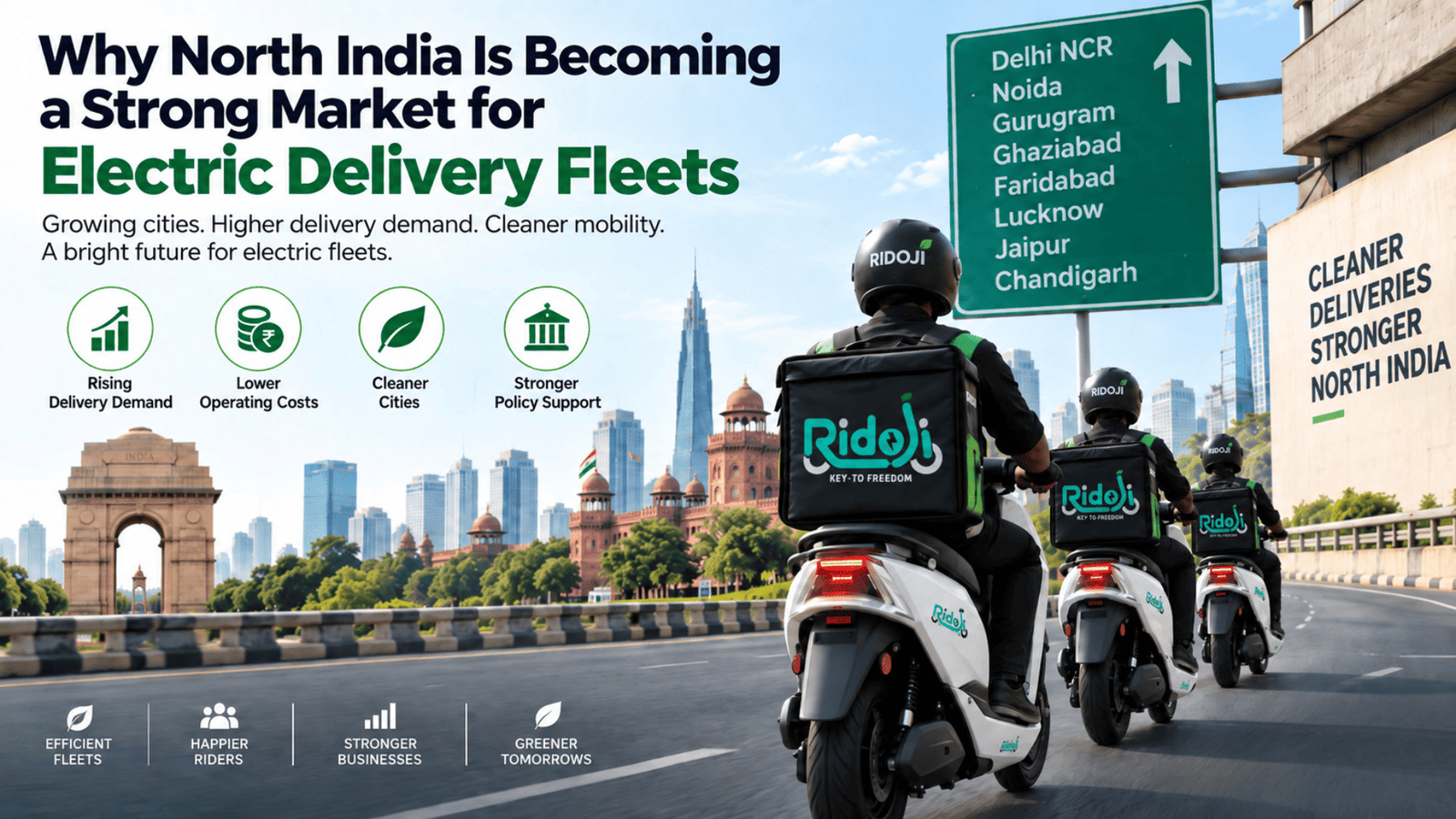
North India is becoming a strong market for Electric Delivery Fleets because cities like Delhi NCR, Noida, Gurugram, Lucknow, Jaipur, and Chandigarh have high delivery demand and growing EV adoption.
What Is Driving the Growth of Electric Delivery Fleets in North India?
1. Rapid Growth of Quick Commerce and Hyperlocal Delivery
North India has become a major hub for quick commerce, food delivery, grocery delivery, and local logistics.
Cities like Delhi, Noida, Gurugram, and Ghaziabad have dense customer clusters and high order frequency. This creates daily demand for delivery riders and vehicles.
Quick commerce businesses depend on speed. Restaurants depend on timely food delivery. Pharmacies depend on reliable movement. Courier companies depend on predictable last-mile operations.
All these use cases require vehicles that can run daily at controlled costs.
This is why electric scooters are gaining attention for delivery fleets.
2. Delhi NCR’s Policy Push Toward Cleaner Mobility
Delhi NCR has one of India’s strongest clean mobility conversations because of pollution challenges and regulatory pressure.
The Delhi EV Policy 2026 draft includes electrification mandates for fleet aggregators and delivery service providers. The draft states that no conventional ICE vehicles running purely on diesel or petrol shall be inducted into the existing fleet of certain light goods vehicle categories and two-wheelers from January 1, 2026, while BS-VI two-wheelers are permitted up to December 31, 2026.
This policy direction is important because it signals that commercial fleets may have to plan electrification more seriously.
For businesses operating in or around Delhi NCR, the message is clear: cleaner fleet operations are becoming more important.
3. Better Charging and EV Infrastructure Support
Charging infrastructure is one of the biggest questions for EV fleet adoption.
A personal EV user may worry about convenience. But for delivery businesses, charging is directly connected to productivity. If a vehicle is not charged on time, deliveries may be delayed.
Government support is improving this part of the ecosystem. The Press Information Bureau stated that ₹2,000 crore has been allocated under PM E-DRIVE for deployment of EV public charging stations across India. The scheme also supports multiple EV segments including e-two-wheelers, e-three-wheelers, e-ambulances, and e-trucks.
This is important for electric delivery fleets because stronger charging infrastructure can increase confidence among businesses, riders, and fleet operators.
4. Rising Need to Reduce Delivery Costs
Delivery businesses face constant pressure to reduce costs without affecting speed and customer experience.
Petrol-powered fleets are affected by fuel prices, engine maintenance, oil changes, repairs, and downtime. Electric scooters can help reduce running costs because they use electricity instead of petrol and have fewer moving parts than ICE vehicles.
For businesses, lower running cost is not the only benefit. Predictability also matters.
Electric delivery fleets can help businesses plan expenses more clearly when charging, maintenance, and fleet operations are managed through a structured system.
5. Electric Two-Wheelers Fit Dense Urban Routes
North Indian cities have congested roads, high delivery density, and compact service areas. This makes two-wheelers highly useful.
Electric scooters are especially suitable for:
- Food delivery
- Grocery delivery
- Courier movement
- Hyperlocal logistics
- Pharmacy delivery
- Rider rental models
- Field staff movement
- Local business deliveries
Their compact size and lower operating cost make them practical for urban delivery routes.
6. Businesses Want Sustainability Without Operational Hassle
Many businesses want to become more sustainable, but they do not want to build an EV operations team from scratch.
They may not want to handle:
- Scooter procurement
- Rider allocation
- Charging planning
- Maintenance scheduling
- Breakdown support
- Vehicle tracking
- Documentation
- Daily fleet reporting
This is where managed EV fleet companies become useful.
A managed fleet partner helps businesses shift to electric mobility without carrying the entire operational burden internally.
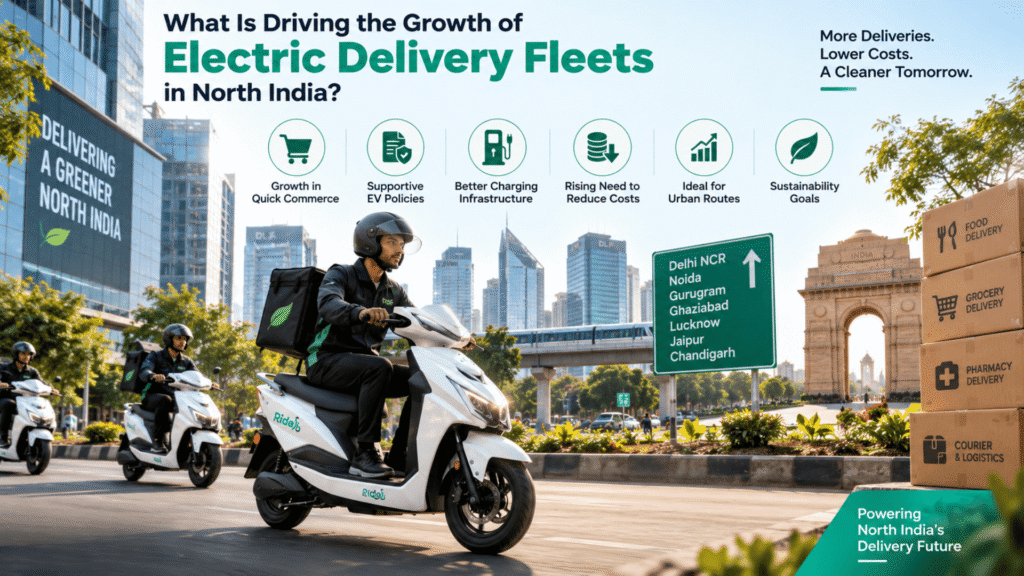
The growth of quick commerce, food delivery, grocery delivery, and courier services is creating more demand for Electric Delivery Fleets across North India.
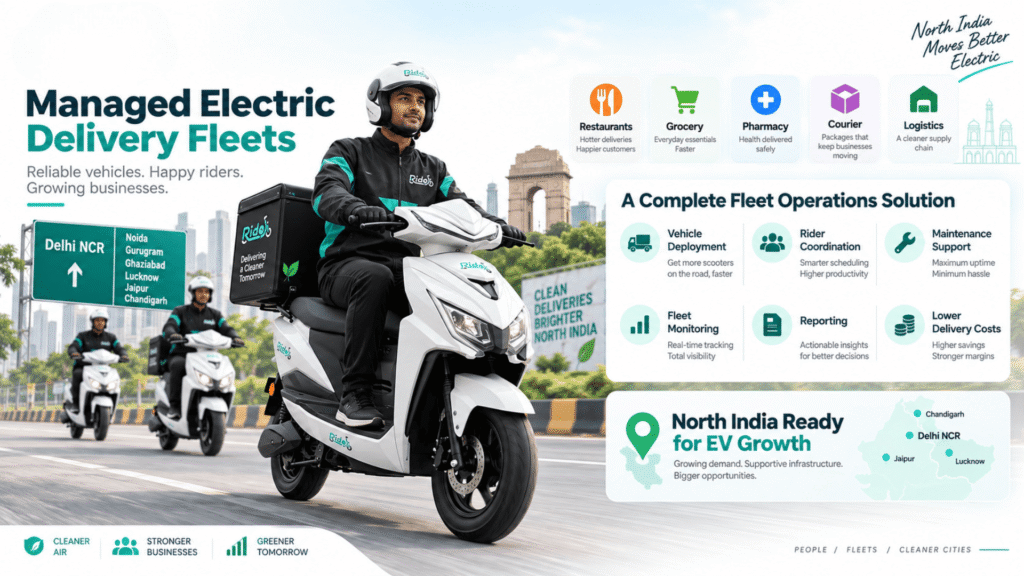
How Businesses Can Benefit from Managed Electric Delivery Fleets
Why Managed EV Fleet Operations Matter
Electric scooters can be useful for delivery businesses, but their success depends on management.
A business may buy 10 electric scooters, but if they are not charged, maintained, assigned, and monitored properly, the expected benefit may not come.
Managed EV fleet operations help businesses convert vehicles into productive delivery assets.
A strong managed EV fleet system usually includes:
- Vehicle deployment
- Rider coordination
- Maintenance support
- Charging planning
- Fleet monitoring
- Downtime control
- Documentation support
- Operational reporting
- Day-to-day fleet management
This is important because delivery businesses need reliability.
A scooter sitting idle does not reduce cost.
A scooter waiting for repairs does not complete orders.
A scooter without a rider does not support delivery.
A scooter without monitoring does not give business visibility.
How Ridoji Supports Electric Delivery Fleets
Ridoji supports businesses with managed EV fleet solutions designed for delivery and commercial mobility.
Instead of only providing electric scooters, Ridoji focuses on fleet operations. This includes vehicle deployment, rider coordination, maintenance support, monitoring, reporting, and daily management.
For businesses, this can reduce the burden of managing vehicles internally.
Ridoji’s EV fleet management model is relevant for:
- Restaurants
- Cloud kitchens
- Grocery brands
- Pharmacies
- Courier companies
- Logistics businesses
- Hyperlocal delivery platforms
- Rider-based mobility operations
The goal is simple:
Businesses focus on orders and customers. Ridoji manages the electric delivery fleet.
What Businesses Should Check Before Choosing an EV Fleet Partner
Before choosing a fleet partner, businesses should ask the right questions.
Important checks include:
- How are vehicles deployed?
- Who manages rider coordination?
- What maintenance support is included?
- How is charging planned?
- What happens during breakdowns?
- How is vehicle downtime controlled?
- Are reports shared regularly?
- Can the fleet scale with business demand?
- What documentation support is available?
- What costs and responsibilities are clearly defined?
These questions help businesses choose a fleet partner based on operational strength, not just vehicle availability.
Why North India Is Ready for Managed Electric Delivery Fleets
North India has the right combination of demand, density, policy direction, and business need.
Delhi NCR has high delivery demand.
Uttar Pradesh is showing strong EV registration growth.
Gurugram and Noida have growing business and logistics activity.
Quick commerce and food delivery continue to scale.
Government schemes are supporting EV adoption and charging infrastructure.
This makes North India a strong market for electric delivery fleets.
But the next stage of growth will not be only about more scooters on the road.
It will be about better-managed fleets.
Businesses will need vehicles that are available, maintained, monitored, and ready for daily delivery operations.
That is where managed EV fleet solutions can create real value.
Final Thoughts
North India is becoming a strong market for electric delivery fleets because the region has dense delivery demand, active business hubs, growing EV adoption, policy support, and increasing pressure to reduce delivery costs.
Electric scooters are practical for last-mile delivery, but businesses need more than vehicles. They need a system that manages deployment, riders, charging, maintenance, monitoring, and reporting.
For restaurants, cloud kitchens, grocery brands, pharmacies, courier companies, and logistics businesses, managed electric delivery fleets can help build cleaner, more cost-efficient, and more reliable last-mile operations.
As EV adoption continues to grow, North India may become one of the most important regions for commercial electric mobility in India.
For businesses, Electric Delivery Fleets work best when vehicles are deployed, maintained, monitored, and managed through a structured fleet system.