

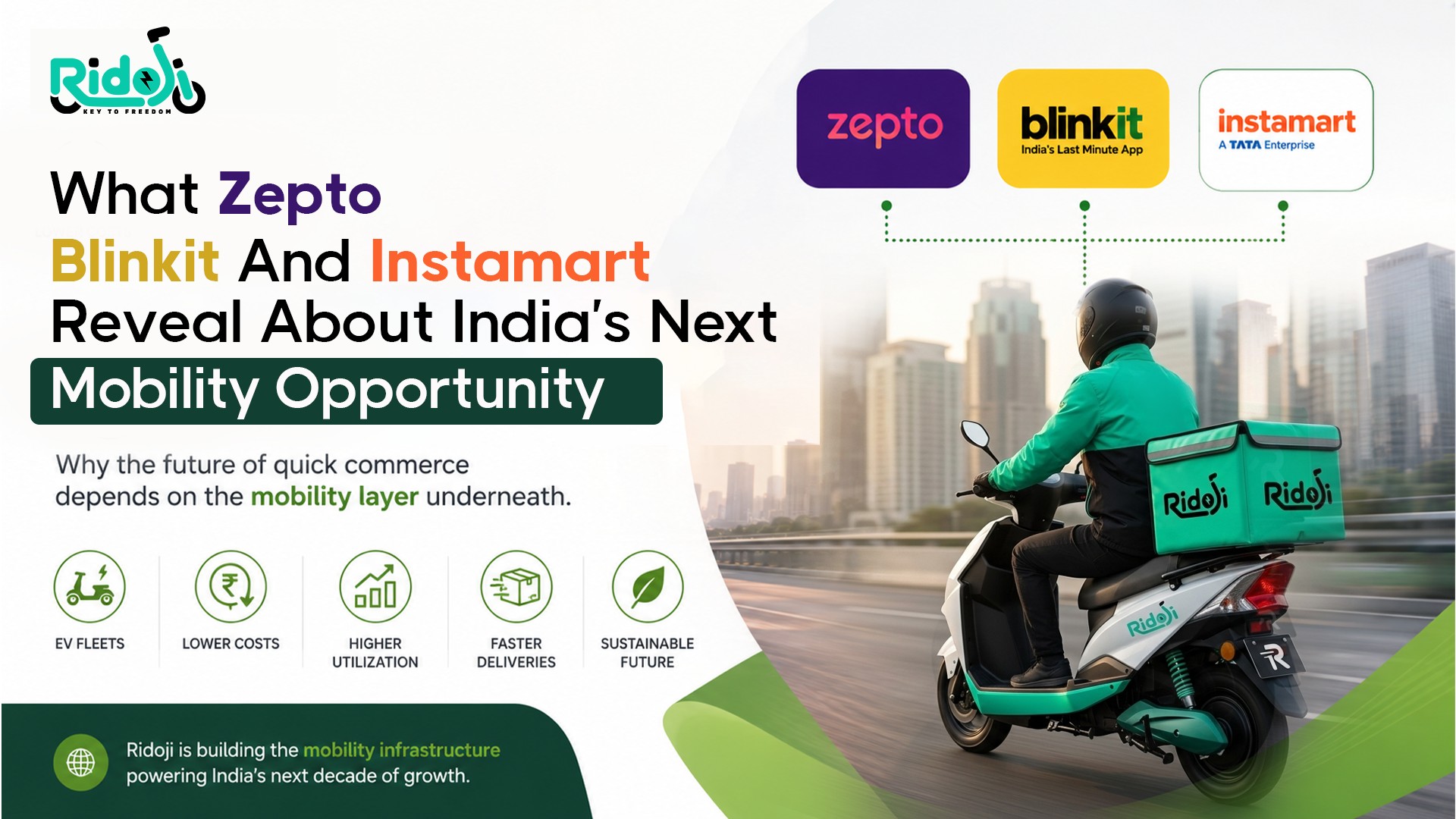
India’s startup ecosystem has spent the last few years obsessing over quick commerce.
Whether it’s Zepto promising deliveries in under 10 minutes, Blinkit expanding across cities, or Instamart increasing its reach, investors have been closely watching the battle for market share, profitability, and customer acquisition.
But amid discussions about dark stores, delivery times, and IPO valuations, one critical component of the ecosystem often receives far less attention than it deserves.
Mobility.
Every order placed on a quick commerce platform ultimately depends on a rider, a vehicle, and a transportation network capable of moving products efficiently from a fulfillment center to a customer’s doorstep.
Without this mobility infrastructure, quick commerce simply cannot exist.
As India’s delivery economy expands, investors may be overlooking one of the country’s most significant emerging trends: the Mobility Opportunity created by last-mile logistics.
The next phase of growth may not belong exclusively to delivery platforms. It may belong to the businesses enabling the movement behind every delivery.
The Rise of Quick Commerce in India
The growth of quick commerce has been extraordinary.
Consumer behavior has changed dramatically over the past few years. Urban customers increasingly expect groceries, medicines, personal care products, and daily essentials to arrive within minutes rather than hours or days.
This shift has fueled rapid expansion across the industry.
Companies have invested heavily in:
- Dark stores
- Technology infrastructure
- Route optimization
- Inventory management
- Customer acquisition
- Delivery networks
While consumers primarily interact with mobile apps, the physical infrastructure required to fulfill these expectations is enormous.
Every order creates a chain of operational activities involving warehouses, technology systems, inventory managers, delivery riders, and transportation assets.
The faster delivery expectations become, the more important mobility infrastructure becomes.
This is where the Mobility Opportunity begins to emerge.
The Hidden Layer Beneath Quick Commerce
Investors often focus on what is visible.
They analyze:
- Gross merchandise value (GMV)
- Revenue growth
- User acquisition
- Market share
- Profitability metrics
These indicators matter.
However, beneath every quick commerce platform lies an operational layer that receives far less attention.
This layer includes:
- Delivery fleets
- Vehicle deployment
- Fleet maintenance
- Charging infrastructure
- Rider onboarding
- Route efficiency
- Vehicle utilization
Without these systems, even the most advanced delivery platform would struggle to operate effectively.
As delivery volumes increase, mobility infrastructure becomes increasingly valuable.
In many ways, delivery platforms are becoming dependent on mobility networks in the same way streaming companies depend on internet infrastructure.
The platform may capture consumer attention, but the infrastructure enables the service.
Why Last-Mile Logistics Is Becoming More Important
Historically, transportation has often been viewed as a supporting function.
Today, it is becoming a strategic asset.
Consumers are demanding:
- Faster deliveries
- Lower delivery charges
- Greater reliability
- Better service coverage
Meeting these expectations requires increasingly sophisticated last-mile logistics networks.
The economics of quick commerce are heavily influenced by delivery efficiency.
A few minutes saved on every delivery can significantly improve operational performance.
A reduction in fuel costs can impact profitability across thousands of daily deliveries.
Improved vehicle uptime can increase order fulfillment capacity.
As a result, mobility is no longer simply a transportation challenge.
It is becoming a business optimization challenge.
And wherever optimization becomes critical, investment opportunities emerge.
Why Electric Vehicles Are Reshaping the Equation
Electric vehicles are changing the economics of last-mile delivery.
Unlike private consumers, commercial delivery riders operate vehicles extensively throughout the day.
This creates a fundamentally different economic model.
For a consumer, fuel savings may be noticeable.
For a delivery rider covering significant distances daily, fuel savings can directly affect earnings and operating costs.
This makes commercial mobility one of the strongest use cases for electric vehicles.
Key advantages include:
- Lower running costs
- Reduced maintenance requirements
- Lower downtime
- Improved operational efficiency
- Better long-term economics
As delivery volumes continue to increase, these advantages become increasingly important.
This is why many industry observers believe commercial adoption may accelerate faster than consumer adoption in certain segments.
The economics are simply easier to justify.
The Mobility Opportunity Investors May Be Missing
When investors evaluate the EV ecosystem, they often focus on manufacturers.
Questions typically revolve around:
- Which company will sell the most vehicles?
- Which battery technology will dominate?
- Which charging network will scale fastest?
These are important questions.
However, they represent only part of the ecosystem.
The Mobility Opportunity extends beyond vehicle manufacturing.
It includes businesses involved in:
- Fleet deployment
- Fleet management
- Vehicle utilization
- Rider enablement
- Maintenance operations
- Mobility infrastructure
As quick commerce expands, demand for these services is likely to grow as well.
The industry’s success increasingly depends on efficient mobility solutions.
This creates opportunities for businesses positioned between vehicle manufacturers and end users.
Why Vehicle Utilization Matters More Than Vehicle Sales
One of the most overlooked metrics in mobility is utilization.
A privately owned scooter may travel relatively limited distances each day.
A commercial delivery vehicle, on the other hand, may operate for extended hours while completing numerous deliveries.
Higher utilization creates:
- Greater economic output
- Faster cost recovery
- Stronger operational value
From an investor perspective, utilization often matters more than ownership.
A vehicle generating consistent daily activity creates measurable economic value.
This is particularly relevant in delivery ecosystems where operational efficiency directly affects business performance.
The future may not be defined by who owns the most vehicles.
It may be defined by who operates them most efficiently.
How Managed Fleet Models Are Emerging
As mobility becomes more important, managed fleet models are attracting increased attention.
Many businesses do not want to manage:
- Vehicle procurement
- Maintenance
- Rider support
- Charging logistics
- Operational monitoring
Instead, they prefer specialized providers capable of managing these functions at scale.
This trend mirrors developments seen in other industries where businesses increasingly focus on core operations while outsourcing supporting infrastructure.
Managed mobility solutions can help businesses:
- Reduce operational complexity
- Improve efficiency
- Scale more rapidly
- Optimize vehicle utilization
This creates an attractive segment within the broader Mobility Opportunity.
Where Ridoji Fits Into This Evolution
The growth of India’s delivery economy is creating demand for mobility solutions that extend beyond vehicle ownership.
This is where companies such as Ridoji are building their presence.
Rather than focusing solely on vehicle sales, Ridoji operates within the broader mobility ecosystem by supporting fleet deployment and managed EV operations.
The company’s model reflects an important market trend.
As delivery networks expand, businesses increasingly require reliable access to electric vehicles, maintenance support, and operational management rather than simply purchasing vehicles outright.
This shift highlights how value creation within the EV industry is moving beyond manufacturing and into fleet utilization and mobility infrastructure.
For investors studying long-term trends, this distinction is important.
The future winners may not only be the companies building vehicles.
They may also include the companies enabling those vehicles to operate productively every day.
The Long-Term Outlook for India’s Mobility Opportunity
India’s urbanization continues to accelerate.
Quick commerce continues to expand.
E-commerce volumes continue to grow.
Consumer expectations continue to rise.
All of these trends point toward increasing demand for efficient mobility infrastructure.
As a result, the Mobility Opportunity is likely to become one of the most important themes within India’s transportation and logistics ecosystem.
Over the next decade, investors should pay close attention to:
- Fleet utilization rates
- Commercial EV adoption
- Last-mile logistics infrastructure
- Managed fleet operators
- Rider enablement platforms
- Charging ecosystem development
These areas may play a critical role in shaping the next phase of India’s mobility transformation.
Conclusion
The conversation around quick commerce often focuses on apps, valuations, and market share.
Yet behind every delivery lies a complex mobility ecosystem that enables the entire industry to function.
As companies like Zepto, Blinkit, and Instamart continue to grow, they are revealing something much larger than the future of online delivery.
They are revealing a massive Mobility Opportunity.
This opportunity extends beyond vehicle manufacturing and into the infrastructure, fleets, systems, and operational networks that power last-mile logistics.
For investors willing to look beneath the surface, the most valuable insights may not come from the delivery platforms themselves.
They may come from understanding the mobility layer that makes modern commerce possible.
As India’s delivery economy expands, mobility is no longer just a supporting function.
It is becoming an investment theme in its own right.